Technology
The Evolution of Systems Development: A Timeline from 1940 to Today
The Evolution of Systems Development: A Timeline from 1940 to Today. Read on CodeBlog
05/27/2024


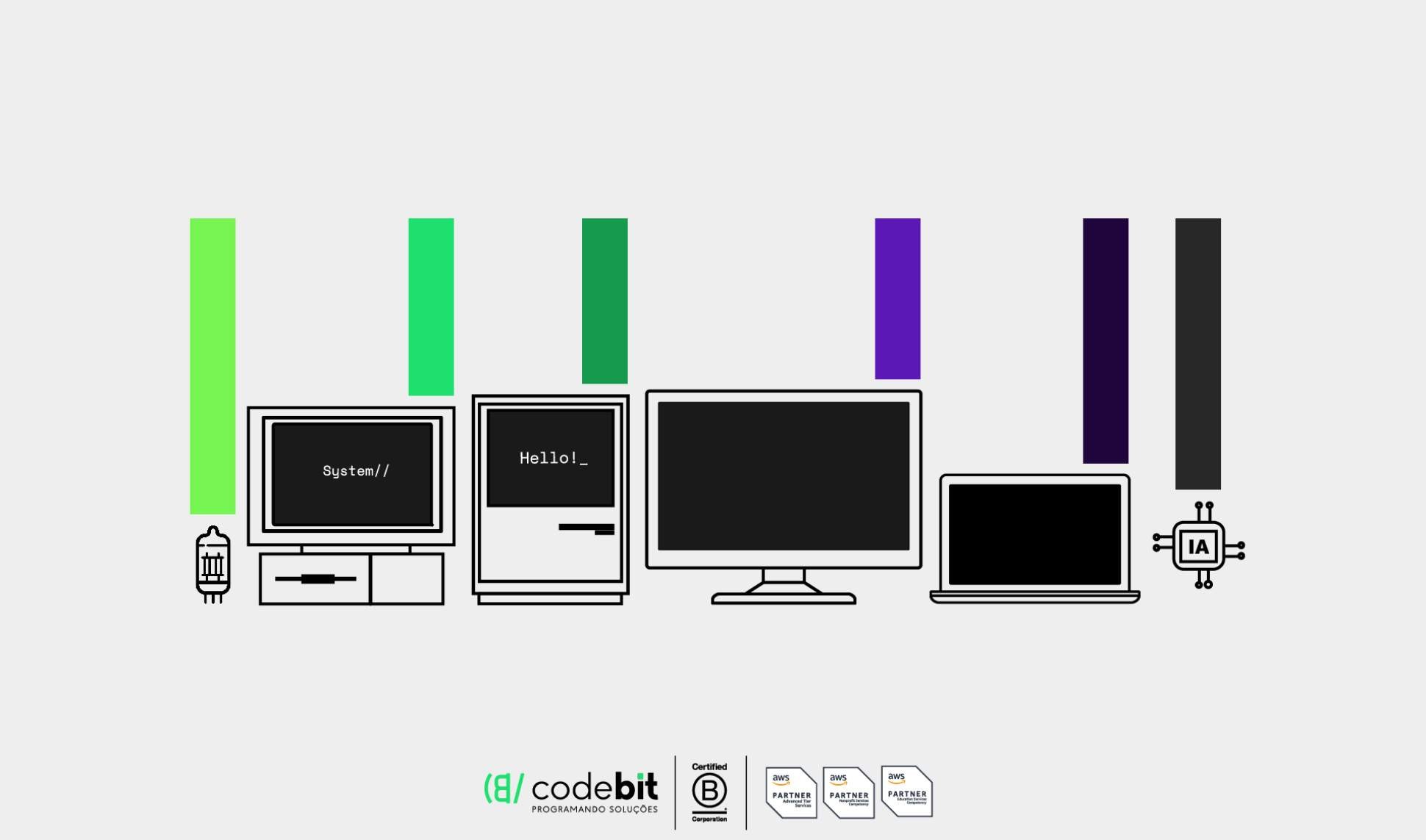
Technologies and innovations are the driving force of progress in systems development. Every day, new features emerge at an impressive speed — but have you ever stopped to think about how it all began?
Here, you will find an overview of the evolution of systems development — from the first computers to the current trends. Follow along and join us on this historical journey!
1940s: The Beginning of a Revolution
The history of systems development begins with the dawn of computing. In the 1940s, the first computers emerged, operating with vacuum tubes and punched cards. Programming back then was a manual and extremely basic task.
Shortly after, new approaches began to surface. The second generation of computers, based on transistors, marked an advancement in programming languages and compiler development.
1970s: Microprocessors and High-Level Languages
In the 70s, microprocessors changed the game. They allowed the emergence of high-level programming languages, making programmers' work more agile and enabling more complex systems. An iconic example is the C language, created in 1972 by Dennis Ritchie at AT&T Bell Labs to develop the Unix operating system.
In the following decade, personal computers hit the market, boosting systems development and making graphical user interfaces — like Windows — much more accessible to everyday users.
1990s: The Internet Boom
In the 90s, the internet took a giant leap forward. The development of iconic apps and languages, such as HTML and JavaScript, paved the way for a new digital era. At the same time, browsers like Mosaic, Netscape, and Internet Explorer transformed online navigation into something much friendlier. Email clients (Eudora) and instant messengers (ICQ) also began to gain ground, revolutionizing online communication.
2000s: Smartphones, Cloud, and Frameworks
With the arrival of the new millennium, the revolution accelerated. Smartphones, mobile apps, and various frameworks emerged, such as Swift (iOS) and Kotlin (Android). Cloud computing, in turn, began to take shape, providing on-demand storage and processing resources, changing how software is developed, distributed, and consumed.
2020s: AI and Machine Learning at the Center of Innovation
Artificial Intelligence and Machine Learning had already been advancing since the 2010s, but it was in the 2020s that their adoption became massive. Advanced models, like GPT-3 and GPT-4, began to automate processes, reduce failures, and increase system efficiency.
Today, AI-based tools help developers write code faster, find bugs, and optimize performance. At the same time, Machine Learning algorithms personalize experiences in streaming, e-commerce, and social media, while virtual assistants and chatbots enhance interaction with users.
Timeline of Innovations That Defined Eras
1942–1954 – Compilers and Languages: Plankalkul (Konrad Zuse) and FORTRAN (IBM, John Backus).
1970 – Relational Databases: storage and manipulation of large volumes of data, enabling more complete and robust systems.
1990 – Dial-up Internet: pioneer modems, telephone lines, and browsers.
2000 – Cloud Computing: flexibility, scalability, and cost reduction for businesses of all sizes.
2020 – AI and Machine Learning: automation, efficiency, and new forms of interaction.
What to Expect from the Future?
Software development has evolved impressively over the decades. But what lies ahead brings both opportunities and challenges:
Information Security: cyber attacks evolve alongside technology; protecting data is a top priority.
Large-Scale Data Management: dealing with massive volumes of data requires robust solutions for storage, processing, and analysis.
Speed and Efficiency: users demand increasingly fast and intuitive systems, putting pressure on developers to constantly innovate.
5 Promising Trends
1. AI and Machine Learning: Automation of testing, code generation, and experience personalization — freeing developers to focus on what really matters: creativity and innovation.
2. Augmented and Virtual Reality: Immersive experiences in the metaverse, training sessions, educational games, and applications that integrate the physical with the digital.
3. Blockchain: More security and transparency in software development, eliminating intermediaries and recording transactions immutably.
4. Agile Development: Rapid adaptation to change, greater collaboration, and continuous delivery to ensure increasingly accurate results.
5. Cloud Computing: Flexibility, savings in time and money, scalability, and efficient process integration. Services like Amazon SageMaker already facilitate the real-time creation and training of machine learning models.
Want to know how cloud computing can revolutionize your business's internal processes and competitiveness? Click here and visit the CodeBit website!
Did you like this article? Share it on social media and keep following the CodeBlog for more



" width="15.500294250860316px"><path d="M 0 15.475 L 0 0 L 15.5 0 L 15.5 15.475 Z" fill="transparent" height="15.475099999999998px" id="tPiDQU_MP" width="15.5px"/><path d="M 3.167 1.589 C 3.847 0.724 4.607 0.171 5.61 0.046 C 6.532 -0.07 7.436 0.022 8.277 0.451 C 9.235 0.938 9.681 1.797 9.877 2.797 C 9.987 3.364 10.049 3.948 10.056 4.525 C 10.079 6.395 10.055 8.265 10.075 10.135 C 10.08 10.527 9.944 10.648 9.574 10.641 C 8.799 10.627 8.023 10.63 7.248 10.644 C 6.911 10.65 6.787 10.528 6.789 10.181 C 6.803 8.533 6.799 6.884 6.789 5.236 C 6.788 4.892 6.754 4.545 6.698 4.206 C 6.57 3.433 6.106 2.974 5.443 2.925 C 4.405 2.849 3.714 3.206 3.495 4.018 C 3.37 4.478 3.333 4.972 3.326 5.451 C 3.306 7.002 3.307 8.555 3.327 10.105 C 3.332 10.504 3.208 10.654 2.807 10.644 C 2.032 10.625 1.257 10.63 0.481 10.642 C 0.156 10.647 -0.001 10.546 0 10.193 C 0.007 7.035 0.006 3.876 0 0.718 C 0 0.391 0.104 0.24 0.458 0.249 C 1.219 0.269 1.981 0.267 2.743 0.252 C 3.068 0.245 3.197 0.361 3.17 0.688 C 3.148 0.948 3.166 1.211 3.166 1.589 Z" fill="rgb(245, 240, 237)" height="10.64451194394125px" id="Hw1mXDepj" transform="translate(5.425 4.831)" width="10.075487656011685px"/><path d="M 3.284 5.2 C 3.284 6.764 3.27 8.327 3.292 9.892 C 3.297 10.284 3.158 10.403 2.79 10.396 C 2.015 10.382 1.24 10.386 0.465 10.399 C 0.14 10.403 -0.001 10.305 0 9.947 C 0.012 6.792 0.012 3.637 0.002 0.481 C 0.001 0.123 0.105 -0.01 0.473 0.001 C 1.261 0.023 2.05 0.02 2.839 0.004 C 3.183 -0.003 3.294 0.124 3.29 0.467 C 3.276 2.044 3.284 3.623 3.284 5.2 Z" fill="rgb(245, 240, 237)" height="10.39869818980116px" id="sgvgyFXCr" transform="translate(0.237 5.076)" width="3.292113077251912px"/><path d="M 3.768 1.898 C 3.761 2.945 2.91 3.782 1.859 3.772 C 0.828 3.763 -0.012 2.892 0 1.842 C 0.012 0.824 0.864 -0.003 1.897 0 C 2.956 0.003 3.776 0.834 3.768 1.898 Z" fill="rgb(245, 240, 237)" height="3.772444228811899px" id="M8BOm1cI0" transform="translate(0 0)" width="3.768370362042166px"/></g></svg>)
" height="17px" id="G9twDfI1x" transform="translate(2 2)" width="17px"/></svg>)
" height="17px" id="q6YSjVL3w" transform="translate(6 2)" width="8.5px"/></svg>)
" height="12.720532384492868px" id="Jh_taQ7si" transform="translate(1 3.586)" width="18.00050025px"/></svg>)