Technology
The origin of AI: how did Artificial Intelligence arise?
The origin of AI: how did Artificial Intelligence come about? Read more on CodeBlog!
03/26/2025
Maria Clara Xavier


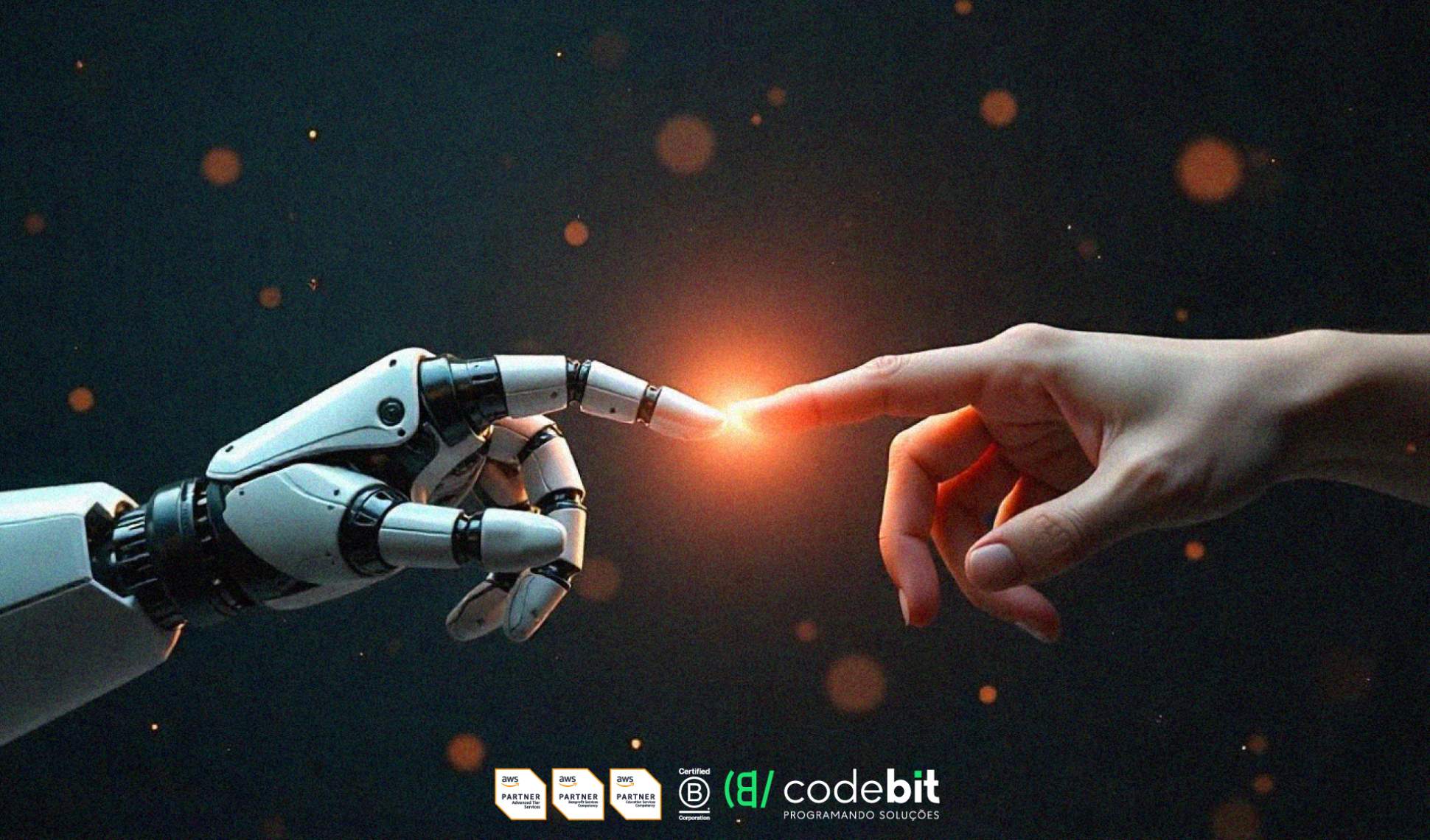
Artificial intelligence (AI) emerged in the mid-20th century, when scientists began to explore the possibility of creating machines capable of performing tasks that require human intelligence. Since then, the AI tool has evolved significantly, passing through various phases of development and innovation.
Understanding the origin and evolution of AI can help us imagine the future, which promises to be increasingly integrated into our daily lives, contributing to the transformation of various sectors, such as education, healthcare, commerce, industry, and many others, bringing technological advancements that improve efficiency, productivity, and profitability in companies.
The AI journey began with pioneers like Alan Turing and evolved into today's innovations, such as self-driving cars and virtual assistants. But how was it possible to get here? In this article, we will explore this trajectory, its important milestones, and the promising future of artificial intelligence.
AI before technology
Few know that the concept of artificial intelligence emerged before the development of modern technology. In this sense, ideas about intelligent machines had already been explored since Antiquity, in fiction and philosophy. In the Middle Ages, mechanical devices powered by gears, springs, or hydraulic systems were created to perform simple tasks, although without real intelligence.
However, the theories and experiments of scientists were fundamental to discovering that machines had the potential to replicate human tasks and enable the development of this constantly evolving technology.
What is Artificial Intelligence?
Artificial Intelligence is one of the most talked-about topics today. This tool refers to the ''training'' of machines to perform basic tasks and functions that would normally require actions of human intelligence, such as pattern recognition, customer service, decision-making, and even problem-solving.
In practice, this is done through mathematical algorithms, which allow the AI to be trained with data to process information, identify patterns, and make predictions.
After that, it can analyze new data and make decisions based on what it has learned. In this sense, it is worth highlighting that AI does not create new knowledge, but uses data to quickly optimize choices, as it is capable of simulating human reasoning, learning from information, and making decisions based on it.
Thus, AI was developed to automate repetitive tasks and process large volumes of data, and can be used as a tool that complements, enhances, and assists in the most complex daily tasks.
What is the origin of artificial intelligence?
The concept of artificial intelligence dates back to Ancient Greece (12th century BC to 4th century AD), but it was in the early 1940s that it began to gain prominence and be more widely discussed. its history was marked by important figures who contributed to its development, initially through theoretical studies and, later, tests and applications. The origin of AI resulted from the effort and study of various specialists and researchers.
Below, you will see a timeline that highlights the fundamental contribution of these researchers to the emergence and advancement of artificial intelligence. Their studies and innovations were essential to transforming AI into what we know today, from the first theoretical concepts to practical applications.
1936: the Turing Machine
Mathematician Alan Turing, born in 1912 in England, is considered the father of artificial intelligence for the creation of the device called the ''Turing Machine.'' He proposed the idea that a machine could be capable of simulating aspects of human intelligence, meaning that any calculation that can be done by an algorithm can also be performed by this device.
In this way, Turing's pioneering work established the fundamental principles for the development of modern computers and AI. Sometime later, in 1950, he introduced the ''Turing Test'' method, which was created to evaluate whether a machine could exhibit intelligent behavior similar to a human.
Since then, the Turing Test continues to be debated and serves as a point of reference for the meaning of the concept of artificial intelligence.
1956: the creation of the term Artificial Intelligence
In the year 1956, researcher John McCarthy coined the term ''Artificial Intelligence'' during the Dartmouth Conference in the US, marking the formal beginning of research in AI. The conference brought together researchers from various fields to discuss the possibility of creating machines that simulate aspects of human intelligence.
This event boosted the development of Chatbots and programs capable of performing human tasks, influencing future research and applications.
1966: the creation of the first Chatbot
In 1966, Joseph Weizenbaum developed one of the first chatbots in history, called ELIZA. This program was designed to have the ability to hold a conversation between a computer and a human with simplicity and naturalness.
The project highlighted the potential of natural language processing and opened doors to future advancements for systems that allow interaction between humans and computers.
1972: AI in healthcare
In 1972, Ted Shortliffe of Stanford University developed the MYCIN system, which was one of the first artificial intelligence systems designed to contribute to the diagnosis and treatment of diseases. Thus, this system marked the beginning of the application of AI in medicine, which has become increasingly present in this area as a support tool.
1980: the AI winter
The term ''AI winter'' was a period of decline in artificial intelligence research. In this context, during this period, there was a significant drop in optimism and funding for AI projects. This occurred due to excessive expectations and technical challenges at the time that could not be overcome.
Still, the setbacks of this period were essential for the advancements that emerged in the following decades. It is worth highlighting the impact of the report published by James Lighthill in 1973, known as the ''Lighthill Report.''
The mathematician criticized the progress of AI, arguing that research had not achieved initial expectations and pointing out the computational limitations of the time.
As a result of this event, a slowdown in research occurred, and thus, fewer innovations. Despite this, some researchers continued working in the field, developing theories that would lead to the revival of AI in the coming years.
2000: the beginning of AI in cars
From the 2000s onwards, there was an explosion of advancements in AI, including its beginning in cars, with the development of driver assistance systems and safety technologies.
2010: AI integrated into daily life
During the 2010s, AI began to be integrated into people's daily lives with the popularization of mobile devices; virtual assistants, like Siri, began to be developed for these devices, among other applications.
2020: the era of Generative AI
With technological advancements, in the following years, the era of Generative AI emerged, marked by visible progress in the capability of intelligent machines to create original content, such as texts, images, and music, transforming various industries.
In this way, generative AI applications, such as ChatGPT, Google Gemini, Midjourney, among other tools, enable the automation of processes and increase productivity in various tasks.
The main applications of AI in the business environment
Even though technology is constantly evolving, many industries already integrate AI into their work routines. In this sense, this technological tool has transformed various areas with its different applications, providing efficient solutions to complicated problems. Below, see the main examples:
Healthcare: AI is widely used as a support for specialists, providing accurate diagnoses, patient monitoring, and even assisting in the development of new medicines. Its role in medicine is transformative, with the capacity to analyze large volumes of medical data.
Finance: in finance, AI can be applied to analyze market data, predict trends, and automate frequent trading. Thus, it is possible to increase company investment returns and reduce potential risks.
Education: by using AI in education, learning can be personalized, adapting educational materials to individual student needs, identifying their difficulties, and improving the learning experience, making it more effective.
Agriculture: in this area, it is possible to monitor crops and weather conditions, detect pests, and increase agricultural production. Therefore, productivity rises while optimizing the use of resources.
Energy: incorporating AI applications into issues involving the company's energy use can provide efficient resource management and predict energy demands.
Logistics and Transportation: AI applications in logistics and transportation processes can offer route optimization, help with inventory management, and predict demands.
Sales: in local sales and commerce, it is possible to automate customer service, such as chatbots, personalize offers, and analyze purchasing behaviors.
Risks and challenges associated with Artificial Intelligence
Artificial intelligence has driven global technological advancement, but it also brings negative impacts. In this context, AI faces ethical conflicts related to copyrights, and its use can discourage human interactions and even cause technological dependency.
Furthermore, there are malicious individuals who can use AI to create scams, spread misinformation, and other threats.
Another widely discussed issue regarding AI is that, for many people, it is seen as something that could increase unemployment by automating human tasks. This has worried society, as the trend is that this automation has the potential to replace jobs in various areas, increasing economic inequality.
Finally, there are challenges related to limited access to data, since AI might end up making wrong decisions without critical human judgment.
The future of Artificial Intelligence
AI advancements are increasingly being developed to solve problems and optimize tasks. However, its future expects many challenges, such as the decrease in human control over this technology.
Furthermore, experts estimate that there is a 50% chance that machines will reach human-level intelligence by 2040.
When analyzing the current scenario, it is possible to state that AI has played an essential role, especially in areas like healthcare, transportation, education, and entertainment, and its technologies will continue to evolve.
This proves the importance of industries starting to adopt AI applications to not become outdated.
In summary, knowing the history of AI is essential to understand its current state and predict its future. Thus, it is possible to identify trends, anticipate risks, and guide the development of this technology, obtaining a vision of how it might evolve and impact the world.
Meet CodeRag: implementing Generative AI models
CodeRag is a tool that facilitates the rapid creation of generative artificial intelligence systems. This tool features multimodal learning, where the AI learns from a knowledge base such as: texts, images, audios, and videos. Based on this, the AI can analyze information, answer complex questions, and generate insights simply and quickly.
With CodeRag, it is possible to transform manual work into agile and intelligent processes in a personalized way for your company and, in addition to increasing efficiency and saving operational costs, it reduces the chances of errors.
To use it, it's easy! You upload any file, whether it's an image, PDF, video, or even an audio, and the AI analyzes the data, processes the information, and returns everything in an organized manner.
The information reaches where you need it, whether on WhatsApp, a chatbot, or directly integrated into your platform, at the speed your business demands.
Did you like the content? Keep following the CodeBlog posts and stay on top of the latest technology innovations!
See you in the next post!




" width="15.500294250860316px"><path d="M 0 15.475 L 0 0 L 15.5 0 L 15.5 15.475 Z" fill="transparent" height="15.475099999999998px" id="tPiDQU_MP" width="15.5px"/><path d="M 3.167 1.589 C 3.847 0.724 4.607 0.171 5.61 0.046 C 6.532 -0.07 7.436 0.022 8.277 0.451 C 9.235 0.938 9.681 1.797 9.877 2.797 C 9.987 3.364 10.049 3.948 10.056 4.525 C 10.079 6.395 10.055 8.265 10.075 10.135 C 10.08 10.527 9.944 10.648 9.574 10.641 C 8.799 10.627 8.023 10.63 7.248 10.644 C 6.911 10.65 6.787 10.528 6.789 10.181 C 6.803 8.533 6.799 6.884 6.789 5.236 C 6.788 4.892 6.754 4.545 6.698 4.206 C 6.57 3.433 6.106 2.974 5.443 2.925 C 4.405 2.849 3.714 3.206 3.495 4.018 C 3.37 4.478 3.333 4.972 3.326 5.451 C 3.306 7.002 3.307 8.555 3.327 10.105 C 3.332 10.504 3.208 10.654 2.807 10.644 C 2.032 10.625 1.257 10.63 0.481 10.642 C 0.156 10.647 -0.001 10.546 0 10.193 C 0.007 7.035 0.006 3.876 0 0.718 C 0 0.391 0.104 0.24 0.458 0.249 C 1.219 0.269 1.981 0.267 2.743 0.252 C 3.068 0.245 3.197 0.361 3.17 0.688 C 3.148 0.948 3.166 1.211 3.166 1.589 Z" fill="rgb(245, 240, 237)" height="10.64451194394125px" id="Hw1mXDepj" transform="translate(5.425 4.831)" width="10.075487656011685px"/><path d="M 3.284 5.2 C 3.284 6.764 3.27 8.327 3.292 9.892 C 3.297 10.284 3.158 10.403 2.79 10.396 C 2.015 10.382 1.24 10.386 0.465 10.399 C 0.14 10.403 -0.001 10.305 0 9.947 C 0.012 6.792 0.012 3.637 0.002 0.481 C 0.001 0.123 0.105 -0.01 0.473 0.001 C 1.261 0.023 2.05 0.02 2.839 0.004 C 3.183 -0.003 3.294 0.124 3.29 0.467 C 3.276 2.044 3.284 3.623 3.284 5.2 Z" fill="rgb(245, 240, 237)" height="10.39869818980116px" id="sgvgyFXCr" transform="translate(0.237 5.076)" width="3.292113077251912px"/><path d="M 3.768 1.898 C 3.761 2.945 2.91 3.782 1.859 3.772 C 0.828 3.763 -0.012 2.892 0 1.842 C 0.012 0.824 0.864 -0.003 1.897 0 C 2.956 0.003 3.776 0.834 3.768 1.898 Z" fill="rgb(245, 240, 237)" height="3.772444228811899px" id="M8BOm1cI0" transform="translate(0 0)" width="3.768370362042166px"/></g></svg>)
" height="17px" id="G9twDfI1x" transform="translate(2 2)" width="17px"/></svg>)
" height="17px" id="q6YSjVL3w" transform="translate(6 2)" width="8.5px"/></svg>)
" height="12.720532384492868px" id="Jh_taQ7si" transform="translate(1 3.586)" width="18.00050025px"/></svg>)