Technology
Augmented Reality is transforming e-commerce
How brands use technology to reduce returns, increase conversions, and bring online consumption closer to the physical experience
06/19/2026
Leonardo Fróes


For many years, e-commerce has lived with a limitation that was difficult to solve: the impossibility of trying out a product before buying it.
This barrier helped to consolidate well-known digital consumer behaviors, such as buying multiple sizes of clothing, returning items that did not fit, or abandoning shopping carts due to insecurity.
In recent years, Augmented Reality (AR) has begun to change this scenario.
Tools known as Virtual Try-On or simply "Try On" have begun to allow consumers to visualize products directly on their own body, face, or environment using only their cell phone camera.
Today, beauty, fashion, home decor, and accessories brands use AR not only in the interactive experience, but also as a tool to increase conversion, reduce returns, and bring the online experience closer to physical shopping behavior.
What has changed in practice?
The first AR experiences in retail had limitations of low fidelity, misalignment, and difficulty in tracking movements in real time.
With the evolution of smartphones, sensors, graphic processing, and computer vision, today's systems can:
Map faces in real time.
Detect depth and lighting.
Simulate texture and scale.
Track user movements.
Render products in 3D with greater fidelity.
This transformed the experience of "virtually testing" into something functional for purchase decisions.
Instead of just visualizing a product, the consumer began to understand how that item behaves in a real-world context.
READ ALSO: How augmented reality is transforming the industry
Beauty: the pioneer sector of Virtual Try-On
The beauty sector was one of the pioneers in the mass adoption of technology.
The reason is relatively simple: makeup, hair, and skin care rely heavily on visual perception.
L'Oréal was one of the companies that helped popularize this movement with virtual hair coloring testing tools developed in partnership with ModiFace.
The system uses Augmented Reality to simulate hair shades before physical application, with real-time recommendations based on the user's current color.
According to the company, the tool works with hundreds of shades and seeks to reproduce results close to real application.
Sephora, on the other hand, consolidated the concept of virtual makeup with the Sephora Virtual Artist.

The technology uses facial recognition to identify eyes, mouth, and face structure, allowing users to test lipsticks, eyeshadows, and complete makeup combinations.
In addition to experimentation, the platform also began to incorporate personalized tutorials and shade comparison in real time.
In Brazil, Principia adopted a similar logic by launching a shade-testing system for tinted sunscreen directly on the website.
The proposal is to reduce doubts related to product choice without relying exclusively on a physical store.
Fashion and accessories
The impact of AR in fashion is directly linked to one of the biggest problems of e-commerce: returns.

When consumers cannot predict fit, size, or real appearance of the product, the chance of an exchange increases considerably.
As a result, companies in the sector began to invest in virtual fitting rooms focused on purchasing confidence.
Warby Parker became one of the best-known cases in this segment by integrating AR for virtual try-on of glasses.
The system uses facial mapping to adjust frames in real time and even calculate measurements related to the fit of the product.
The company reported a significant reduction in returns after expanding the use of the feature, precisely because users started making more accurate decisions before purchasing.
Gucci also adopted AR experiences for sneakers and accessories, in partnership with Wannaby, allowing users to visualize models directly on their feet using their cell phone camera.
In fast fashion retail, brands like C&A have also been testing experiences linked to digital fitting rooms and visual interaction within the mobile environment.
Furniture and decor
If in fashion the problem is size and fit, in the furniture sector the main doubt has always been scale.
It is hard to imagine if a sofa fits in the living room, if a table matches the environment, or if the flow of space will remain functional.
In this context, AR found an extremely efficient use case.
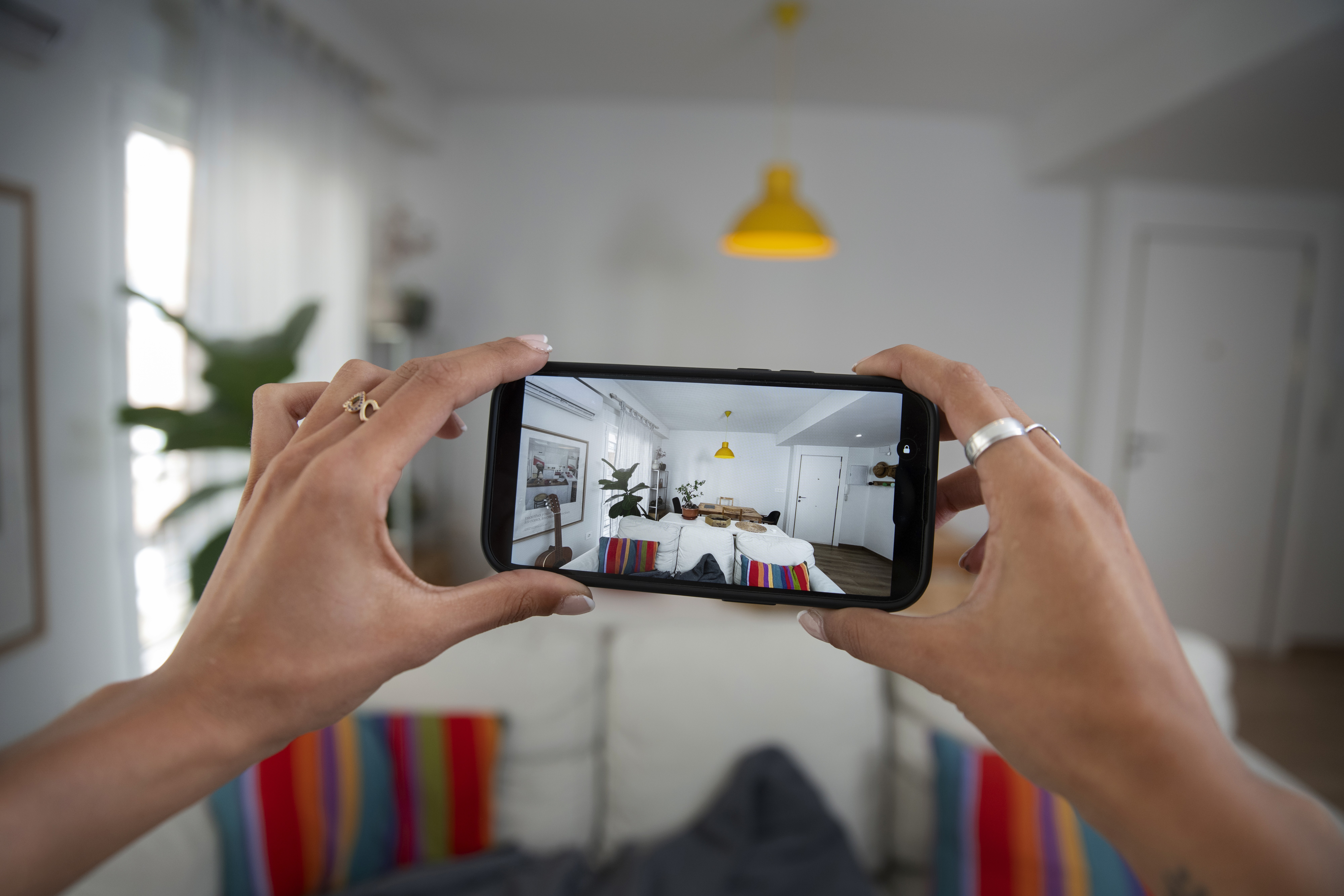
IKEA Place remains one of the main global references. The application allows users to place furniture on a real scale within the environment using the smartphone's camera and sensors.
The technology uses frameworks like ARKit and ARCore to reproduce:
Proportional scale.
Depth.
Spatial positioning.
Relationship between objects and the environment.
In Brazil, MadeiraMadeira has been expanding investments in virtual visualization and space simulation.
Tools like Mooble allow users to create digital spaces with real measurements to test furniture combinations directly in the browser.
Retail has discovered a new metric
Much of the discussion about AR in retail tends to focus solely on user experience, but the financial impact has become one of the main drivers for technology adoption.
Industry reports and analysis indicate that AR experiences can boost conversion rates by 40% to 90%, depending on product category and implementation maturity.
But there is another even more important metric for companies: reduction of returns.
When consumers can better visualize size, color, or scale, the chance of frustration decreases. This reduces costs related to reverse logistics, restocking, and customer service.
In categories like fashion and furniture, this saving has come to justify the investment in AR more clearly.
An upward trend
The advancement of technology indicates that virtual try-on should cease to be an "extra" feature and become a natural part of the digital experience.
The evolution of sensors, generative AI, and computer vision tends to increase accuracy and personalization.
At the same time, retail has realized that AR does not just solve an aesthetic issue.
It acts directly on important indicators of the digital business:
Conversion.
Retention.
Browsing time.
Reduction of returns.
Purchase confidence.
The trend is for "try on" to advance to new categories, combining algorithmic recommendation, personalization, and real-time visualization.




" width="15.500294250860316px"><path d="M 0 15.475 L 0 0 L 15.5 0 L 15.5 15.475 Z" fill="transparent" height="15.475099999999998px" id="tPiDQU_MP" width="15.5px"/><path d="M 3.167 1.589 C 3.847 0.724 4.607 0.171 5.61 0.046 C 6.532 -0.07 7.436 0.022 8.277 0.451 C 9.235 0.938 9.681 1.797 9.877 2.797 C 9.987 3.364 10.049 3.948 10.056 4.525 C 10.079 6.395 10.055 8.265 10.075 10.135 C 10.08 10.527 9.944 10.648 9.574 10.641 C 8.799 10.627 8.023 10.63 7.248 10.644 C 6.911 10.65 6.787 10.528 6.789 10.181 C 6.803 8.533 6.799 6.884 6.789 5.236 C 6.788 4.892 6.754 4.545 6.698 4.206 C 6.57 3.433 6.106 2.974 5.443 2.925 C 4.405 2.849 3.714 3.206 3.495 4.018 C 3.37 4.478 3.333 4.972 3.326 5.451 C 3.306 7.002 3.307 8.555 3.327 10.105 C 3.332 10.504 3.208 10.654 2.807 10.644 C 2.032 10.625 1.257 10.63 0.481 10.642 C 0.156 10.647 -0.001 10.546 0 10.193 C 0.007 7.035 0.006 3.876 0 0.718 C 0 0.391 0.104 0.24 0.458 0.249 C 1.219 0.269 1.981 0.267 2.743 0.252 C 3.068 0.245 3.197 0.361 3.17 0.688 C 3.148 0.948 3.166 1.211 3.166 1.589 Z" fill="rgb(245, 240, 237)" height="10.64451194394125px" id="Hw1mXDepj" transform="translate(5.425 4.831)" width="10.075487656011685px"/><path d="M 3.284 5.2 C 3.284 6.764 3.27 8.327 3.292 9.892 C 3.297 10.284 3.158 10.403 2.79 10.396 C 2.015 10.382 1.24 10.386 0.465 10.399 C 0.14 10.403 -0.001 10.305 0 9.947 C 0.012 6.792 0.012 3.637 0.002 0.481 C 0.001 0.123 0.105 -0.01 0.473 0.001 C 1.261 0.023 2.05 0.02 2.839 0.004 C 3.183 -0.003 3.294 0.124 3.29 0.467 C 3.276 2.044 3.284 3.623 3.284 5.2 Z" fill="rgb(245, 240, 237)" height="10.39869818980116px" id="sgvgyFXCr" transform="translate(0.237 5.076)" width="3.292113077251912px"/><path d="M 3.768 1.898 C 3.761 2.945 2.91 3.782 1.859 3.772 C 0.828 3.763 -0.012 2.892 0 1.842 C 0.012 0.824 0.864 -0.003 1.897 0 C 2.956 0.003 3.776 0.834 3.768 1.898 Z" fill="rgb(245, 240, 237)" height="3.772444228811899px" id="M8BOm1cI0" transform="translate(0 0)" width="3.768370362042166px"/></g></svg>)
" height="17px" id="G9twDfI1x" transform="translate(2 2)" width="17px"/></svg>)
" height="17px" id="q6YSjVL3w" transform="translate(6 2)" width="8.5px"/></svg>)
" height="12.720532384492868px" id="Jh_taQ7si" transform="translate(1 3.586)" width="18.00050025px"/></svg>)