Technology
How self-driving cars work and why they don't dominate the streets yet
From theory to practice: understand what is missing for self-driving cars to become part of our daily lives.
06/01/2026
Leonardo Fróes


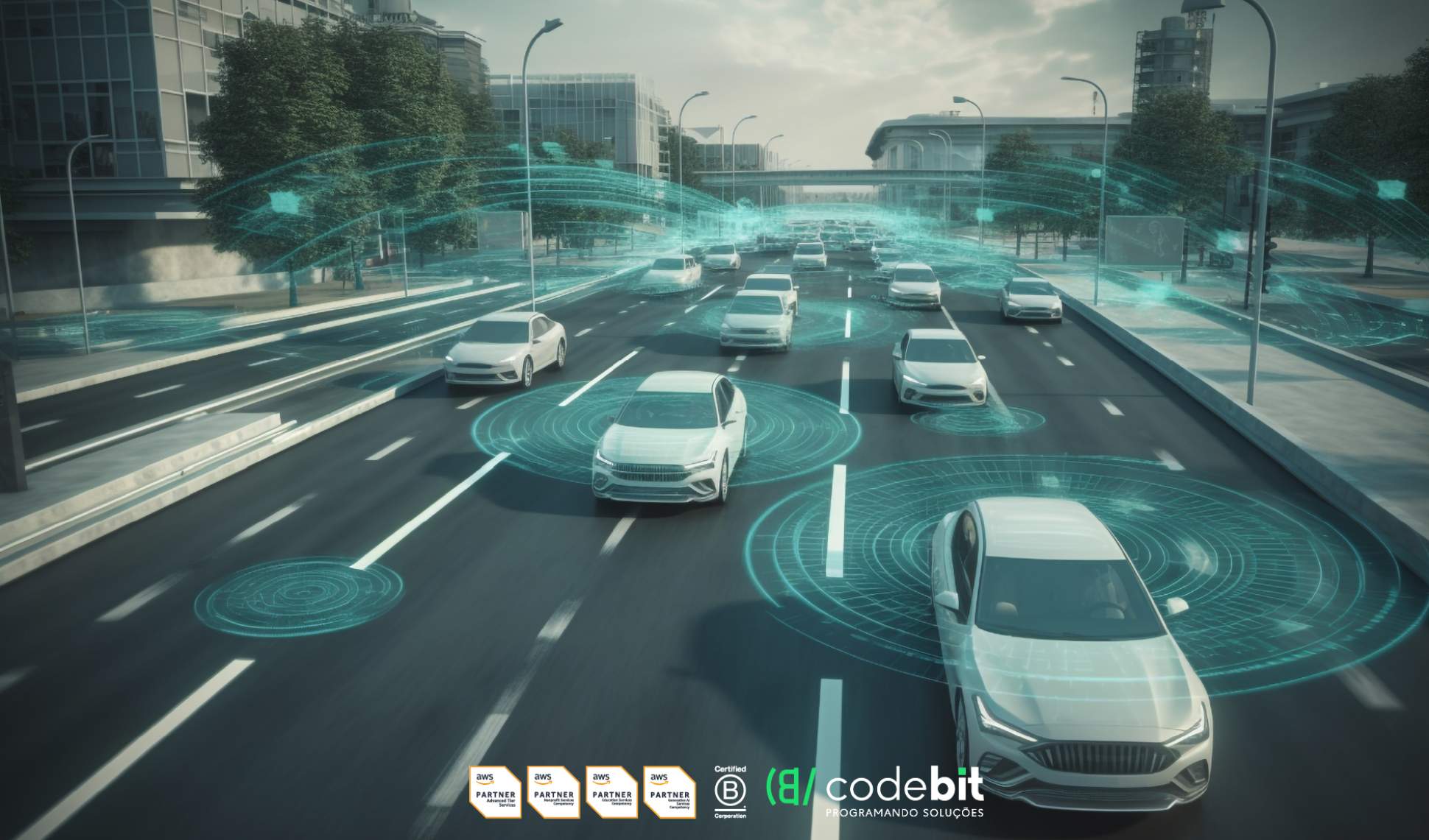
The promises are eye-catching: vehicles that drive themselves, without a driver, without accidents caused by human error, smoother traffic, and new possibilities for mobility. Artificial intelligence (the central core of this revolution) already impacts various sectors, and autonomous cars are among the most visible applications of this type of technology.
However, reality shows that these vehicles, despite the advancements, do not yet dominate the streets. Estimates for the arrival of the "fully autonomous car" have been surpassed; regulation, infrastructure, public trust, and technical risks delay mass adoption.
This article presents how autonomous cars work and analyzes why, despite the progress, they are still not a common presence in everyday traffic.
The levels of autonomy
To understand what an autonomous car is, it is first necessary to comprehend the levels of automation defined by SAE International (acronym for "Society of Automotive Engineers"). The levels go from 0 to 5:
Level 0 – no automation: the driver is responsible for all driving actions.
Level 1 – driver assistance: the system assists with a specific function, such as adaptive cruise control or lane-keeping alert.
Level 2 – partial automation: the vehicle can control speed and steering simultaneously in certain situations, but the driver must maintain full attention and take control at any moment.
Level 3 – conditional automation: the car performs all driving tasks in delimited scenarios, but the driver must be prepared to intervene when requested.
Level 4 – high automation: the vehicle is capable of driving itself in specific areas or under certain conditions, without requiring human intervention within that operational context.
Level 5 – full automation: the car operates fully autonomously, in any environment or condition, without the need for a driver, steering wheel, or pedals.
Currently, no commercial vehicle reaches level 5 in all circumstances.
How they work: sensors, maps, and AI
Autonomous cars bring together several integrated technologies: sensors (radar, cameras, lidar, ultrasound), high-definition mapping, vehicle-to-infrastructure (V2I) and vehicle-to-vehicle (V2V) communication, as well as artificial intelligence and machine learning algorithms.
The typical workflow goes like this:
Sensors capture the surrounding environment: vehicles, pedestrians, obstacles, signage, traffic lanes.
The data goes through real-time processing, being interpreted by AI algorithms that decide acceleration, braking, steering, or maneuvering.
The system relies on detailed maps and world models to predict situations, react to unexpected events, and ensure safety.
In many cases, there is external communication: the vehicle receives data or sends information about its state or external conditions (such as traffic, weather, construction).
This technological setup demands a lot of computing power, connectivity infrastructure, and robust software, factors that explain part of the delays in broad adoption.
Areas of deployment and what already exists today
Although the "fully" autonomous car is not yet a mass reality, there are already actual applications:
Robotaxi services: companies like Waymo (USA) operate fleets in specific areas, with passengers.
Public testing and limited permits: in China, for example, tests of advanced driving vehicles have been approved for use on public roads.
Private cars with Level 2 or 3 automation features: manufacturers offer hands-off steering functionalities under certain conditions (such as highways).
Why don't they dominate the streets yet?
Several challenges persist, slowing down the mass adoption of autonomous cars:
Unpredictable scenarios: inattentive humans, erratic behaviors, adverse weather conditions, construction, or inadequate infrastructure require the system to recognize and respond safely. Experts state that it could still take decades to reach full maturity in these scenarios.
Safety and reliability: accidents involving vehicles in testing or with automation systems show that significant flaws still exist. Even if statistically autonomous driving, per mile, is safer, the threshold for public and regulatory acceptance is very high.
Infrastructure and mapping: to operate at level 4 or 5, vehicles depend on high-definition maps, connectivity, calibrated sensors, and continuous updates. In most countries, this is not yet available in a uniform manner.
High cost: high-quality lidar sensors, onboard computing power, and safety redundancies raise costs. Therefore, making this scalable for mass vehicles is a considerable economic challenge.
These technical obstacles explain why reality is lagging behind promises and also why the transition will be gradual.
Regulatory, societal, and trust barriers
In addition to driving technology, human, legal, and social factors act as significant barriers:
Regulation: few jurisdictions have authorized driverless autonomous vehicles (Level 4/5) for general use. The legal framework is still under construction, and liability in the event of an accident remains an open question.
Public trust: surveys show that only a small portion of people are willing to ride in a fully autonomous vehicle. Social acceptance is crucial for adoption.
Impacts on employment and the mobility model: extensive automation can lead to significant changes in public transport, fleets, taxis, and driver jobs. Societies will need to adapt.
Cybersecurity and ethics: connected and autonomous vehicles face risks of hacking, sensor manipulation, and biases in decision algorithms. These are issues that require a robust response to obtain social license.
These questions show that autonomous mobility is, beyond a technical challenge, a cultural challenge.
The expected impact on mobility, economy, and society
When (and if) autonomous vehicles become common, the effects go beyond simple convenience. Among the expected impacts:
Reduction of accidents: many traffic accidents are attributable to human error. In view of this, autonomous vehicles could significantly reduce these statistics.
Change in urban use: less need for private parking, greater efficiency in road use, changes in urban planning, and shared transport.
Expanded access to mobility: people with disabilities, the elderly, or those in underserved regions can benefit from autonomous transport.
Resource savings: smoother traffic, lower energy consumption, less congestion, and pollution.
New business models: Transport as a Service (TaaS), autonomous fleets, automated logistics, redefining entire industries.
Even so, there are risks: a possible increase in "deadhead miles" if vehicles run without passengers, higher energy consumption, or urban expansion if commutes become less burdensome. Adoption will require that these externalities be managed proactively.
The reality we already live in
Cars with different levels of automation are already driving among us. Models that park themselves, maintain a safe distance from the vehicle ahead, and even take control on highways are examples of level 2, 3, and, in some cases, 4 autonomy. The highly discussed fully autonomous car, in any condition and without a driver, level 5, is still a distant goal.
But, the artificial intelligence driving these advancements is already present in several areas of our daily lives. It is the same technology that predicts routes in mobility apps, optimizes deliveries in real-time, and manages entire urban transport fleets.
Even if autonomous cars do not yet dominate the streets, and perhaps never turn out exactly as they do in futuristic films, the technology behind them is already driving the economy and redefining mobility. Sensors, computer vision, and predictive algorithms today equip drones, delivery robots, public transit vehicles, and urban monitoring systems.
The promise of vehicles that drive themselves has always carried a futuristic tone, but today, what we see is a process of continuous evolution, with small achievements that are already transforming the way we move and think about transportation.
Autonomous mobility continues to develop, bringing technology and society closer step by step. The car that drives itself does not yet dominate the streets, but the intelligence that makes it possible is already driving the future of innovation.




" width="15.500294250860316px"><path d="M 0 15.475 L 0 0 L 15.5 0 L 15.5 15.475 Z" fill="transparent" height="15.475099999999998px" id="tPiDQU_MP" width="15.5px"/><path d="M 3.167 1.589 C 3.847 0.724 4.607 0.171 5.61 0.046 C 6.532 -0.07 7.436 0.022 8.277 0.451 C 9.235 0.938 9.681 1.797 9.877 2.797 C 9.987 3.364 10.049 3.948 10.056 4.525 C 10.079 6.395 10.055 8.265 10.075 10.135 C 10.08 10.527 9.944 10.648 9.574 10.641 C 8.799 10.627 8.023 10.63 7.248 10.644 C 6.911 10.65 6.787 10.528 6.789 10.181 C 6.803 8.533 6.799 6.884 6.789 5.236 C 6.788 4.892 6.754 4.545 6.698 4.206 C 6.57 3.433 6.106 2.974 5.443 2.925 C 4.405 2.849 3.714 3.206 3.495 4.018 C 3.37 4.478 3.333 4.972 3.326 5.451 C 3.306 7.002 3.307 8.555 3.327 10.105 C 3.332 10.504 3.208 10.654 2.807 10.644 C 2.032 10.625 1.257 10.63 0.481 10.642 C 0.156 10.647 -0.001 10.546 0 10.193 C 0.007 7.035 0.006 3.876 0 0.718 C 0 0.391 0.104 0.24 0.458 0.249 C 1.219 0.269 1.981 0.267 2.743 0.252 C 3.068 0.245 3.197 0.361 3.17 0.688 C 3.148 0.948 3.166 1.211 3.166 1.589 Z" fill="rgb(245, 240, 237)" height="10.64451194394125px" id="Hw1mXDepj" transform="translate(5.425 4.831)" width="10.075487656011685px"/><path d="M 3.284 5.2 C 3.284 6.764 3.27 8.327 3.292 9.892 C 3.297 10.284 3.158 10.403 2.79 10.396 C 2.015 10.382 1.24 10.386 0.465 10.399 C 0.14 10.403 -0.001 10.305 0 9.947 C 0.012 6.792 0.012 3.637 0.002 0.481 C 0.001 0.123 0.105 -0.01 0.473 0.001 C 1.261 0.023 2.05 0.02 2.839 0.004 C 3.183 -0.003 3.294 0.124 3.29 0.467 C 3.276 2.044 3.284 3.623 3.284 5.2 Z" fill="rgb(245, 240, 237)" height="10.39869818980116px" id="sgvgyFXCr" transform="translate(0.237 5.076)" width="3.292113077251912px"/><path d="M 3.768 1.898 C 3.761 2.945 2.91 3.782 1.859 3.772 C 0.828 3.763 -0.012 2.892 0 1.842 C 0.012 0.824 0.864 -0.003 1.897 0 C 2.956 0.003 3.776 0.834 3.768 1.898 Z" fill="rgb(245, 240, 237)" height="3.772444228811899px" id="M8BOm1cI0" transform="translate(0 0)" width="3.768370362042166px"/></g></svg>)
" height="17px" id="G9twDfI1x" transform="translate(2 2)" width="17px"/></svg>)
" height="17px" id="q6YSjVL3w" transform="translate(6 2)" width="8.5px"/></svg>)
" height="12.720532384492868px" id="Jh_taQ7si" transform="translate(1 3.586)" width="18.00050025px"/></svg>)