Technology
The benefits of implementing AI Chatbots for your business
The benefits of implementing AI Chatbots for your business. Read more on CodeBlog!
04/01/2025
Maria Clara Xavier


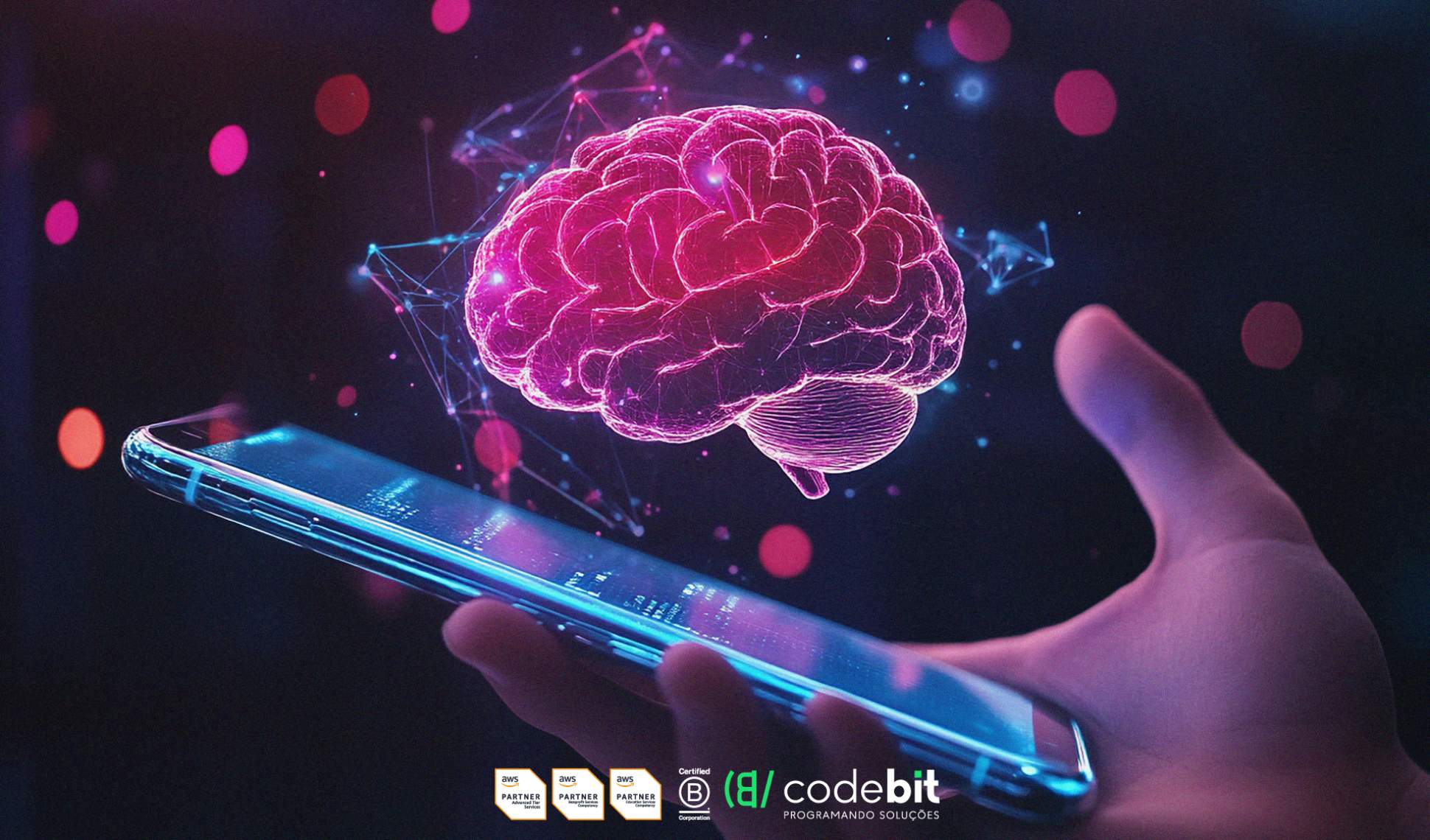
Intelligent systems have transformed the way companies interact with their customers, in addition to improving user experience, they also improve efficiency and reduce costs.
In today's digital era, time is an essential resource. Therefore, it is necessary to adopt technologies that aim to improve company actions, such as the speed with which it responds to its customers, in order not to miss potential business opportunities.
The adoption of AI chatbots has been growing and can be observed in various sectors, from customer service to the automation of internal processes. These systems have great potential, leading to market expansion and innovation, where companies can use these technologies to transform their actions and increase customer satisfaction and loyalty.
What is an AI Chatbot?
An artificial intelligence chatbot is a digital tool developed to interact with users through interactive conversations. Unlike traditional chatbots, which follow pre-programmed responses, AI chatbots are flexible and have the ability to learn and adapt their responses through Machine Learning and Natural Language Processing.
These intelligent systems are designed with the purpose of generating a more natural and fluid language, bringing it closer and closer to a human conversation. Furthermore, it is worth noting that they are able to learn from past interactions, improving their responses over time.
In this way, this technology works to provide faster and more personalized service, in addition to automating processes, making customer communication more efficient. As a result, it improves the user experience and ensures that their needs are met in a more assertive manner.
AI-Driven Analysis: Driving the Expansion of the Chatbot Market
Artificial intelligence has been shaping various sectors, and the AI chatbot market is expanding globally. In this context, this expansion is driven by the growing demand for messaging bot applications in different sectors, which seek more efficient and automated solutions for communicating with users, in addition to allowing continuous adaptation to customer needs.
Therefore, the expansion of this market is driven by the search for efficiency and innovation. By analyzing data with AI guidance, it results in more personalized interactions according to the needs of each user. Thus, this AI-driven analysis will continue to be a competitive differentiator for companies concerned with improving their service.
The Rise in Adoption of AI Chatbots Across Sectors
AI chatbots are gaining more and more prominence in various sectors. According to research by Mordor Intelligence, the global chatbot market is valued at $7.01 billion USD and is expected to reach $20.81 billion USD in the coming years. The significant increase in the adoption of these technologies provides efficient and personalized solutions, benefiting companies and consumers alike.
In this sense, adopting AI chatbots can improve operational efficiency, reduce costs, personalize the customer experience, and achieve a smoother sales flow. By analyzing the current landscape, it is possible to identify some sectors where AI chatbots are showing their benefits, which are:
Customer support: 24-hour service, solving problems simply, allowing human agents to focus their attention on handling more complex issues.
Healthcare: chatbots can assist with scheduling appointments and creating personalized plans, facilitating access to healthcare services.
Retail: these systems can offer shopping assistance, in addition to improving the shopping and after-sales experience, assisting with returns, exchanges, and product warranties.
Marketing: in this sector, chatbots are being used to personalize campaigns and improve the shopping experience, as they have the ability to interact with customers in real-time and provide recommendations according to each individual's needs.
Chatbot Market Analysis in Various Segments
The chatbot market is transforming the way companies and customers communicate, collaborating for faster, more accessible, and personalized service.
Thus, with the advancement of AI and natural language processing, chatbots are increasingly innovative and present in various segments. Below, it is possible to analyze how this technology impacts some of these segments:
Fashion and Apparel (Retail Sector): in the fashion segment, chatbot assistants can help consumers make product choices, recommending items based on their preferences and trends.
There are also some brands that use augmented reality chatbots for virtual try-ons. Finally, the use of AI can be useful for predicting trends based on customer behavior.
Real Estate and Brokers (Real Estate Sector): within the real estate segment, chatbots assist in searching for properties, answer questions about financing, and even automate virtual tours. In this sense, they are capable of analyzing the buyer's profile to provide more specific recommendations. Thus, it is possible to use this technology to speed up negotiations.
Marketing Automation: in this sector, chatbots act in capturing, qualifying, and engaging customers and potential customers, making campaigns more effective and personalized. In this scope, it is possible to identify website visitors, collect information, answer questions instantly, send relevant content at the ideal time, among others. In this way, communication will be much more personalized, effective, and persuasive.
Language Teaching (Educational Sector): in the education sector, specifically in the language teaching segment, chatbots help simulate conversations, correct pronunciation, and offer interactive learning. Some apps already incorporate AI chatbots to facilitate and assist with language practice. In addition to generating greater student engagement, it is possible to customize learning based on user progress.
AI Integration is the Key to Future Market Dominance
The use of artificial intelligence is not just a futuristic trend and has become an important factor in market competitiveness. This is because, by integrating AI into business processes, it is possible not only to optimize operations but also to redefine how brands will interact and communicate with customers, as well as assist in strategic decision-making.
In today's times, where time is a valuable resource and the speed of decisions can define the success of a business, integrating the tools that AI provides has become an essential action. With the large volume of data generated daily, AI comes to process this information in real-time, reducing the time that would be spent on manual analysis.
Therefore, it can be stated that using AI capabilities is the key to future market dominance. Not just as an advantage, but rather a necessity for businesses that want to remain competitive and innovative, standing out in the market. In summary, the question will be how to use AI tools strategically to grow and differentiate amid so much competitiveness.
What are the Pros and Cons of Implementing Chatbots?
The integration of chatbot technologies has become common across several industries, driven by the need for automation and efficiency in customer service. However, like any technology, its implementation has benefits and challenges. Next, look at some of the pros and cons of this implementation:
Pros –
Fast and 24/7 service availability: chatbots ensure instant support with no wait times, regardless of the hour. This improves the user experience and reduces the workload on support teams, who can invest their time in other matters.
Reduction of operational costs and efficiency: by adopting this technology, with the automation of repetitive tasks, it is possible to decrease the need for large customer service teams, allowing companies to invest in other strategic areas. Thus, AI chatbots have the capacity to interact with multiple customers simultaneously, optimizing the service flow and making it more efficient.
Data analysis and personalization: integrating AI with chatbots allows analyzing large volumes of data and interactions, learning customer behavior patterns and tastes to personalize responses, offering a more effective and accurate service.
Cons –
Risks of errors and security: the implementation of this technology can present language processing errors, integration issues with other systems, and security vulnerabilities. This can compromise the efficiency of the chatbot and create risks for the company.
Public resistance: there are also people who prefer human service and may feel dissatisfied when dealing with a chatbot, especially if there is no quick option to speak with a real agent, which may be needed in some cases.
Continuous maintenance and implementation costs: chatbots require regular maintenance to keep their features up to date and ensure accurate answers. Also, AI-based chatbots demand a significant investment in ongoing development and improvement.
What are the Benefits of Implementing AI Chatbots?
AI chatbots are an essential tool for companies seeking efficiency, cost reduction, and improved customer experience. These virtual assistants play a strategic role in various areas, from customer service to sales.
In this aspect, see some of the benefits generated as a result of this implementation:
Sales boost and lead generation: chatbots act as virtual sales assistants, interacting with website visitors, recommending products, and guiding the customer to purchase. They also collect important information, helping with lead qualification and increasing conversion rates.
Improved customer service: using this tool enhances the customer experience, providing quick and personalized answers, answering questions, resolving issues, and offering immediate assistance.
Operational cost reduction: it can be said that chatbots work like a company employee who operates 24 hours a day without the need for salaries, benefits, or breaks. Thus, they can serve multiple customers at the same time, making it an efficient and economically advantageous solution.
How CodeRag Can Boost Your Business?
The CodeRag is a generative AI solution specialized in critical analysis and generating insights from various types of data, such as texts, images, audio, and videos. Its main differentiator is the ability to learn and process information from different sources, which allows companies to optimize processes and make more informed and precise decisions.
The CodeRag can boost your business by automating access to and analysis of information, reducing time spent on research and reviews. With its continuous learning capability, it enables more precise and grounded responses, improving decision-making and operational efficiency.
Furthermore, its compatibility with different content formats expands its potential application, making it an essential tool for companies dealing with large volumes of data and requiring rapid, intelligent analysis.
CodeRag, by Codebit. Implementing generative AI for analysis and generating insights from various types of content.
Are you interested in learning more about our solutions? Get in touch and try the tool that will boost your business and take efficiency to another level!
Did you like the content? Keep following the CodeBlog and stay on top of the future of technology.
Until next post!




" width="15.500294250860316px"><path d="M 0 15.475 L 0 0 L 15.5 0 L 15.5 15.475 Z" fill="transparent" height="15.475099999999998px" id="tPiDQU_MP" width="15.5px"/><path d="M 3.167 1.589 C 3.847 0.724 4.607 0.171 5.61 0.046 C 6.532 -0.07 7.436 0.022 8.277 0.451 C 9.235 0.938 9.681 1.797 9.877 2.797 C 9.987 3.364 10.049 3.948 10.056 4.525 C 10.079 6.395 10.055 8.265 10.075 10.135 C 10.08 10.527 9.944 10.648 9.574 10.641 C 8.799 10.627 8.023 10.63 7.248 10.644 C 6.911 10.65 6.787 10.528 6.789 10.181 C 6.803 8.533 6.799 6.884 6.789 5.236 C 6.788 4.892 6.754 4.545 6.698 4.206 C 6.57 3.433 6.106 2.974 5.443 2.925 C 4.405 2.849 3.714 3.206 3.495 4.018 C 3.37 4.478 3.333 4.972 3.326 5.451 C 3.306 7.002 3.307 8.555 3.327 10.105 C 3.332 10.504 3.208 10.654 2.807 10.644 C 2.032 10.625 1.257 10.63 0.481 10.642 C 0.156 10.647 -0.001 10.546 0 10.193 C 0.007 7.035 0.006 3.876 0 0.718 C 0 0.391 0.104 0.24 0.458 0.249 C 1.219 0.269 1.981 0.267 2.743 0.252 C 3.068 0.245 3.197 0.361 3.17 0.688 C 3.148 0.948 3.166 1.211 3.166 1.589 Z" fill="rgb(245, 240, 237)" height="10.64451194394125px" id="Hw1mXDepj" transform="translate(5.425 4.831)" width="10.075487656011685px"/><path d="M 3.284 5.2 C 3.284 6.764 3.27 8.327 3.292 9.892 C 3.297 10.284 3.158 10.403 2.79 10.396 C 2.015 10.382 1.24 10.386 0.465 10.399 C 0.14 10.403 -0.001 10.305 0 9.947 C 0.012 6.792 0.012 3.637 0.002 0.481 C 0.001 0.123 0.105 -0.01 0.473 0.001 C 1.261 0.023 2.05 0.02 2.839 0.004 C 3.183 -0.003 3.294 0.124 3.29 0.467 C 3.276 2.044 3.284 3.623 3.284 5.2 Z" fill="rgb(245, 240, 237)" height="10.39869818980116px" id="sgvgyFXCr" transform="translate(0.237 5.076)" width="3.292113077251912px"/><path d="M 3.768 1.898 C 3.761 2.945 2.91 3.782 1.859 3.772 C 0.828 3.763 -0.012 2.892 0 1.842 C 0.012 0.824 0.864 -0.003 1.897 0 C 2.956 0.003 3.776 0.834 3.768 1.898 Z" fill="rgb(245, 240, 237)" height="3.772444228811899px" id="M8BOm1cI0" transform="translate(0 0)" width="3.768370362042166px"/></g></svg>)
" height="17px" id="G9twDfI1x" transform="translate(2 2)" width="17px"/></svg>)
" height="17px" id="q6YSjVL3w" transform="translate(6 2)" width="8.5px"/></svg>)
" height="12.720532384492868px" id="Jh_taQ7si" transform="translate(1 3.586)" width="18.00050025px"/></svg>)