Economy
CES 2026: over 50 years of anticipating technology trends
CES 2026 showcased the main technology trends at the start of this year. Check out what defined this edition and how the event remains relevant.
02/23/2026
Leonardo Fróes


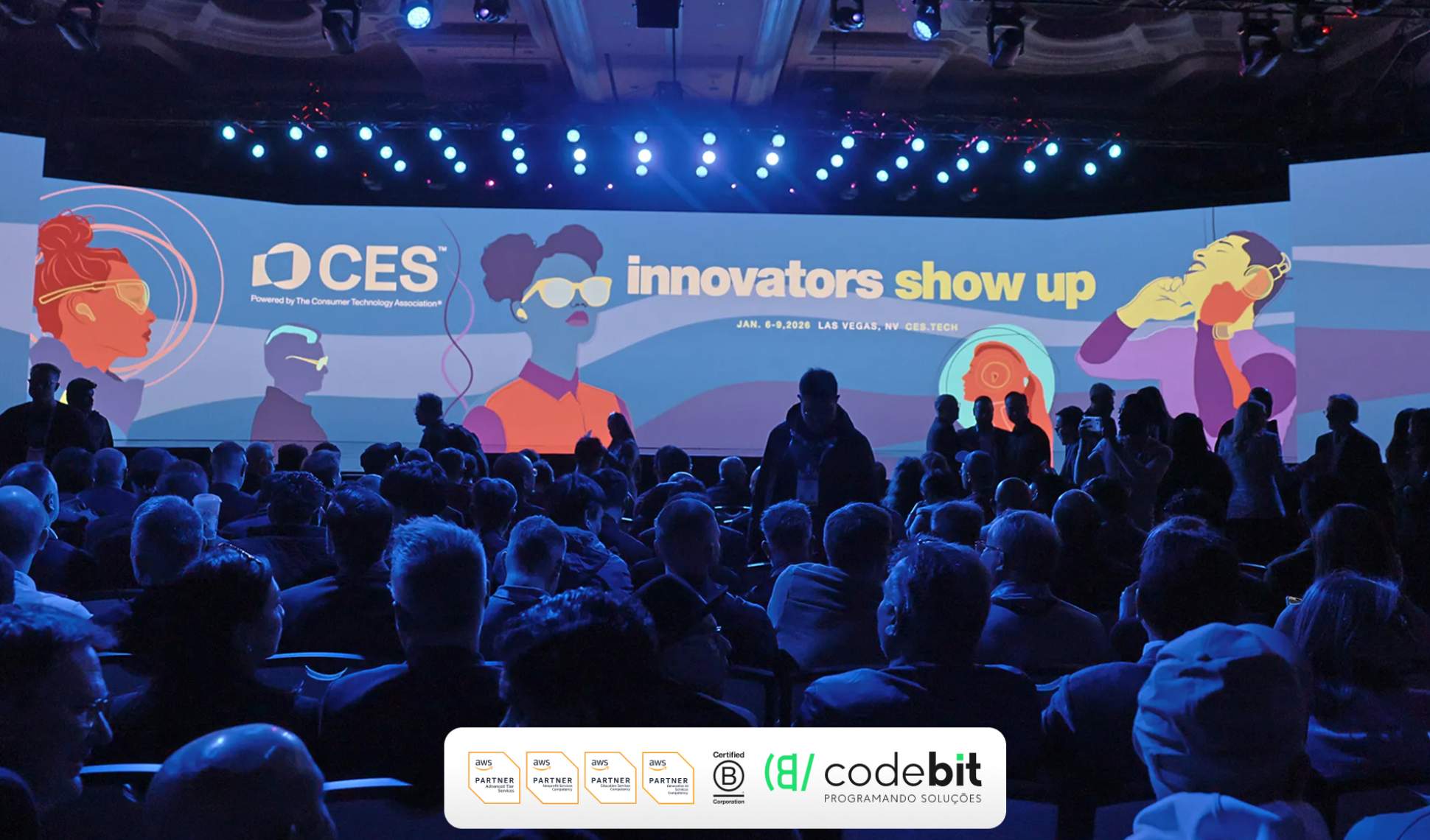
Las Vegas has consolidated itself as one of the main meeting points for the technology industry. At the end of 2025, the city hosted another edition of AWS re:Invent, an event that CodeBit attended in person and participated in discussions about infrastructure, cloud, data, and artificial intelligence at scale.
Shortly after, in the first week of January, it was CES 2026's turn to take over the city and attract the attention of the global market.
Held since 1967 by the Consumer Technology Association (CTA), the CES (Consumer Electronics Show) has gone through different industry cycles. It started with a focus on audio and video, followed the popularization of computers, witnessed the rise of smartphones, connected TVs, electric mobility, and, more recently, artificial intelligence applied to products and services.
The show has always anticipated movements. Many of the technologies that seem obvious today first passed through its hallways, still as prototypes or uncertain bets.
CES as an industry radar since 1967
Over nearly six decades, CES has established itself as a space where companies test narratives, present concepts, and observe market reactions. Not everything that appears there reaches the final consumer, but almost everything helps to understand where the industry is looking.
Historically, the show stands out for some central roles:
Presenting technologies still in the experimental stage.
Connecting startups, major manufacturers, and investors.
Serving as a showcase for new product categories.
Anticipating debates that will gain traction in the following years.
CES functions as a snapshot of the global technological moment. And, looking back, it is possible to identify clear patterns between what was displayed and what, years later, became consolidated.
When CES “predicted” the future
Revisiting past editions helps to understand how the show acts as a trend thermometer, often before they become a consensus.
CES 2010
The dispute between iOS and Android was beginning to intensify. Android was gaining ground with new manufacturers and carriers, while tablets and “smartbooks” emerged as bets beyond the smartphone.
CES 2011
The year of fourth-generation mobile networks. Announcements about LTE and 4G dominated the show, especially in the United States. In Brazil, 4G would begin to materialize shortly after, with the frequency auction in 2012 and the first commercial activations between 2013 and 2014, driven by the World Cup.
CES 2012
Smart TVs were still looking for their ideal format. Direct integrations with pay-TV services and digital platforms drew attention at a time when streaming was not yet dominant.
CES 2013
Nvidia presented Project Shield, marking its entry into its own hardware. The move anticipated the company's expansion beyond traditional GPUs, something that would consolidate in the following years in AI, automobiles, and high-performance computing.
Learn the full story: How Nvidia became the most valuable company in the world
CES 2014
Streaming began to gain prominence. The announcement of 4K content and the presence of platforms like Netflix indicated a profound shift in how video is consumed, a movement that would rapidly intensify.
From electronics show to automotive
For many years, CES was also one of the main stages for the automotive industry. Electric car concepts, driver assistance systems, digital dashboards, and vehicle connectivity gained prominence in Las Vegas, often before reaching traditional auto shows.
The show helped reposition the car as a technological platform, integrating:
Software and connectivity.
Sensors and automation.
Digital experiences inside the vehicle.
Integration with assistants and data ecosystems.
This prominence, however, fluctuated over time, reflecting the ups and downs of the global automotive sector.
CES 2026: AI and robotics gain prominence in practical applications
CES 2026 reinforced a gradual shift in the profile of innovations presented at the event. Instead of betting on isolated concepts or futuristic demonstrations, the show gave more space to concrete applications of artificial intelligence, automation, and robotics integrated into real products and services.
AI appeared less as an experimental feature and more as a core layer of operation. Across different booths, it was present in the form of embedded assistants, decision-making systems, real-time analysis, and more natural interfaces between people and machines.
Among the main highlights of the edition:
AI solutions focused on personalizing experiences, automating tasks, and integrating devices, reducing dependency on traditional interfaces.
Humanoid robots and autonomous systems, presented with greater technical maturity, focused on mobility, balance, environmental perception, and applications in logistics, industry, and services.
Smart platforms, which connect hardware, software, and data in more closed ecosystems, with a heavy reliance on cloud, edge computing, and machine learning models.
Read also: Humanoid robots on the rise: the future of advanced robotics
The 2026 edition made it clear that innovation, at this moment, is less in the form of the devices and more in the intelligence that operates them.
This shift reinforces the idea that AI has become the first layer of attention for different sectors, as the technical base upon which new products, services, and experiences are beginning to be built.
AWS re:Invent and CES in the same innovation cycle
re:Invent has a more technical focus geared towards infrastructure, but it usually anticipates how cloud, data, and artificial intelligence technologies will be applied at scale.
Many of the solutions discussed there appear, weeks later, at CES, already transformed into products, prototypes, and concrete experiences.
In the most recent edition of re:Invent, three fronts were particularly clear:
Autonomous mobility, with projects like the Zoox robotaxi, highlighting a more pragmatic approach to driverless vehicles, focused on controlled environments, limited urban operation, and a heavy reliance on real-time data, sensors, and AI.
Technology applied to sport, with an emphasis on solutions used in Formula 1, where data, simulation, machine learning, and cloud computing are employed for performance analysis, race strategy, and optimizing decisions in split seconds.
Sustainability, with global initiatives focused on water management, energy efficiency, and the responsible use of natural resources, supported by data platforms, predictive models, and scalable infrastructure.
When is CES 2027?
For those who regularly follow the event, the CES calendar is already available for the coming years:
CES 2027: January 6 to 9, 2027
CES 2028: January 11 to 14, 2028
CES 2029: January 9 to 12, 2029
These future editions are expected to continue reflecting the shift of innovation to software layers, AI, automation, and systems integration.
CES 2026 shows that the event continues to play a role in reflecting the actual stage of technology in the world, with its priorities, limits, and bets.
Over the years, the show's focus has adjusted to market transformations and, today, concentrates less on isolated devices and more on intelligence, integration, automation, and practical applications—signs of a market that has matured and come to value execution and scale.
Nearly six decades after its creation, CES remains relevant precisely because it manages to adapt. It follows industry changes, absorbs new themes, and functions as a point of convergence for trends that are already forming.
It does not define the future alone, but it helps make it more legible.


" width="15.500294250860316px"><path d="M 0 15.475 L 0 0 L 15.5 0 L 15.5 15.475 Z" fill="transparent" height="15.475099999999998px" id="tPiDQU_MP" width="15.5px"/><path d="M 3.167 1.589 C 3.847 0.724 4.607 0.171 5.61 0.046 C 6.532 -0.07 7.436 0.022 8.277 0.451 C 9.235 0.938 9.681 1.797 9.877 2.797 C 9.987 3.364 10.049 3.948 10.056 4.525 C 10.079 6.395 10.055 8.265 10.075 10.135 C 10.08 10.527 9.944 10.648 9.574 10.641 C 8.799 10.627 8.023 10.63 7.248 10.644 C 6.911 10.65 6.787 10.528 6.789 10.181 C 6.803 8.533 6.799 6.884 6.789 5.236 C 6.788 4.892 6.754 4.545 6.698 4.206 C 6.57 3.433 6.106 2.974 5.443 2.925 C 4.405 2.849 3.714 3.206 3.495 4.018 C 3.37 4.478 3.333 4.972 3.326 5.451 C 3.306 7.002 3.307 8.555 3.327 10.105 C 3.332 10.504 3.208 10.654 2.807 10.644 C 2.032 10.625 1.257 10.63 0.481 10.642 C 0.156 10.647 -0.001 10.546 0 10.193 C 0.007 7.035 0.006 3.876 0 0.718 C 0 0.391 0.104 0.24 0.458 0.249 C 1.219 0.269 1.981 0.267 2.743 0.252 C 3.068 0.245 3.197 0.361 3.17 0.688 C 3.148 0.948 3.166 1.211 3.166 1.589 Z" fill="rgb(245, 240, 237)" height="10.64451194394125px" id="Hw1mXDepj" transform="translate(5.425 4.831)" width="10.075487656011685px"/><path d="M 3.284 5.2 C 3.284 6.764 3.27 8.327 3.292 9.892 C 3.297 10.284 3.158 10.403 2.79 10.396 C 2.015 10.382 1.24 10.386 0.465 10.399 C 0.14 10.403 -0.001 10.305 0 9.947 C 0.012 6.792 0.012 3.637 0.002 0.481 C 0.001 0.123 0.105 -0.01 0.473 0.001 C 1.261 0.023 2.05 0.02 2.839 0.004 C 3.183 -0.003 3.294 0.124 3.29 0.467 C 3.276 2.044 3.284 3.623 3.284 5.2 Z" fill="rgb(245, 240, 237)" height="10.39869818980116px" id="sgvgyFXCr" transform="translate(0.237 5.076)" width="3.292113077251912px"/><path d="M 3.768 1.898 C 3.761 2.945 2.91 3.782 1.859 3.772 C 0.828 3.763 -0.012 2.892 0 1.842 C 0.012 0.824 0.864 -0.003 1.897 0 C 2.956 0.003 3.776 0.834 3.768 1.898 Z" fill="rgb(245, 240, 237)" height="3.772444228811899px" id="M8BOm1cI0" transform="translate(0 0)" width="3.768370362042166px"/></g></svg>)
" height="17px" id="G9twDfI1x" transform="translate(2 2)" width="17px"/></svg>)
" height="17px" id="q6YSjVL3w" transform="translate(6 2)" width="8.5px"/></svg>)
" height="12.720532384492868px" id="Jh_taQ7si" transform="translate(1 3.586)" width="18.00050025px"/></svg>)