Technology
How gaming technology is transforming the digital market
How gaming technology is transforming the digital market. Check it out on CodeBlog!
02/28/2025
Igor Reis


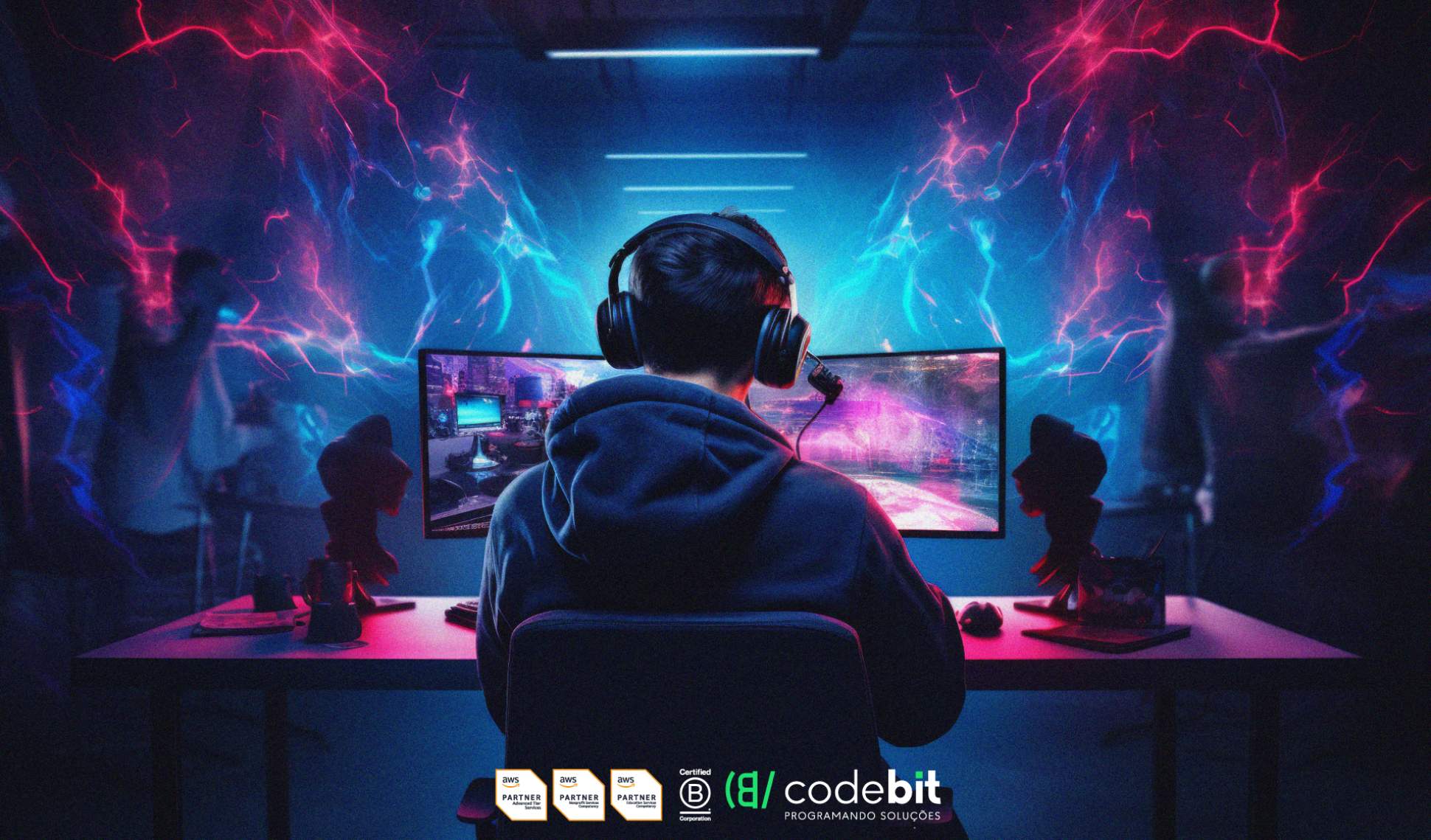
As technology advances, the gaming world stands out as one of the main drivers of the digital economy. What started as a form of entertainment is now shaping various markets, from retail to advertising, and impacting daily life in unexpected ways.
Let's explore how gaming technology has not only revolutionized the entertainment sector, but also brought new opportunities for businesses and consumers, creating a new era of digital innovation and engagement.
How gaming moves the economy
The gaming industry has become one of the most lucrative entertainment sectors, growing rapidly and generating billions of dollars annually. According to the consultancy Superdata, digital games generated about $120.1 billion globally in 2019, with $64.4 billion coming from mobile devices alone. This growth is due to the popularization of online games, the advancement of technology, and easy access to digital platforms.
The e-sports phenomenon has further boosted this market, with professional competitions, live streams, and millionaire sponsorships. Major brands invest in this sector, attracting millions of viewers and consolidating gaming as a global and increasingly relevant form of entertainment.
The online gaming revolution
Over the years, games have evolved significantly, especially online games. Interactivity with other players has enabled online games, which connect millions of people around the world, to become true social platforms. This allows the creation of a community with similar interests, and with the advancement of technology in multiplayer game development and open worlds, players have begun to interact in increasingly complex and immersive ways.
Today, it is possible to build bonds and even establish professional relationships within these digital environments, making them a dynamic space for socialization and collaboration.
In addition to the social impact, this transformation has also generated new opportunities for the advertising market. Brands have started to see games as a strategic channel to reach different audiences, inserting campaigns organically and engagingly.
In-game advertising allows companies to connect directly with players through interactive experiences, sponsorships, and subtle placements within the virtual universe, expanding the possibilities for engagement and loyalty. With this, games have not only revolutionized the way people have fun, but also how they interact and consume content in the digital environment.
Gameplay, immersiveness, and reality
Technology has been transforming the gameplay experience, taking it to a new level and bringing the virtual universe increasingly closer to reality. With consoles and computers becoming more powerful, modern games offer ultra-realistic graphics, advanced physics, and sophisticated artificial intelligence, making interactions more natural and dynamic.
These advancements allow players to engage in digital worlds with a level of detail and fluidity never seen before, providing an impressive sense of realism.
Virtual reality (VR) and augmented reality (AR) also play a fundamental role in this evolution, completely redefining the concept of immersion. These technologies transport players inside the game, offering interactive experiences that go beyond the screen and allowing every action to be felt in a more intuitive and engaging way.
With motion sensors, haptic controllers, and three-dimensional environments, it is possible to explore fantastic scenarios, participate in epic battles, or solve challenges as if you were truly inside that digital reality. The future of gaming is increasingly aligned with breaking down the barriers between the physical and the virtual, expanding the possibilities of entertainment and interaction.
Engaging new audiences
Immersive entertainment has proven to be a powerful tool for attracting diverse audiences, transcending the boundaries of traditional players and reaching increasingly wider audiences.
Platforms like Twitch and YouTube Gaming have revolutionized how games are consumed, creating a dynamic system where streamers and digital influencers share their experiences in real time.
These content creators do not just play, but also interact with their communities, promote discussions, and build authentic connections with their followers.
This transformation in entertainment consumption has opened up new possibilities for digital marketing, allowing brands to explore more efficient and engaging strategies. Through partnerships with influencers, sponsored placements, and interactive campaigns, companies can promote their products and services in a more natural way that is integrated into the gaming universe.
With this, advertising becomes less invasive and more aligned with the audience's interests, generating genuine engagement and strengthening the relationship between brands and consumers within this constantly evolving digital landscape.
Fostering customer loyalty in an increasingly digital market
In the digital environment, personalization has become an essential factor for retaining customers and creating more engaging experiences.
Gaming and technology companies constantly invest in solutions that adapt to each user's profile, using advanced recommendation algorithms to suggest customized content, challenges, and rewards.
This level of customization makes the player's journey more attractive, encouraging active retention and frequent returns to the platforms.
In addition to smart recommendations, gamification strategies have been widely applied to increase retention and engagement. Scoring systems, achievements, daily missions, and progressive rewards motivate users to interact continuously, transforming the digital experience into a cycle of challenges and rewards.
These strategies not only offer exclusive advantages to subscribers, but also create a sense of exclusivity and belonging, strengthening the connection between the audience and the platform.
Fostering motivation and collaboration in companies
The concept of gamification has expanded beyond the gaming universe, being widely adopted in the corporate environment as an innovative strategy to boost motivation and productivity.
Companies in various sectors have been implementing game mechanics in their daily work routines to stimulate employee engagement, promoting a more dynamic and interactive culture.
Through challenges, rewards, and progression systems, employees are encouraged to achieve goals, improve skills, and collaborate more effectively.
Game-based training programs make learning more engaging and accessible, allowing employees to acquire new knowledge in a practical and motivating way.
Another advantage of this approach is the improvement in job satisfaction, as routine tasks and bureaucratic processes can be transformed into more stimulating experiences. With this methodology, companies not only optimize productivity but also create a more innovative corporate environment focused on employee well-being.
Revolutionizing companies with digital twins
What are Digital Twins?
Digital twins are one of the most promising technological innovations of today, allowing the creation of detailed virtual replicas of real-world objects, processes, and systems. These digital models are constantly updated with real-time data, enabling precise analysis and advanced simulations.
How can they revolutionize businesses?
The application of digital twins has been transforming various sectors by optimizing operations, reducing costs, and improving decision-making. In manufacturing, this technology is used to simulate production processes, predict equipment failures, and increase operational efficiency.
In retail, it allows for more personalized and interactive shopping experiences, providing more efficient customer service. In healthcare, digital twins assist in more accurate diagnoses, medical training, and even the development of personalized treatments, revolutionizing the sector and driving innovation.
Spatial computing redefining everyday experiences
Spatial computing, which integrates augmented reality, artificial intelligence, and advanced sensors, is revolutionizing how we interact with the digital world, making experiences more immersive and intuitive.
This technology allows the merger of physical and virtual environments, creating dynamic interactions that go beyond traditional screens and devices. Spatial computing is gaining ground in various areas such as education, retail, healthcare, and entertainment.
Education
Spatial computing is transforming education by creating immersive learning environments. It allows students to explore contents in a practical and engaging way, making the educational process more dynamic and interactive.
Retail
In the retail sector, spatial computing enables interactive shopping experiences, such as viewing products in 3D before purchasing. This provides a more personalized and enhanced experience for consumers.
Healthcare
Technologies like augmented reality can be used in medical training, surgery simulations, and even as diagnostic assistance.
Entertainment
In entertainment, spatial computing opens up new possibilities for immersive experiences, such as interactive games, holographic interfaces, and virtual assistants that make interaction more natural and engaging. It allows the creation of experiences that go beyond traditional screens, providing greater immersion for the user.
Generative AI: unprecedented personalization
Personalization of experiences
The generative artificial intelligence is transforming the way users interact with digital entertainment. With advanced machine learning algorithms, games, streaming platforms, and social networks analyze audience behavior in real time, adjusting content and interactions according to their individual preferences. This allows each user to have a unique experience, adapted to their style of consumption.
Automated content creation
Games use this technology to generate dynamic narratives, creating stories that adjust to players' choices. Personalized soundtracks and interactive dialogues are also automatically developed, increasing the immersiveness of digital experiences.
Impact on cinema and music
In the audiovisual sector, generative AI is already being used to optimize creative processes. Scripts can be automatically generated based on specific themes, sound effects are created on-demand, and even musical compositions can be developed by artificial intelligence.
The future of digital entertainment
With the continuous advancements of generative artificial intelligence, digital entertainment becomes increasingly immersive and interactive. The ability to create tailored experiences for each user redefines the boundaries of the sector, providing a new level of innovation and engagement.
What is the future of immersiveness?
As technology evolves, immersiveness in gaming and digital entertainment will become even more realistic and accessible. The development of the metaverse drives the fusion between the physical and digital worlds, creating unprecedented interactive and social experiences.
In addition to entertainment, immersiveness will impact other areas such as work, education, and communication. Virtual environments will allow training, meetings, and learning in a more engaging way, bringing people closer and expanding possibilities.
The future of immersiveness promises to transform our relationship with technology, making it increasingly integrated into daily life.
With CodeBit you stay on top of digital transformation!
CodeBit is at the forefront of digital transformation, closely following the innovations that shape the future of entertainment and technology.
If you wish to explore new opportunities in this universe, we offer solutions and insights so your company is always one step ahead.
Stay tuned and prepare for an increasingly immersive future!




" width="15.500294250860316px"><path d="M 0 15.475 L 0 0 L 15.5 0 L 15.5 15.475 Z" fill="transparent" height="15.475099999999998px" id="tPiDQU_MP" width="15.5px"/><path d="M 3.167 1.589 C 3.847 0.724 4.607 0.171 5.61 0.046 C 6.532 -0.07 7.436 0.022 8.277 0.451 C 9.235 0.938 9.681 1.797 9.877 2.797 C 9.987 3.364 10.049 3.948 10.056 4.525 C 10.079 6.395 10.055 8.265 10.075 10.135 C 10.08 10.527 9.944 10.648 9.574 10.641 C 8.799 10.627 8.023 10.63 7.248 10.644 C 6.911 10.65 6.787 10.528 6.789 10.181 C 6.803 8.533 6.799 6.884 6.789 5.236 C 6.788 4.892 6.754 4.545 6.698 4.206 C 6.57 3.433 6.106 2.974 5.443 2.925 C 4.405 2.849 3.714 3.206 3.495 4.018 C 3.37 4.478 3.333 4.972 3.326 5.451 C 3.306 7.002 3.307 8.555 3.327 10.105 C 3.332 10.504 3.208 10.654 2.807 10.644 C 2.032 10.625 1.257 10.63 0.481 10.642 C 0.156 10.647 -0.001 10.546 0 10.193 C 0.007 7.035 0.006 3.876 0 0.718 C 0 0.391 0.104 0.24 0.458 0.249 C 1.219 0.269 1.981 0.267 2.743 0.252 C 3.068 0.245 3.197 0.361 3.17 0.688 C 3.148 0.948 3.166 1.211 3.166 1.589 Z" fill="rgb(245, 240, 237)" height="10.64451194394125px" id="Hw1mXDepj" transform="translate(5.425 4.831)" width="10.075487656011685px"/><path d="M 3.284 5.2 C 3.284 6.764 3.27 8.327 3.292 9.892 C 3.297 10.284 3.158 10.403 2.79 10.396 C 2.015 10.382 1.24 10.386 0.465 10.399 C 0.14 10.403 -0.001 10.305 0 9.947 C 0.012 6.792 0.012 3.637 0.002 0.481 C 0.001 0.123 0.105 -0.01 0.473 0.001 C 1.261 0.023 2.05 0.02 2.839 0.004 C 3.183 -0.003 3.294 0.124 3.29 0.467 C 3.276 2.044 3.284 3.623 3.284 5.2 Z" fill="rgb(245, 240, 237)" height="10.39869818980116px" id="sgvgyFXCr" transform="translate(0.237 5.076)" width="3.292113077251912px"/><path d="M 3.768 1.898 C 3.761 2.945 2.91 3.782 1.859 3.772 C 0.828 3.763 -0.012 2.892 0 1.842 C 0.012 0.824 0.864 -0.003 1.897 0 C 2.956 0.003 3.776 0.834 3.768 1.898 Z" fill="rgb(245, 240, 237)" height="3.772444228811899px" id="M8BOm1cI0" transform="translate(0 0)" width="3.768370362042166px"/></g></svg>)
" height="17px" id="G9twDfI1x" transform="translate(2 2)" width="17px"/></svg>)
" height="17px" id="q6YSjVL3w" transform="translate(6 2)" width="8.5px"/></svg>)
" height="12.720532384492868px" id="Jh_taQ7si" transform="translate(1 3.586)" width="18.00050025px"/></svg>)