Technology
How to Simplify Cloud Service Procurement?
How to simplify the procurement of cloud services? Read on CodeBlog!
06/06/2024
Ana Elisa Alqualo


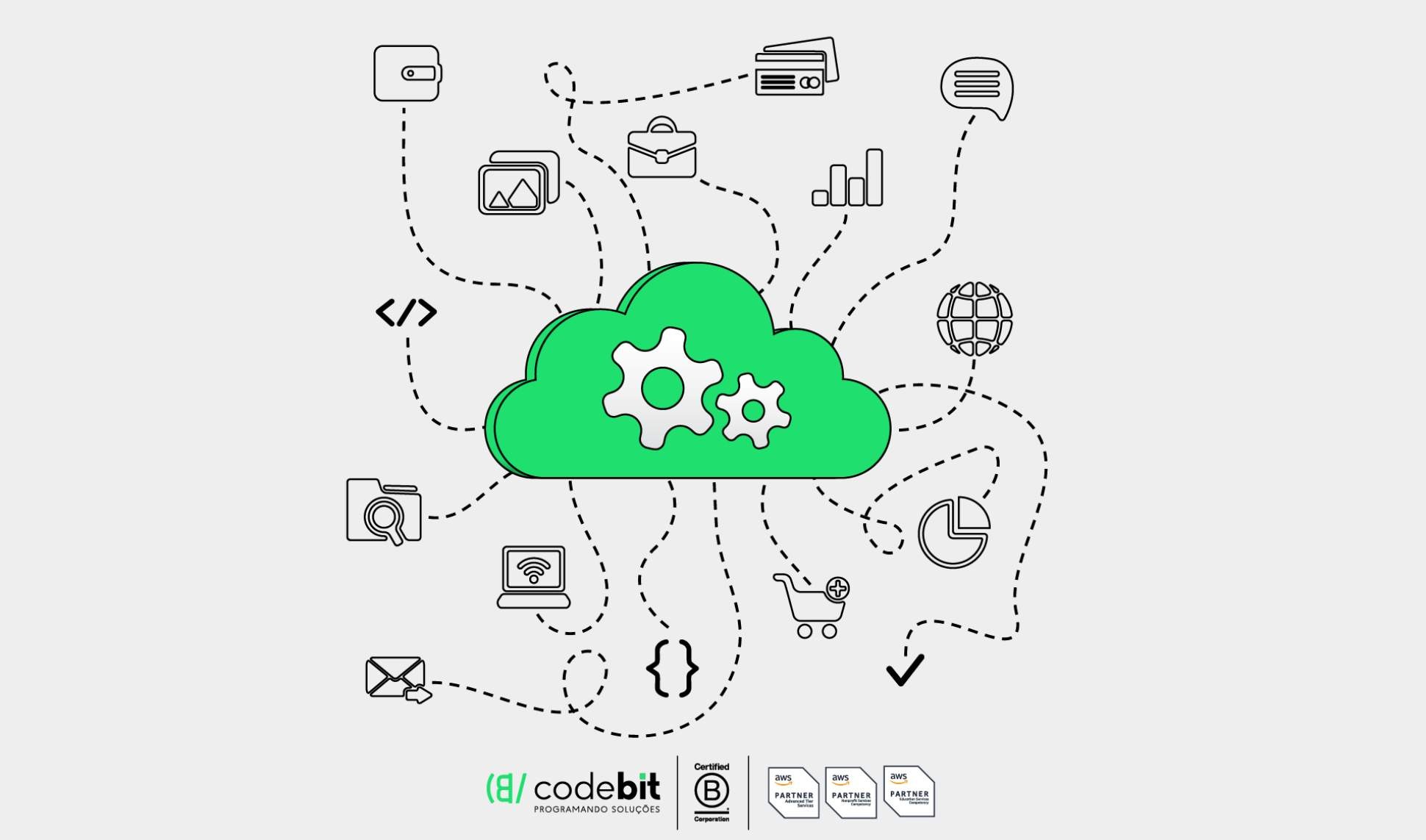
The migration to the cloud has been established as a smart strategy for businesses that wish to operate with more agility, automation, flexibility, and scalability.
The cloud is recognized for its ability to scale resources in a simplified manner and offer multiple customized features, capable of meeting the individual needs of each enterprise and positively impacting the reduction of costs, waste, and unnecessary expenses.
In view of this, it is no coincidence that, with each passing day, the number of companies adopting the solution grows.
With the cloud, instead of measuring capacity needs in advance, the organization can adjust services according to demand, eliminating unused hardware and rigid on-premises assets.
But, after all, how can you experience the full potential of the environment in a simplified way? We have listed some tips to help you in this mission. Read on and check them out!
How Does Cloud Migration Work?
In practice, cloud migration is a process that involves transferring a company's systems, data, and applications to the cloud environment, provided by a cloud provider.
The first step for a successful migration is a detailed assessment of current systems (to identify what needs to be migrated, as well as any adjustment needs).
Next, a migration plan is developed, which determines the specific steps and resources required within a timeline. Right after, it is time to prepare the cloud environment.
This is the moment to configure virtual servers, install the necessary software, and implement security measures.
To minimize the risk of file loss, the transfer of data and applications to the cloud environment is generally carried out in stages, starting with the least critical components.
After that, a series of tests is conducted to ensure that everything operates correctly. Once testing is complete and any issues are resolved, the company begins operating in the cloud environment.
It is worth mentioning that, during the first few weeks, the system is monitored intensively to adjust and optimize performance.
Furthermore, it should be highlighted that cloud migration does not end with the initial transfer.
After all, this is a cyclic process that demands continuous adjustments and optimizations, precisely to ensure that businesses can make the most of the cloud's benefits, which are:
Cost Reduction
The ideal scenario for any company's operation is one that ensures higher performance with lower costs, and the good news is that cloud services shorten this journey.
By migrating to cloud computing, it is possible to observe clear improvements in team performance, thanks to the high availability and scalability of systems.
Another considerable advantage is the savings provided by service customization.
In short, users pay only for the resources they use and can customize plans according to their needs.
Regarding physical infrastructure, savings are also a differentiator. This is because, with cloud computing, almost all equipment that takes up time, space, and demands constant maintenance becomes dispensable.
Scalability and Flexibility
As mentioned previously, the cloud environment is fully structured on the pillars of scalability and flexibility.
In practice, this means that, with migration, users do not need to worry about system maintenance or the security of stored data, as these processes become the responsibility of the provider.
Additionally, the cloud is built on a virtual infrastructure model which, unlike physical hardware, allows organizations to expand computing capacity as their needs intensify.
Unlimited Storage
Relying on the cloud, your employees will never have to worry about the space available for storing data, files, and software again.
With unlimited storage, the cloud environment, when provided by a trusted provider, also ensures the security and availability of user information, even under adverse circumstances.
Security
Any company that does not act preventively to maintain the security of its information is subject to colossal losses if it is accessed by malicious individuals.
That is why serious and committed providers, such as AWS, take process security seriously and feature a series of resources to keep their data centers free of vulnerabilities, such as advanced data encryption, continuous monitoring, strict access control policies, and regular security audits.
How to ensure a simplified and assertive decision?
Well, now that you know all the advantages of migration, you must be wondering how it is possible to perform the process in a simplified and successful way.
Discover in the next topics.
1. Assess the Demands
The first step in choosing a provider that meets your organization's expectations is to analyze all processes and demands.
This makes it easier to identify which resources are essential for your business and which can be discarded.
To do this, establish an overview of the amount of data to be stored and other key factors, such as security, accessibility, robustness, etc.
Then, assess all procedures conducted by your team and analyze the service alternatives available in the market.
To help you in this mission, we have listed some questions that may be useful during this process:
- Does the provider company give guidance throughout the entire implementation?
- Does the provider monitor your actual needs?
- Does the company offer complete support for both your organization and the users?
2. Identify Security Needs
Before beginning the cloud migration process, it is necessary to conduct a deep assessment, capable of identifying all of your organization's security needs.
This involves, for example, identifying the volume of sensitive data that will be stored, determining which applications and systems will be migrated and which resources will be needed to protect them, as well as verifying protection regulations and policies that the organization must comply with during data storage - such as the GDPR / LGPD (General Data Protection Law).
Only with careful and close analysis is it possible to develop a customized security strategy to meet the individual demands of each business.
3. Prioritize Reliability
To keep your data safe and accessible, it is essential to choose a reliable provider.
The AWS cloud, for example, provides services 24 hours a day, 7 days a week, ensuring that businesses experience constantly managed, reliable, and consistent processes.
4. Scalability
As you have already realized, scalability is one of the main advantages of the cloud.
Therefore, it is important to choose a provider capable of scaling resources according to your business needs, ensuring that data storage capacity increases as access grows.
If you intend to adapt your company to a cloud computing environment with reliability and security, count on CodeBit.
Our team of specialists offers, together with AWS (Amazon Web Services), various solutions that ensure the support your organization needs throughout the entire journey, from understanding the level of technological maturity to the implementation of cloud environments with high efficiency and low operational cost.
5. Train Your Team
Considering that cloud technology is used mainly by a business's employees, it is key that they are previously trained so they can master the use of the tool and learn all the features and possibilities it offers.
Given this, the most recommended approach is to establish a training and adaptation period so that the entire team can get used to the technology, reducing any feelings of resistance.
To put this tip into practice, there are several ways such as holding meetings focused on the features and benefits of the cloud environment, implementing customized workshops, encouraging participation in courses and certifications, and actions that promote the use of technology in the daily personal lives of employees.
Migrate to the Cloud with CloudOps Migration
CloudOps Migration is an innovative solution developed by the specialist team at Codebit.
The service covers all the features of the AWS cloud, engineered by Amazon Web Services, offering full support to teams in migration processes, assistance with training, capacity building, help with product questions, architecture, and much more!
With CloudOps Migration, the entire necessary environment is properly configured so that applications are fully operational in an AWS cloud environment that is secure, scalable, highly available, and under controlled costs, in a process always carried out hand-in-hand.
We also clarify that everything is developed with total respect for each organization's IT investment history, in order to promptly meet current market demands in compliance with the planned budget.
Click here, access the CodeBit website and see how easy it is to migrate to the AWS cloud right now!




" width="15.500294250860316px"><path d="M 0 15.475 L 0 0 L 15.5 0 L 15.5 15.475 Z" fill="transparent" height="15.475099999999998px" id="tPiDQU_MP" width="15.5px"/><path d="M 3.167 1.589 C 3.847 0.724 4.607 0.171 5.61 0.046 C 6.532 -0.07 7.436 0.022 8.277 0.451 C 9.235 0.938 9.681 1.797 9.877 2.797 C 9.987 3.364 10.049 3.948 10.056 4.525 C 10.079 6.395 10.055 8.265 10.075 10.135 C 10.08 10.527 9.944 10.648 9.574 10.641 C 8.799 10.627 8.023 10.63 7.248 10.644 C 6.911 10.65 6.787 10.528 6.789 10.181 C 6.803 8.533 6.799 6.884 6.789 5.236 C 6.788 4.892 6.754 4.545 6.698 4.206 C 6.57 3.433 6.106 2.974 5.443 2.925 C 4.405 2.849 3.714 3.206 3.495 4.018 C 3.37 4.478 3.333 4.972 3.326 5.451 C 3.306 7.002 3.307 8.555 3.327 10.105 C 3.332 10.504 3.208 10.654 2.807 10.644 C 2.032 10.625 1.257 10.63 0.481 10.642 C 0.156 10.647 -0.001 10.546 0 10.193 C 0.007 7.035 0.006 3.876 0 0.718 C 0 0.391 0.104 0.24 0.458 0.249 C 1.219 0.269 1.981 0.267 2.743 0.252 C 3.068 0.245 3.197 0.361 3.17 0.688 C 3.148 0.948 3.166 1.211 3.166 1.589 Z" fill="rgb(245, 240, 237)" height="10.64451194394125px" id="Hw1mXDepj" transform="translate(5.425 4.831)" width="10.075487656011685px"/><path d="M 3.284 5.2 C 3.284 6.764 3.27 8.327 3.292 9.892 C 3.297 10.284 3.158 10.403 2.79 10.396 C 2.015 10.382 1.24 10.386 0.465 10.399 C 0.14 10.403 -0.001 10.305 0 9.947 C 0.012 6.792 0.012 3.637 0.002 0.481 C 0.001 0.123 0.105 -0.01 0.473 0.001 C 1.261 0.023 2.05 0.02 2.839 0.004 C 3.183 -0.003 3.294 0.124 3.29 0.467 C 3.276 2.044 3.284 3.623 3.284 5.2 Z" fill="rgb(245, 240, 237)" height="10.39869818980116px" id="sgvgyFXCr" transform="translate(0.237 5.076)" width="3.292113077251912px"/><path d="M 3.768 1.898 C 3.761 2.945 2.91 3.782 1.859 3.772 C 0.828 3.763 -0.012 2.892 0 1.842 C 0.012 0.824 0.864 -0.003 1.897 0 C 2.956 0.003 3.776 0.834 3.768 1.898 Z" fill="rgb(245, 240, 237)" height="3.772444228811899px" id="M8BOm1cI0" transform="translate(0 0)" width="3.768370362042166px"/></g></svg>)
" height="17px" id="G9twDfI1x" transform="translate(2 2)" width="17px"/></svg>)
" height="17px" id="q6YSjVL3w" transform="translate(6 2)" width="8.5px"/></svg>)
" height="12.720532384492868px" id="Jh_taQ7si" transform="translate(1 3.586)" width="18.00050025px"/></svg>)