Technology
The Impact and Transformation of Technology in Healthcare
The Impact and Transformation of Technology in Healthcare. Read on CodeBlog!
06/03/2024
Ana Elisa Alqualo


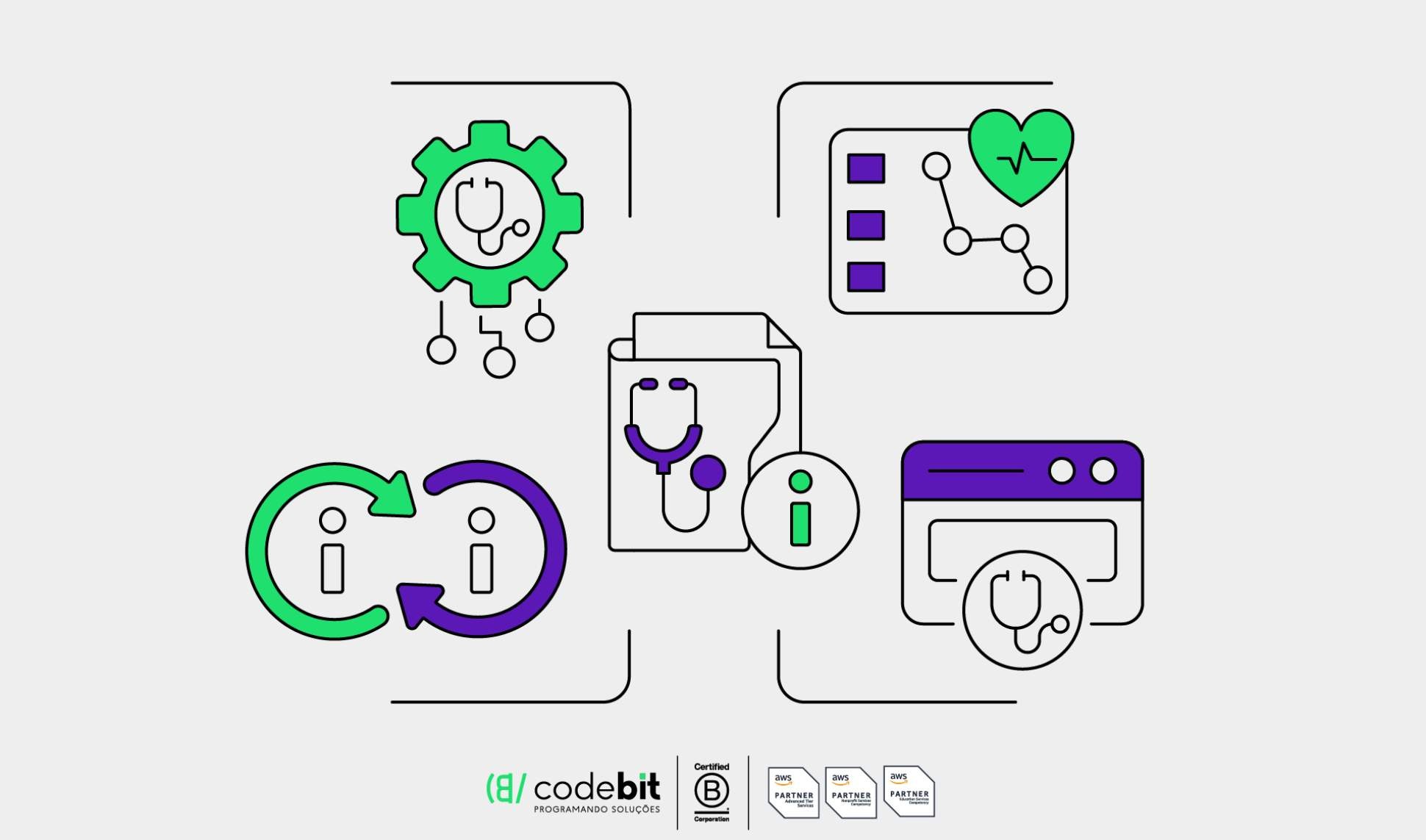
Technology and humanity can walk together towards our well-being. It is undeniable how much technology has revolutionized the way we live, consume, and relate to one another.
Technological resources have broken physical barriers, made daily life more practical, and contributed to the innovation of projects and business models in the healthcare sector.
The pandemic forced clinics, hospitals, and medical offices to bring themselves up to date by implementing cloud-based medical systems, representing a major milestone in the technological transformation of the healthcare sector.
Thanks to innovations such as telemedicine, apps focused on vaccination control, artificial intelligence, information systems with contract and health insurance management, patient care, electronic health records, surgical and supply control, many lives have been saved.
Additionally, the concept of interoperability has allowed for the reduction of costs in beneficiary care, increased security and stability for clinical processes, simplified data management, and provided several other benefits.
In this article, you will discover some of the benefits and the impact that technological transformation has brought to medicine, reinforcing how important it is to invest in technology in healthcare. Keep reading to find out more!
The Integration Between Healthcare and Technology
Today, we can state that healthcare and technology are inseparable concepts. It is evident that this partnership stimulates the evolution of both: on one hand, healthcare creates demands, and on the other, technology provides equipment and systems, enabling the improvement of the professionals' daily routines and higher quality in patient care.
Currently, advances also optimize the administrative area and offer patients greater accessibility, as processes become much more agile, assertive, and efficient. Discover, in the next topics, how technological solutions have revolutionized various processes in the healthcare field:
Telemedicine
Telemedicine is a resource that offers healthcare services at a distance through communication and information technologies. In practice, this solution enables real-time interaction among doctors, patients, and hospitals.
Furthermore, it facilitates the sharing of exams with other professionals involved in treatment, as well as requests for specialized clinical opinions and the monitoring of more complex cases.
In short, the service reduces process execution times and increases the volume of consultations and procedures, ensuring greater financial advantages for institutions and greater comfort and convenience for patients.
Integrated Softwares and Cloud Computing
Tools such as integrated software and cloud computing optimize the management processes of healthcare organizations, simplifying routines like billing control, demand management, internal task organization, and the tracking of short-, medium-, and long-term goals.
In addition, the cloud facilitates integration among different medical specialties, promoting a more integrated and holistic approach to the patient's health.
In the cloud, data, information, systems, and files no longer require physical structures, ensuring online access for users via a browser link.
Monitoring of Clinical Parameters
Equipment, software, and applications provide patients with greater autonomy, ensuring they can identify critical signs and symptoms, especially those related to chronic diseases.
In addition to enabling more constant and detailed monitoring, these resources also help prevent and manage various health conditions.
Artificial Intelligence
Besides helping professionals obtain positive results regarding patient diagnoses, Artificial Intelligence also assists newly graduated doctors in gaining more experience through




" width="15.500294250860316px"><path d="M 0 15.475 L 0 0 L 15.5 0 L 15.5 15.475 Z" fill="transparent" height="15.475099999999998px" id="tPiDQU_MP" width="15.5px"/><path d="M 3.167 1.589 C 3.847 0.724 4.607 0.171 5.61 0.046 C 6.532 -0.07 7.436 0.022 8.277 0.451 C 9.235 0.938 9.681 1.797 9.877 2.797 C 9.987 3.364 10.049 3.948 10.056 4.525 C 10.079 6.395 10.055 8.265 10.075 10.135 C 10.08 10.527 9.944 10.648 9.574 10.641 C 8.799 10.627 8.023 10.63 7.248 10.644 C 6.911 10.65 6.787 10.528 6.789 10.181 C 6.803 8.533 6.799 6.884 6.789 5.236 C 6.788 4.892 6.754 4.545 6.698 4.206 C 6.57 3.433 6.106 2.974 5.443 2.925 C 4.405 2.849 3.714 3.206 3.495 4.018 C 3.37 4.478 3.333 4.972 3.326 5.451 C 3.306 7.002 3.307 8.555 3.327 10.105 C 3.332 10.504 3.208 10.654 2.807 10.644 C 2.032 10.625 1.257 10.63 0.481 10.642 C 0.156 10.647 -0.001 10.546 0 10.193 C 0.007 7.035 0.006 3.876 0 0.718 C 0 0.391 0.104 0.24 0.458 0.249 C 1.219 0.269 1.981 0.267 2.743 0.252 C 3.068 0.245 3.197 0.361 3.17 0.688 C 3.148 0.948 3.166 1.211 3.166 1.589 Z" fill="rgb(245, 240, 237)" height="10.64451194394125px" id="Hw1mXDepj" transform="translate(5.425 4.831)" width="10.075487656011685px"/><path d="M 3.284 5.2 C 3.284 6.764 3.27 8.327 3.292 9.892 C 3.297 10.284 3.158 10.403 2.79 10.396 C 2.015 10.382 1.24 10.386 0.465 10.399 C 0.14 10.403 -0.001 10.305 0 9.947 C 0.012 6.792 0.012 3.637 0.002 0.481 C 0.001 0.123 0.105 -0.01 0.473 0.001 C 1.261 0.023 2.05 0.02 2.839 0.004 C 3.183 -0.003 3.294 0.124 3.29 0.467 C 3.276 2.044 3.284 3.623 3.284 5.2 Z" fill="rgb(245, 240, 237)" height="10.39869818980116px" id="sgvgyFXCr" transform="translate(0.237 5.076)" width="3.292113077251912px"/><path d="M 3.768 1.898 C 3.761 2.945 2.91 3.782 1.859 3.772 C 0.828 3.763 -0.012 2.892 0 1.842 C 0.012 0.824 0.864 -0.003 1.897 0 C 2.956 0.003 3.776 0.834 3.768 1.898 Z" fill="rgb(245, 240, 237)" height="3.772444228811899px" id="M8BOm1cI0" transform="translate(0 0)" width="3.768370362042166px"/></g></svg>)
" height="17px" id="G9twDfI1x" transform="translate(2 2)" width="17px"/></svg>)
" height="17px" id="q6YSjVL3w" transform="translate(6 2)" width="8.5px"/></svg>)
" height="12.720532384492868px" id="Jh_taQ7si" transform="translate(1 3.586)" width="18.00050025px"/></svg>)