Cloud Computing
Cloud computing: answering the main questions
Cloud computing: answering the main questions.
01/15/2024


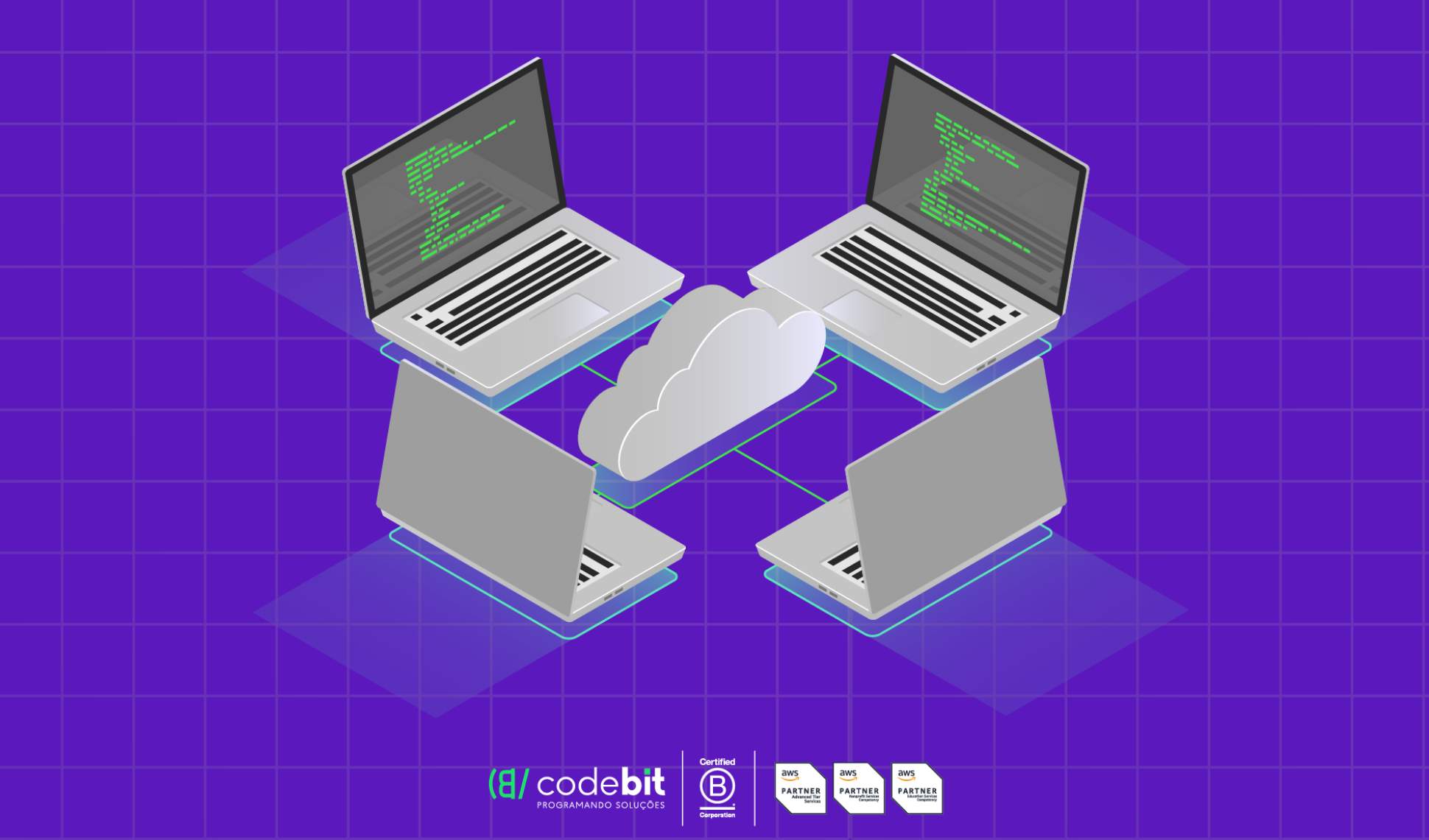
The arrival of cloud computing has transformed how companies do and develop business. Due to the ease promoted by the solution, thousands of organizations have been migrating to the cloud and experiencing more security and protection in IT functions, data management, file storage and sharing, systems, and more.
However, as it is a relatively new tool, many people still have doubts about the services. With that in mind, we at CodeBlog have created this article, focusing on the most common questions we receive. Come join us and check it out!
How does cloud computing work?
The cloud integrates a series of servers that represent a broad data storage and processing device, allowing total elasticity in all provided resources.
With cloud computing, it is possible to allocate resources from interconnected servers for your use and customize processing capacity according to demand, with appropriate security and without the need for frequent reinstalls or maintenance.
Does it generate savings?
Yes!
With scalable and customizable resources, cloud computing, when implemented by reliable and renowned providers like AWS, still provides time and money savings to organizations.
After all, with the reduced need for physical structure, ease of integration, efficient scalability, and digitization of manual tasks, businesses free IT professionals from bureaucratic and repetitive tasks, reducing errors and rework, ensuring a leaner, more economical, and, above all, effective operation.
Is it secure?
Unlike physical servers, which are subject to failures, natural disasters, theft, and loss of files or information, outsourced servers, like those provided by AWS and marketed by CodeBit, reinforce the security of all data stored in the environment, with reliable providers, integrated with the most advanced information security technologies, such as protection protocols, backup routines, and updates.
Are operations scalable?
The capacity for scalability is one of the main advantages of the cloud, because it allows its users to increase and reduce machine capacity in a simple and uncomplicated way. In practice, this advantage provides more elasticity and optimizes processes overall.
Is it reliable and manageable?
Yes!
Considering that cloud computing services are available 24 hours a day, 7 days a week, companies that invest in this technology count on constantly managed, reliable, and consistent processes.
Is storage unlimited?
In the cloud, storage capacity, in addition to being scalable, is practically unlimited.
Therefore, there is no need to worry about space and memory, as occurs with physical systems.
How is backup done in the cloud?
Practical, modern, and functional, cloud backup has gained significant adoption from both regular users and large organizations.
The system integrates data storage into a data center that is managed by a third party or a service provider contracted for this purpose.
In addition to simplifying corporate processes, the so-called "cloud backup" also offers countless benefits compared to external hard drives.
This is because, unlike physical backup, the solution ensures that all information is stored in a completely secure location against theft, loss, and natural disasters.
Focused on accessibility, the tool does not require any type of software or hardware maintenance associated with the backup to operate.
Furthermore, cloud backup is synonymous with mobility and allows all data to be accessed from any device connected to the internet, such as tablets, smartphones, desktops, etc.
It is also possible to restrict access and customize permissions to ensure that documents are viewed, edited, or shared only by authorized people.
What are the types of cloud computing?
Public Cloud
Also known as Public Cloud, in the Public Cloud, third-party service providers present resources and services to users online.
In this way, customer information, as well as related security, is concentrated in the infrastructure owned by the providers and services.
Among the main public cloud providers, Amazon AWS, Microsoft Azure, and Google Cloud Platform stand out.
Private Cloud
The Private Cloud involves a system that provides resources similar to those of the Public Cloud, but in this case, the services and information are managed by the organization or by third parties solely to maintain the client organization's setup.
In addition, in this format, the infrastructure has more control and monitoring to reduce possible problems related to security.
Hybrid Cloud
As the name implies, the Hybrid Cloud is the combination of public and private clouds, though not necessarily from different providers.
It is also important to note that the decision to run services on a public or private cloud depends on numerous factors, such as data sensitivity, industry certifications and standards, regulations, etc.
What can be migrated to the cloud?
The answer is basically everything! After all, the AWS cloud is marked primarily by versatility. Therefore, it is an excellent ally for businesses that want to experience more efficiency and innovation in their processes.
But before starting to migrate to the cloud, it is essential to carry out previous and customized planning, especially to identify tools that cannot be migrated, whether due to technical restrictions, such as specific hardware or software requirements, or even safety and compliance standards that make migration unviable.
If after clarifying your main questions about the cloud, you intend to adapt your company to a cloud computing environment with reliability and security, rely on CodeBit. Our team of specialists, alongside AWS (Amazon Web Services), offers various solutions that secure the support your institution needs throughout the entire journey, from understanding the level of technological maturity to implementing cloud environments with high efficiency and low operational costs.
Click here to access the website and check out all the services offered to support and assist in the processes of implementing and maintaining the cloud model.
For more, keep an eye on CodeBlog. Soon, we will have plenty of news here.
Best regards and see you in the next post.




" width="15.500294250860316px"><path d="M 0 15.475 L 0 0 L 15.5 0 L 15.5 15.475 Z" fill="transparent" height="15.475099999999998px" id="tPiDQU_MP" width="15.5px"/><path d="M 3.167 1.589 C 3.847 0.724 4.607 0.171 5.61 0.046 C 6.532 -0.07 7.436 0.022 8.277 0.451 C 9.235 0.938 9.681 1.797 9.877 2.797 C 9.987 3.364 10.049 3.948 10.056 4.525 C 10.079 6.395 10.055 8.265 10.075 10.135 C 10.08 10.527 9.944 10.648 9.574 10.641 C 8.799 10.627 8.023 10.63 7.248 10.644 C 6.911 10.65 6.787 10.528 6.789 10.181 C 6.803 8.533 6.799 6.884 6.789 5.236 C 6.788 4.892 6.754 4.545 6.698 4.206 C 6.57 3.433 6.106 2.974 5.443 2.925 C 4.405 2.849 3.714 3.206 3.495 4.018 C 3.37 4.478 3.333 4.972 3.326 5.451 C 3.306 7.002 3.307 8.555 3.327 10.105 C 3.332 10.504 3.208 10.654 2.807 10.644 C 2.032 10.625 1.257 10.63 0.481 10.642 C 0.156 10.647 -0.001 10.546 0 10.193 C 0.007 7.035 0.006 3.876 0 0.718 C 0 0.391 0.104 0.24 0.458 0.249 C 1.219 0.269 1.981 0.267 2.743 0.252 C 3.068 0.245 3.197 0.361 3.17 0.688 C 3.148 0.948 3.166 1.211 3.166 1.589 Z" fill="rgb(245, 240, 237)" height="10.64451194394125px" id="Hw1mXDepj" transform="translate(5.425 4.831)" width="10.075487656011685px"/><path d="M 3.284 5.2 C 3.284 6.764 3.27 8.327 3.292 9.892 C 3.297 10.284 3.158 10.403 2.79 10.396 C 2.015 10.382 1.24 10.386 0.465 10.399 C 0.14 10.403 -0.001 10.305 0 9.947 C 0.012 6.792 0.012 3.637 0.002 0.481 C 0.001 0.123 0.105 -0.01 0.473 0.001 C 1.261 0.023 2.05 0.02 2.839 0.004 C 3.183 -0.003 3.294 0.124 3.29 0.467 C 3.276 2.044 3.284 3.623 3.284 5.2 Z" fill="rgb(245, 240, 237)" height="10.39869818980116px" id="sgvgyFXCr" transform="translate(0.237 5.076)" width="3.292113077251912px"/><path d="M 3.768 1.898 C 3.761 2.945 2.91 3.782 1.859 3.772 C 0.828 3.763 -0.012 2.892 0 1.842 C 0.012 0.824 0.864 -0.003 1.897 0 C 2.956 0.003 3.776 0.834 3.768 1.898 Z" fill="rgb(245, 240, 237)" height="3.772444228811899px" id="M8BOm1cI0" transform="translate(0 0)" width="3.768370362042166px"/></g></svg>)
" height="17px" id="G9twDfI1x" transform="translate(2 2)" width="17px"/></svg>)
" height="17px" id="q6YSjVL3w" transform="translate(6 2)" width="8.5px"/></svg>)
" height="12.720532384492868px" id="Jh_taQ7si" transform="translate(1 3.586)" width="18.00050025px"/></svg>)