Technology
FinOps: Revolution in the cloud environment
FinOps: Revolution in the cloud environment. Check it out on CodeBlog!
05/14/2024
Ana Elisa Alqualo


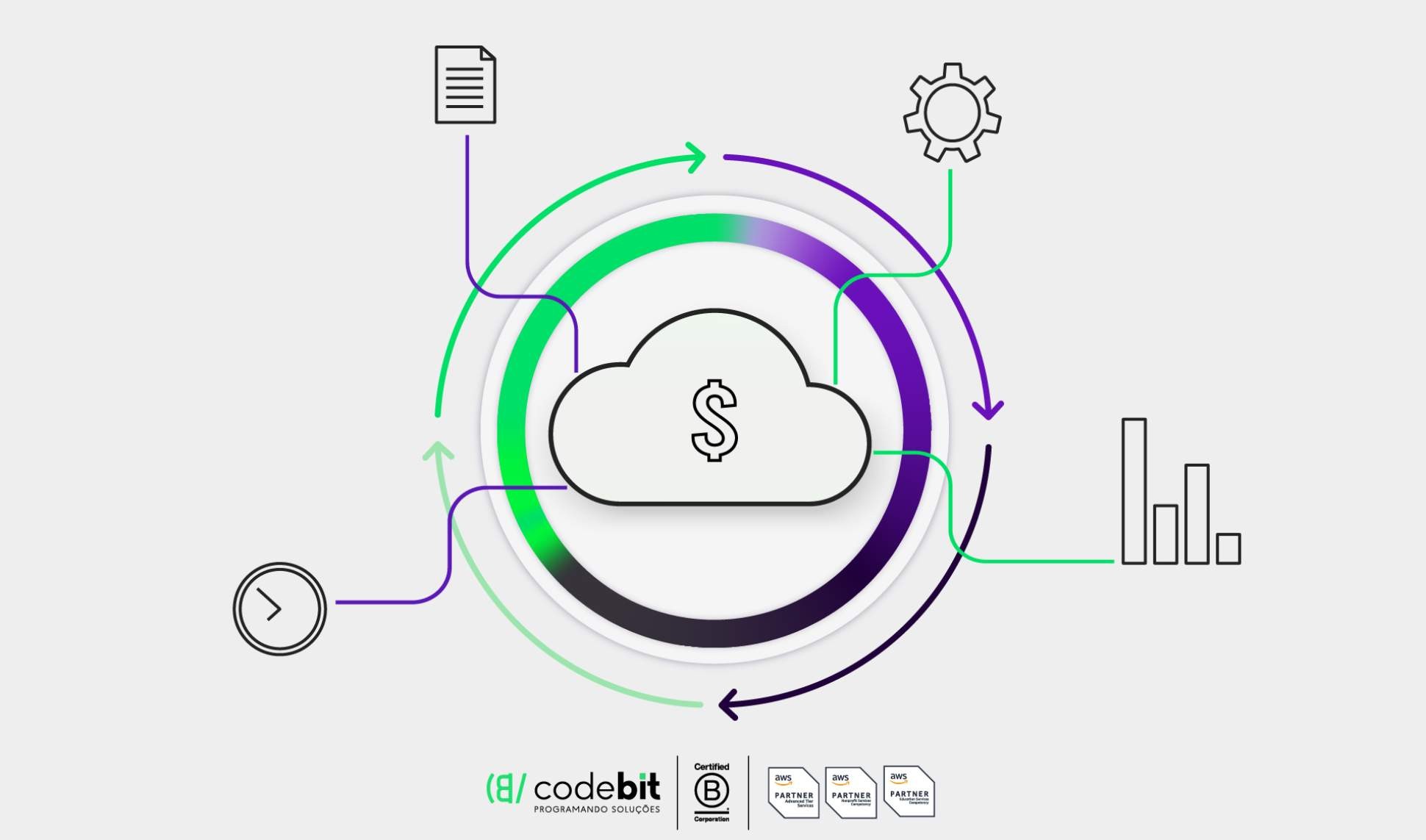
According to research, by 2025, 65% of enterprise expenditures will be related to cloud technology.
The numbers prove that cloud computing is here to stay, revolutionizing processes and boosting business competitiveness. In this automated and technological scenario, FinOps emerges to ensure the management, control, and success of business investments.
Want to know more about FinOps and discover how to drive cultural transformation in your organization? Then just keep reading!
What is FinOps?
The term FinOps is short for Financial Operations, and it is an operational framework and cultural practice that maximizes the commercial value of the cloud, enables timely data-driven decisions, and creates financial accountability through collaboration between engineering, finance, and business teams.
Considered an innovative approach, it is marked by the integration between finance and DevOps areas; its objective is precisely to ensure efficient financial responsibility based in the cloud.
By understanding and, most importantly, practicing FinOps, businesses balance the connection between speed, cost, and performance. As a result, they begin to operate in the cloud computing landscape in a more agile, assertive, and effective manner.
FinOps: Main Objectives
It is important to highlight that, contrary to what many managers believe, FinOps goes far beyond cost reduction. Historically, it consists of eliminating operational barriers, fostering integration and collaboration between different areas, and empowering engineering teams.
The main objective is to ensure the rapid delivery of features, applications, and migrations, but to achieve this, it is necessary that all expenditure-related decisions are not made in isolation.
FinOps determines that organizations deeply understand the reasons behind every decision, whether to reduce or increase costs.
This is a fundamental resolution in a reality where at least one-third of cloud budgets are wasted, representing a considerable loss for companies.
While the rapid adoption of cloud challenges traditional purchasing cycles and consumption models, FinOps acts as a control element, capable of centralizing the purchasing department and making best practices available to optimize costs in the environment.
With a common and highly accessible language, FinOps empowers companies, ensuring that all members can operate efficiently and scalably in the cloud.
The Pillars of FinOps
At its core, FinOps is a cultural practice. It is the way teams manage their cloud costs, where everyone takes responsibility for cloud usage with the support of a central best practices group. Cross-functional teams from Engineering, Finance, and Product work together to enable faster product delivery while gaining more financial control and predictability.
To better understand the role of FinOps, we can associate it with DevOps; by increasing agility within teams, DevOps revolutionized development in enterprises. In a similar way, FinOps manages to guarantee the best utilization of the cloud's commercial value across its different phases, thanks to its three pillars:
Information
Information is the first phase of the FinOps journey. To empower teams and organizations, it is first necessary to inform them about predictability, allocation, expectations, benchmarking, and budgets.
Optimization
From the moment teams are properly trained and informed, the optimization phase begins. In this stage, teams work on platform development, finding ways to review and decommission unnecessary resources to maximize cloud presence and ensure the efficient use of features.
Operation
A successful migration to the cloud environment depends, above all, on the implementation of a comprehensive FinOps culture. To achieve this, it is necessary to establish the creation of a cloud cost center, integrating business, finance, and operations teams.
It is also important to have adequate governance focused on the efficiency and security of operations, involving a culture of collaboration and setting aside traditional departmental silos.
Focused on the integration between financial, technology, and business areas, FinOps processes ensure that organizations operate at greater speed, while guaranteeing that resources are used in a customized way to effectively meet individual business goals.
The Principles of FinOps
For a legacy of shared responsibility in business, the FinOps Foundation, a project of The Linux Foundation, along with organizations like the Cloud Native Computing Foundation, established some principles. Discover what they are in the following topics:
Collaboration Across Teams
To ensure effective collaboration among all members of distinct areas, it is necessary to break down barriers and establish a culture focused on cost efficiency, processes, and decisions between sectors that generally do not interact with one each other.
Shared Responsibilities
Decentralization is a primary factor for FinOps; cloud utilization and resources are delegated to technical teams, which consider costs as well as performance and uptime. Furthermore, all collaborators, regardless of department or role, are responsible for achieving continuous improvements.
Centralization
The optimization of rates, commitments, and discounts is centralized to leverage economies of scale; this eliminates the need for engineers and operations teams to spend time on rate negotiations, allowing them to remain focused on optimizing the usage of their own environments.
Timely and Accessible Reporting
In FinOps, transparency is a fundamental point. Therefore, all shared reports must contain clear and accessible data regarding features and costs. This way, it is possible to simplify decisions and de-clutter planning.
Driven Decisions
FinOps also advocates for a balance between decisions, costs, and business benefits. Therefore, it is important to weigh the quality, speed, and capacity of the business, ensuring that resolutions are not limited to costs but also take into account the potential value that can be generated for organizations.
Continuous Adjustments and Leveraging the Variable Cost Model
Instead of abrupt changes, FinOps operates by promoting constant adjustments in the utilization and optimization of the cloud environment. In this sense, taking advantage of the cloud's variable cost model dictates the continuous implementation of small adaptations to improve efficiency and ensure total alignment with an organization's goals.
Who Benefits From FinOps?
Comprehensive and multi-functional, FinOps is geared towards collaborators, managers, and stakeholders. The practice highlights how each role, responsibility, and perspective can impact the optimization of cloud costs and resources.
Although the central function of FinOps is to enable organizational change, FinOps is not carried out by a single person or team. Below, we explain in more detail how each department can be integrated into the process:
Finance
Indispensable in the FinOps strategy, the finance department is responsible for budget management, precise projections, generating reports on cost indicators, and much more, always ensuring transparency and control throughout the process.
Leadership
Leaders and executives act in managing applications at high points of the cloud, to make the maximization of business value viable. In this context, the strategic vision of leadership professionals is decisive in aligning FinOps objectives with the organization's general goals.
FinOps Practitioners
FinOps practitioners work on deploying and maintaining best practices. To do this, they must perform an educational and standardizing role, encouraging teams to adopt and follow all FinOps guidelines and contributing to the gradual achievement of consistency and efficiency.
FinOps: How to Implement?
In order for FinOps to be implemented in an assertive and efficient manner, it is necessary to adopt or strengthen practices focused on individual responsibility, cost predictability, collaboration, blamelessness, and a focus on business value. To traverse this long journey, we suggest some actions:
Individual Responsibility
The first step in encouraging individual responsibility is to train all users of the cloud environment on cost optimization strategies and techniques. To do this, it is worth investing in courses, workshops, lectures, and, most importantly, encouraging dialogue and feedback.
Visibility
To ensure cost visibility, it is important to invest in a unique and integrated method of calculations. Another interesting strategy is to use interactive, real-time dashboards, which allow collaborators to access their cloud spending instantly.
Collaboration
When seeking to promote collaboration between teams, it is worth utilizing collaborative and integrative tools such as Slack and Trello, for example. In parallel, to ensure profitability, it is essential to establish an integrated workflow process, including members of both financial and operations teams, so that all expenses are estimated and then optimized.
Blamelessness
Instead of searching for someone to blame, it is much more constructive to establish a preventive culture, where analyses and retrospectives are conducted to understand the root causes of problems and identify opportunities for improvement. This way, it is possible to strengthen a culture of mutual learning within the organization.
Business Value
To effectively focus on business value, it is important to relate cloud utilization with data and metrics of business value, such as resilience, profitability, and resource delivery speed. Finally, the implementation of unit cost for all applications and cloud services is also highly recommended.
The practice of FinOps is inherently iterative, and the maturity of any process, functional activity, capability, or domain will improve with repetition.
Now that you know what FinOps is and how this approach can optimize cloud management for a business, how about checking out all the solutions that the specialist team at CodeBit can provide for your organization?
Click here and discover all the development and cloud computing services available for companies, startups, corporate foundations, universities, third-sector organizations, and social project initiatives.
Keep an eye on the CodeBlog. See you in the next post!




" width="15.500294250860316px"><path d="M 0 15.475 L 0 0 L 15.5 0 L 15.5 15.475 Z" fill="transparent" height="15.475099999999998px" id="tPiDQU_MP" width="15.5px"/><path d="M 3.167 1.589 C 3.847 0.724 4.607 0.171 5.61 0.046 C 6.532 -0.07 7.436 0.022 8.277 0.451 C 9.235 0.938 9.681 1.797 9.877 2.797 C 9.987 3.364 10.049 3.948 10.056 4.525 C 10.079 6.395 10.055 8.265 10.075 10.135 C 10.08 10.527 9.944 10.648 9.574 10.641 C 8.799 10.627 8.023 10.63 7.248 10.644 C 6.911 10.65 6.787 10.528 6.789 10.181 C 6.803 8.533 6.799 6.884 6.789 5.236 C 6.788 4.892 6.754 4.545 6.698 4.206 C 6.57 3.433 6.106 2.974 5.443 2.925 C 4.405 2.849 3.714 3.206 3.495 4.018 C 3.37 4.478 3.333 4.972 3.326 5.451 C 3.306 7.002 3.307 8.555 3.327 10.105 C 3.332 10.504 3.208 10.654 2.807 10.644 C 2.032 10.625 1.257 10.63 0.481 10.642 C 0.156 10.647 -0.001 10.546 0 10.193 C 0.007 7.035 0.006 3.876 0 0.718 C 0 0.391 0.104 0.24 0.458 0.249 C 1.219 0.269 1.981 0.267 2.743 0.252 C 3.068 0.245 3.197 0.361 3.17 0.688 C 3.148 0.948 3.166 1.211 3.166 1.589 Z" fill="rgb(245, 240, 237)" height="10.64451194394125px" id="Hw1mXDepj" transform="translate(5.425 4.831)" width="10.075487656011685px"/><path d="M 3.284 5.2 C 3.284 6.764 3.27 8.327 3.292 9.892 C 3.297 10.284 3.158 10.403 2.79 10.396 C 2.015 10.382 1.24 10.386 0.465 10.399 C 0.14 10.403 -0.001 10.305 0 9.947 C 0.012 6.792 0.012 3.637 0.002 0.481 C 0.001 0.123 0.105 -0.01 0.473 0.001 C 1.261 0.023 2.05 0.02 2.839 0.004 C 3.183 -0.003 3.294 0.124 3.29 0.467 C 3.276 2.044 3.284 3.623 3.284 5.2 Z" fill="rgb(245, 240, 237)" height="10.39869818980116px" id="sgvgyFXCr" transform="translate(0.237 5.076)" width="3.292113077251912px"/><path d="M 3.768 1.898 C 3.761 2.945 2.91 3.782 1.859 3.772 C 0.828 3.763 -0.012 2.892 0 1.842 C 0.012 0.824 0.864 -0.003 1.897 0 C 2.956 0.003 3.776 0.834 3.768 1.898 Z" fill="rgb(245, 240, 237)" height="3.772444228811899px" id="M8BOm1cI0" transform="translate(0 0)" width="3.768370362042166px"/></g></svg>)
" height="17px" id="G9twDfI1x" transform="translate(2 2)" width="17px"/></svg>)
" height="17px" id="q6YSjVL3w" transform="translate(6 2)" width="8.5px"/></svg>)
" height="12.720532384492868px" id="Jh_taQ7si" transform="translate(1 3.586)" width="18.00050025px"/></svg>)