Cloud Computing
Application migration to the AWS cloud: discover 7 strategies
Migrating applications to the AWS cloud: discover 7 strategies on the CodeBit blog.
12/20/2023


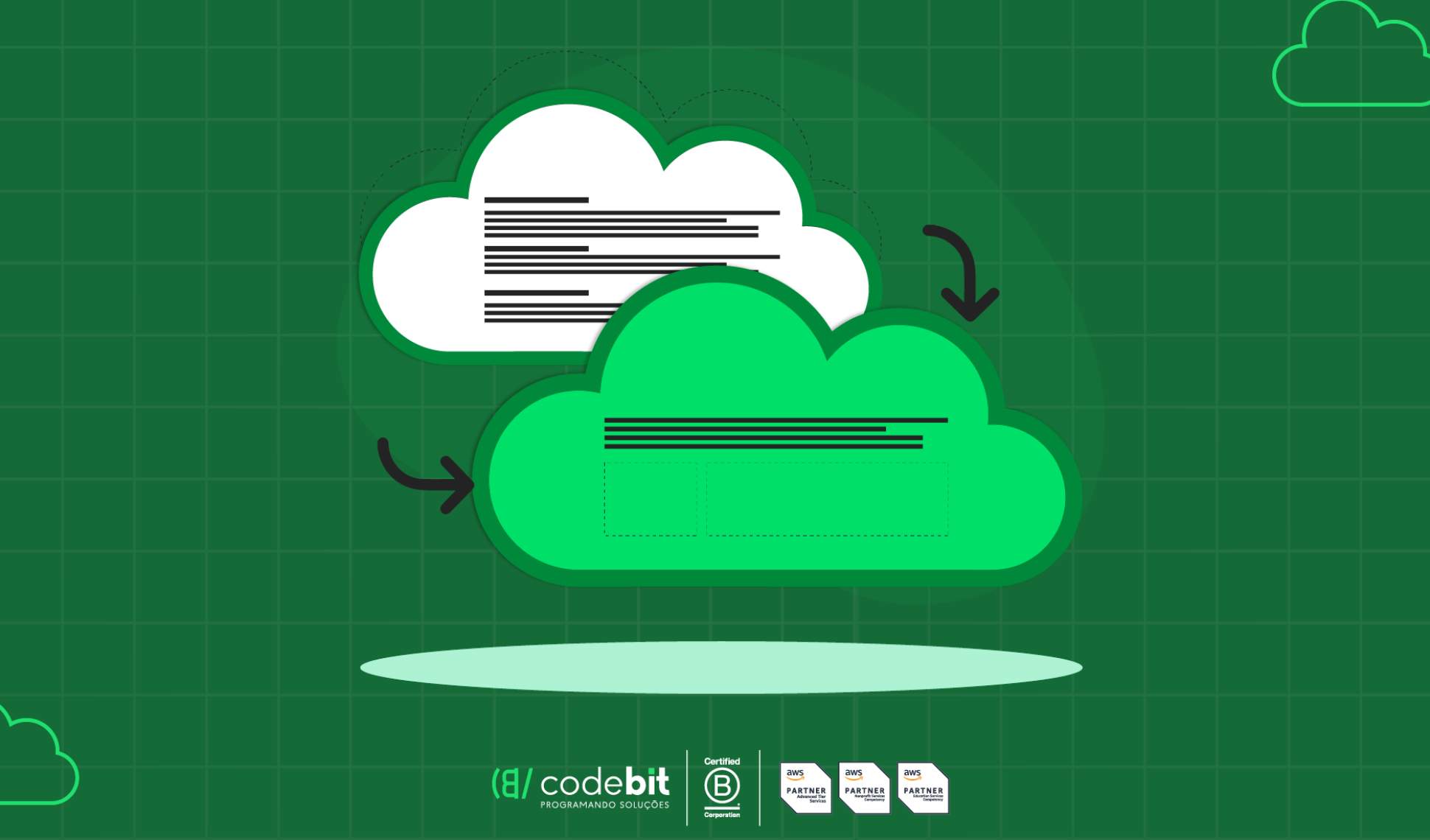
If until recently migrating to the cloud was an optional matter, today, it has become almost mandatory for companies that wish to make their processes more fluid and maintain their competitiveness in the market.
After all, when an organization frees itself from the limitations of an on-premises infrastructure, it starts hosting applications and information in cloud environments, ensuring more agility, productivity, automation, and cost reduction.
But, like any other transition, migrating to the cloud requires some specific strategies and processes, and that is what we, the CodeBlog team, will talk about today.
Want to discover how to migrate applications to the AWS cloud? Then, keep reading and check out the blog post we prepared for you.
7 app migration strategies: “The 7 R's”
1. Rehost
Also known as “lift and shift,” Rehost is a solution that allows the migration of applications, systems, and data in an uncomplicated way. Because it involves moving already established physical and virtual servers to an IaaS (Infrastructure as a Service) solution, it is generally most recommended for initial migrations.
The IaaS model hosts structures found on sites, providing virtualized environments through a hypervisor.
The "rehosting" process still allows companies to build new architectures in the future, as long as the cloud management-based operation is already in place.
2. Replatform
This solution allows organizations with already outlined and established structures to migrate to the IaaS cloud without having to alter the entire core of the applications.
To do this, an emulator, integrated into a virtual machine, makes legacy IT systems compatible with modern cloud technologies.
In this way, Replatform provides a more effective alternative for businesses that cannot restructure legacy IT systems during migration to the cloud. In practice, the strategy allows for some specific configuration changes, to optimize and adapt the cloud environment, without major modifications to the core architecture.
Generally, developers adopt this approach to reshape the format of interactions with the database, allowing its execution on managed platforms.
3. Repurchase
The Repurchase strategy, also known as "drop and shop," acts as a replacement for the on-premise application, using cloud-native software. Generally, the technique consists of migrating to a SaaS (Software as a Service) platform with the same resources and capabilities. Sometimes, the process requires changes in licensing. In these cases, it is necessary to surrender the current local license and start a new agreement with the cloud provider. By adopting the latest and most updated cloud management, organizations experience greater efficiency, automation, and cost reduction, both in storage and in maintenance-related investments.
4. Refactoring/Re-architecting
The terms, Refactoring/Re-architecting refer to refactoring and re-architecting, respectively.
In practice, this strategy makes it possible to take full advantage of technologies like microservices architecture, without the need for equipment such as servers, containers, and load balancers.
For example, you can refactor digital assets by moving them from a legacy on-premises monolithic architecture to a serverless architecture in the cloud. Because they are based on agility, efficiency, and scalability, these frameworks return ROI over the long term.
Compared to other strategies, this approach is more intensive and takes longer, which is why it should be broken down and refactored, ensuring that legacy applications run on-premises while the cloud is built and reconfigured.
5. Retire
The Retire strategy is a migration option that "retires" services and workloads that are not used.
With decommissioning, the organization can focus on more strategic and creative areas, saving time and resources.
6. Retain
Also known as Re-visit, the Retain strategy determines the revisiting of some critical parts of digital assets that require refactoring techniques before cloud migration. Sometimes during processes, it is possible to analyze and identify which applications are best suited for on-premises use and which have been recently updated and should be kept.
In other cases, systems may be retained due to other factors such as latency requirements, restrictions, or compliance.
7. Relocate
Finally, the seventh R refers to relocation, a strategy primarily based on infrastructure, but with a focus on leveraging the same set of basic components.
Just like in Rehost, the software running inside migrating virtual machines remains unaware of the changes.
The difference is that, in this approach, existing operational tools and processes can be maintained, even if they depend on third-party products.
Migrate to the cloud with CloudOps Migration
CloudOps Migration is a solution developed by the CodeBit team of experts.
In practice, the service provides all the features of the AWS cloud, designed by Amazon Web Services and considered the most complete in the market. In addition, it offers complete support in migration processes, training aid, capacity building, assistance for questions about products, architecture, and much more!
With CloudOps Migration, the entire necessary environment is properly configured so that applications are fully functional in an AWS cloud environment that is secure, scalable, highly available, and with controlled costs in a collaborative process.
The process is developed with total respect for the IT investment history of each organization, to promptly meet current market demands in accordance with the planned budget.
Click here, access the CodeBit website, and see how easy it is to migrate to the AWS cloud right now!



" width="15.500294250860316px"><path d="M 0 15.475 L 0 0 L 15.5 0 L 15.5 15.475 Z" fill="transparent" height="15.475099999999998px" id="tPiDQU_MP" width="15.5px"/><path d="M 3.167 1.589 C 3.847 0.724 4.607 0.171 5.61 0.046 C 6.532 -0.07 7.436 0.022 8.277 0.451 C 9.235 0.938 9.681 1.797 9.877 2.797 C 9.987 3.364 10.049 3.948 10.056 4.525 C 10.079 6.395 10.055 8.265 10.075 10.135 C 10.08 10.527 9.944 10.648 9.574 10.641 C 8.799 10.627 8.023 10.63 7.248 10.644 C 6.911 10.65 6.787 10.528 6.789 10.181 C 6.803 8.533 6.799 6.884 6.789 5.236 C 6.788 4.892 6.754 4.545 6.698 4.206 C 6.57 3.433 6.106 2.974 5.443 2.925 C 4.405 2.849 3.714 3.206 3.495 4.018 C 3.37 4.478 3.333 4.972 3.326 5.451 C 3.306 7.002 3.307 8.555 3.327 10.105 C 3.332 10.504 3.208 10.654 2.807 10.644 C 2.032 10.625 1.257 10.63 0.481 10.642 C 0.156 10.647 -0.001 10.546 0 10.193 C 0.007 7.035 0.006 3.876 0 0.718 C 0 0.391 0.104 0.24 0.458 0.249 C 1.219 0.269 1.981 0.267 2.743 0.252 C 3.068 0.245 3.197 0.361 3.17 0.688 C 3.148 0.948 3.166 1.211 3.166 1.589 Z" fill="rgb(245, 240, 237)" height="10.64451194394125px" id="Hw1mXDepj" transform="translate(5.425 4.831)" width="10.075487656011685px"/><path d="M 3.284 5.2 C 3.284 6.764 3.27 8.327 3.292 9.892 C 3.297 10.284 3.158 10.403 2.79 10.396 C 2.015 10.382 1.24 10.386 0.465 10.399 C 0.14 10.403 -0.001 10.305 0 9.947 C 0.012 6.792 0.012 3.637 0.002 0.481 C 0.001 0.123 0.105 -0.01 0.473 0.001 C 1.261 0.023 2.05 0.02 2.839 0.004 C 3.183 -0.003 3.294 0.124 3.29 0.467 C 3.276 2.044 3.284 3.623 3.284 5.2 Z" fill="rgb(245, 240, 237)" height="10.39869818980116px" id="sgvgyFXCr" transform="translate(0.237 5.076)" width="3.292113077251912px"/><path d="M 3.768 1.898 C 3.761 2.945 2.91 3.782 1.859 3.772 C 0.828 3.763 -0.012 2.892 0 1.842 C 0.012 0.824 0.864 -0.003 1.897 0 C 2.956 0.003 3.776 0.834 3.768 1.898 Z" fill="rgb(245, 240, 237)" height="3.772444228811899px" id="M8BOm1cI0" transform="translate(0 0)" width="3.768370362042166px"/></g></svg>)
" height="17px" id="G9twDfI1x" transform="translate(2 2)" width="17px"/></svg>)
" height="17px" id="q6YSjVL3w" transform="translate(6 2)" width="8.5px"/></svg>)
" height="12.720532384492868px" id="Jh_taQ7si" transform="translate(1 3.586)" width="18.00050025px"/></svg>)