Cloud Computing
Multicloud: what is it?
Multicloud: what is it? Discover more in this article prepared for you by the CodeBlog team.
12/11/2023


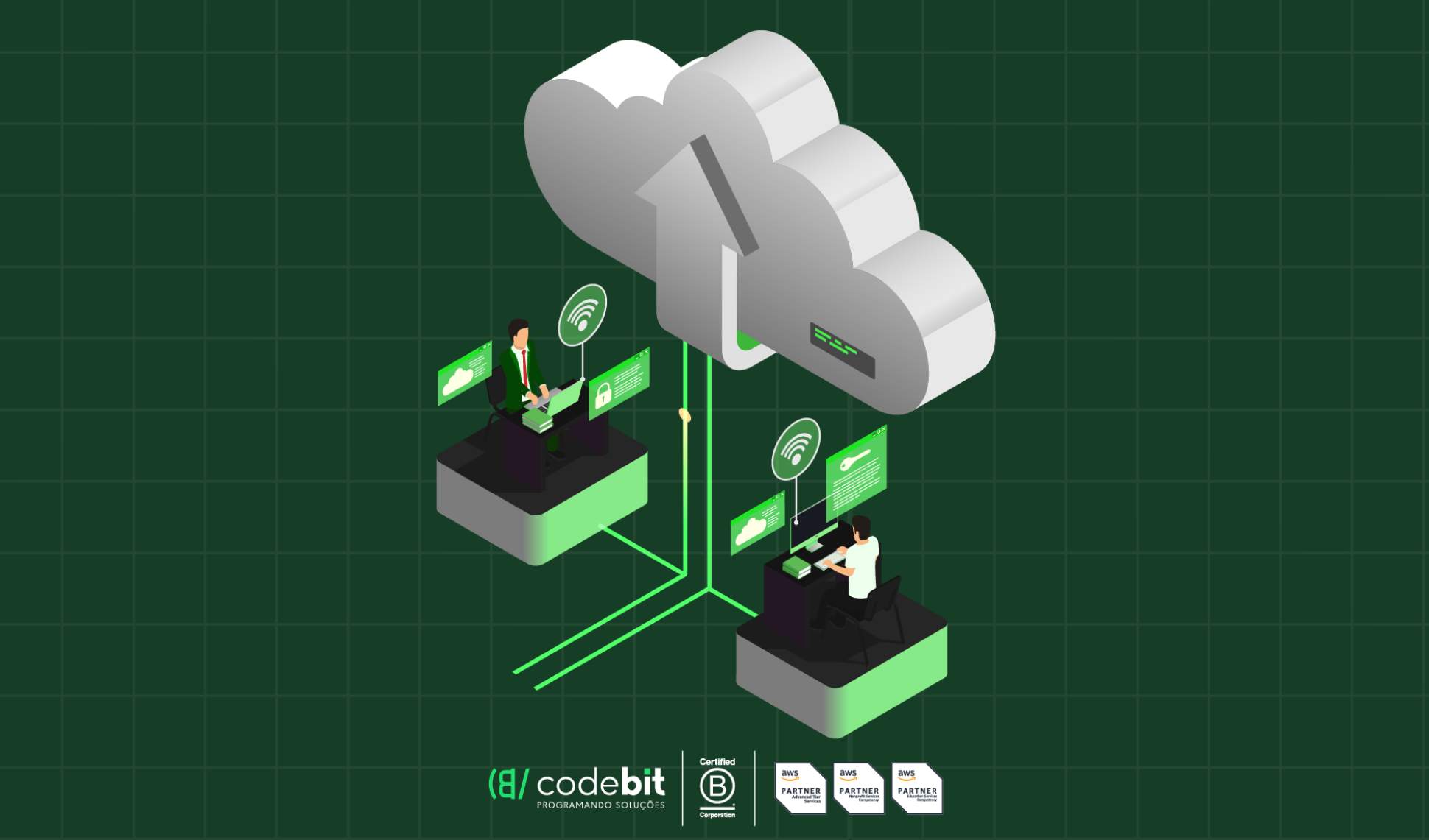
Technology has revolutionized the way companies operate. Resources have broken physical barriers, brought more automation to processes, made deliveries faster, and allowed employees to continue operating, even outside the physical business environment. In this context, the contribution of the cloud in optimizing access and storage of corporate data is evident. Proof of this is the short space of time in which this technology became popular.
With the high adoption of the solution, new demands, trends, and features naturally began to emerge, such as multi-cloud, which is the topic of today's article.
Want to know what the tool is about and what advantages it can provide to businesses? Then you're in the right place. Read on and check out the article that we, from the Code Blog team, have prepared for you!
Multi Cloud: the definition
Multi Cloud is, first and foremost, an environment. In practice, it allows organizations to use more than one cloud platform to try out specific applications or services.
To adapt to the individual needs of each business, multi-cloud can include public or private clouds, or a combination of both, mixing on-premises operations with services from multiple public cloud providers.
In this way, companies can gain operational and competitive advantages from the benefits offered by each platform.
Is Multi Cloud the same as hybrid cloud?
Although the terms might indicate that they are the same solution, believe me, they are very different proposals and operations.
While the hybrid cloud features a configuration that allows the transmission of data and applications using a combination of public and private cloud resources from the same provider, enabling users to use the features separately to perform tasks, the so-called Multi cloud uses resources from two or more clouds, from different providers, so that organizations can access different service models according to each task or demand.
It is correct to say that hybrid and multi-cloud formats complement each other.
In addition, a multi-cloud environment can also become hybrid if private cloud resources are incorporated with multiple public clouds.
Why adopt this strategy?
Undoubtedly, one of the main advantages provided by the application of multi-cloud is the flexibility and freedom to choose the best cloud providers on the market. This is a factor that offers multiple benefits.
Check out some of them in the next topics.
Infrastructure
By combining different cloud computing structures, an organization can access and scale resources from different providers according to the type of task to be performed.
Optimization
Multi-cloud enables a more competitive and effective integration of services, mainly regarding decisive factors such as cost-effectiveness and scalability.
Integration
With several models and servers available, multi-cloud ensures the integration of each provider, ensuring that teams can manage services and meet all their needs with fully customized solutions.
Security
Another great advantage of the multi-cloud strategy is the security it provides, which, in addition to preventing the loss of data blocks, reduces, or even eliminates, human errors and downtime caused by errors in cloud applications.
Innovation
Multi-cloud is also an excellent solution to drive the application of new technologies in organizations, helping them embrace innovations and ensure optimized processes, greater delivery reach, and, consequently, more visibility and competitiveness in the market.
Adaptability
Marked by versatility and flexibility, with multi-cloud, organizations of all sizes can keep their computing resources much closer to users.
As a result, they clearly guarantee more efficiency and performance.
Legislation
Betting on a structure that accommodates and integrates various types of cloud complies with all current legislation and even regulations related to government entities, which need to keep data in specific environments.
Orchestration
When it comes to data management, relying on orchestration solutions allows for the automation and coordination of various complex systems management processes.
In practice, the tools enable total control over app settings, storage and database, storage array, web server, and much more.
Anyway, now that you know what it is about and what the advantages of multi-cloud are, if you want to adapt your company to a cloud computing environment with reliability and security, count on CodeBit.
Our team of specialists offers, together with AWS (Amazon Web Services), several solutions that guarantee the support your institution needs throughout the journey, from understanding the level of technological maturity to implementing cloud environments with high efficiency and low operational cost.
Click here, access the website, and check out all the services offered to support and assist educational institutions in the processes of implementation and maintenance of the cloud model.
Otherwise, keep an eye on Codeblog. Soon, we will have many updates here.
A big hug, and see you in the next post.




" width="15.500294250860316px"><path d="M 0 15.475 L 0 0 L 15.5 0 L 15.5 15.475 Z" fill="transparent" height="15.475099999999998px" id="tPiDQU_MP" width="15.5px"/><path d="M 3.167 1.589 C 3.847 0.724 4.607 0.171 5.61 0.046 C 6.532 -0.07 7.436 0.022 8.277 0.451 C 9.235 0.938 9.681 1.797 9.877 2.797 C 9.987 3.364 10.049 3.948 10.056 4.525 C 10.079 6.395 10.055 8.265 10.075 10.135 C 10.08 10.527 9.944 10.648 9.574 10.641 C 8.799 10.627 8.023 10.63 7.248 10.644 C 6.911 10.65 6.787 10.528 6.789 10.181 C 6.803 8.533 6.799 6.884 6.789 5.236 C 6.788 4.892 6.754 4.545 6.698 4.206 C 6.57 3.433 6.106 2.974 5.443 2.925 C 4.405 2.849 3.714 3.206 3.495 4.018 C 3.37 4.478 3.333 4.972 3.326 5.451 C 3.306 7.002 3.307 8.555 3.327 10.105 C 3.332 10.504 3.208 10.654 2.807 10.644 C 2.032 10.625 1.257 10.63 0.481 10.642 C 0.156 10.647 -0.001 10.546 0 10.193 C 0.007 7.035 0.006 3.876 0 0.718 C 0 0.391 0.104 0.24 0.458 0.249 C 1.219 0.269 1.981 0.267 2.743 0.252 C 3.068 0.245 3.197 0.361 3.17 0.688 C 3.148 0.948 3.166 1.211 3.166 1.589 Z" fill="rgb(245, 240, 237)" height="10.64451194394125px" id="Hw1mXDepj" transform="translate(5.425 4.831)" width="10.075487656011685px"/><path d="M 3.284 5.2 C 3.284 6.764 3.27 8.327 3.292 9.892 C 3.297 10.284 3.158 10.403 2.79 10.396 C 2.015 10.382 1.24 10.386 0.465 10.399 C 0.14 10.403 -0.001 10.305 0 9.947 C 0.012 6.792 0.012 3.637 0.002 0.481 C 0.001 0.123 0.105 -0.01 0.473 0.001 C 1.261 0.023 2.05 0.02 2.839 0.004 C 3.183 -0.003 3.294 0.124 3.29 0.467 C 3.276 2.044 3.284 3.623 3.284 5.2 Z" fill="rgb(245, 240, 237)" height="10.39869818980116px" id="sgvgyFXCr" transform="translate(0.237 5.076)" width="3.292113077251912px"/><path d="M 3.768 1.898 C 3.761 2.945 2.91 3.782 1.859 3.772 C 0.828 3.763 -0.012 2.892 0 1.842 C 0.012 0.824 0.864 -0.003 1.897 0 C 2.956 0.003 3.776 0.834 3.768 1.898 Z" fill="rgb(245, 240, 237)" height="3.772444228811899px" id="M8BOm1cI0" transform="translate(0 0)" width="3.768370362042166px"/></g></svg>)
" height="17px" id="G9twDfI1x" transform="translate(2 2)" width="17px"/></svg>)
" height="17px" id="q6YSjVL3w" transform="translate(6 2)" width="8.5px"/></svg>)
" height="12.720532384492868px" id="Jh_taQ7si" transform="translate(1 3.586)" width="18.00050025px"/></svg>)