Environment
The Sustainable Future: Adopting Green Technologies
The Sustainable Future: Adopting Green Technologies. Discover in the article that the CodeBlog team has prepared for you.
10/20/2023


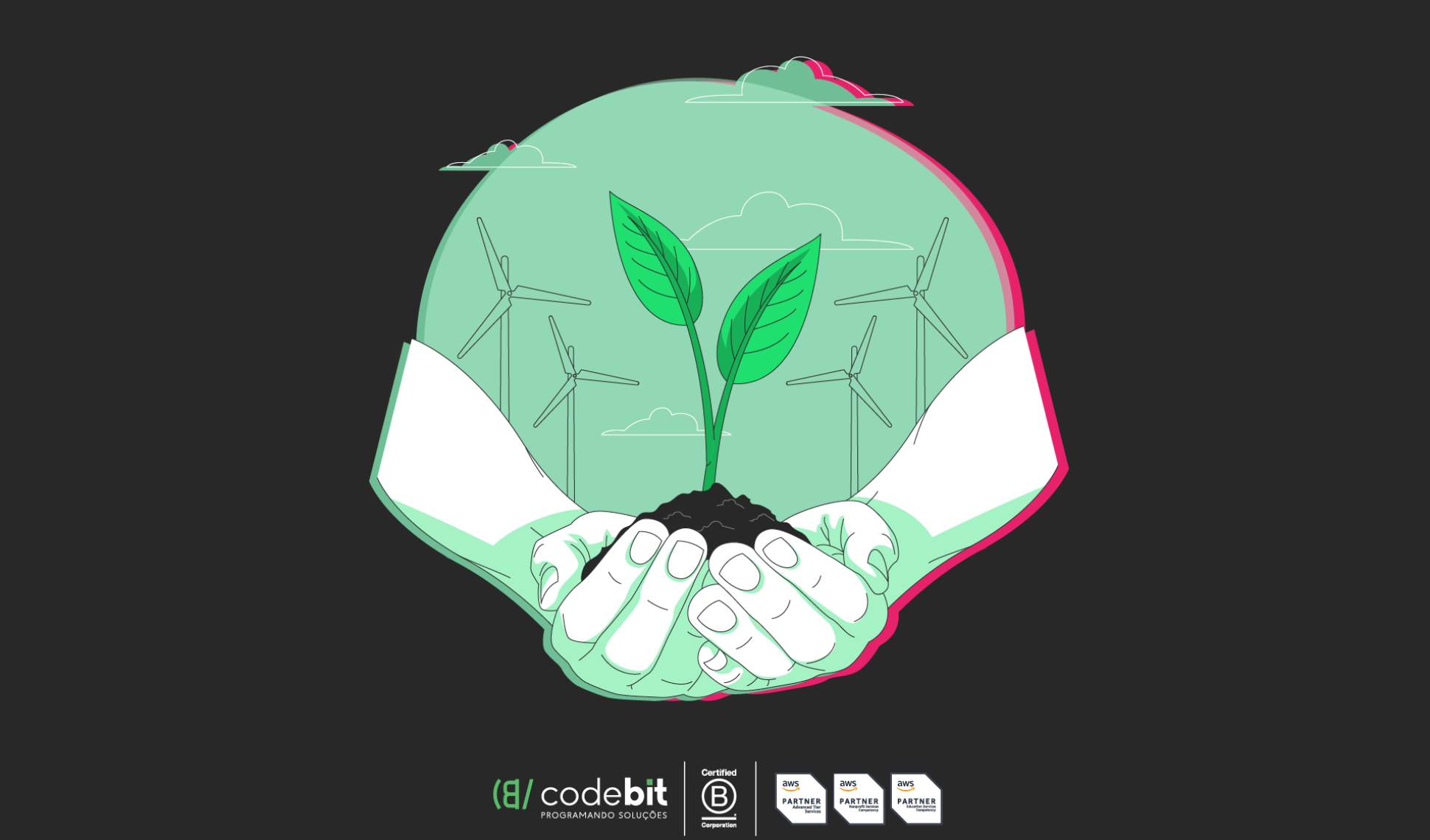
In addition to ensuring greater agility in processes, automating repetitive tasks, and boosting team productivity, some technological resources, when well applied, can contribute to sustainability, reduce costs, and even add value to business.
In today's blog post, we, the team at CodeBit, will present some ways to combine technological evolution with a sustainable mindset to maintain profitability, attract and retain new consumer profiles, who are increasingly concerned with environmental themes and discussions.
Come with us to discover the importance of sustainable technologies and some practical application examples.
Sustainable technologies: what are they?
In a few words, technologies that are sustainable are those that present disruptive digital solutions without causing impacts to the environment.
In the business context, they combine operational advantages with socio-environmental awareness practices, promoting considerable benefits to companies, such as:
►attracting and retaining consumers with the same values;
►reducing costs related to the use of paper and physical structures;
►reduction of waste;
►sustainability certifications that add value and competitiveness to the brand in the market.
When a company replaces paper printing with document digitization, for example, besides ensuring greater protection and security for sensitive information, it also makes file consultation faster and more efficient.
In the same way, cloud computing allows remote access to information, collaborating for the integration, connectivity, and productivity of the team, which becomes capable of operating and maintaining activities anywhere in the world, with just an internet connection, freeing itself from physical barriers.
Sustainable technologies: why adopt them?
The sustainable technologies involve, above all, a new approach for companies, since they encourage growth and development, not only corporate, but also environmental and social. By balancing these factors, it is possible to maintain, or even increase, profitability while also enabling a greener future for new generations, who will certainly be able to continue the cycle of sustainability.
According to a study conducted by Amcham and integrated into the Eco 2022 Award trend report, 87% of business leaders and managers stated that opting for sustainable alternatives, even with a higher investment, is an excellent strategy to promote the growing appreciation of brands.
The main types of sustainable technologies:
Solar energy
Solar energy corresponds to energy coming from light and heat emitted by the sun - an inexhaustible, renewable, clean, and abundant source that does not emit greenhouse gases and significantly reduces environmental impacts.
Regarding the Brazilian scenario, this is a smart choice for companies, after all, our naturally tropical country receives intense solar radiation most of the year.
Electronic Signature
Refers to a type of virtual signature which, unlike traditional ones, does not require the use of paper and pen, allowing managers and employees to sign documents in digital environments, with the same legal credibility as physical documents.
By being integrated with other systems, this solution facilitates and speeds up the completion of processes and deliveries of organizations.
Digital document management
Just like the digital signature, digital document management replaces physical archives and documents and reduces the use of paper with digital versions with the same legal validity, facilitating user query and freeing organizations from maintaining large servers or physical spaces for storing documentation.
Cloud computing
Cloud computing is a solution that allows access to computing resources, such as servers, storage, and services, over the internet. Instead of physically owning and managing these resources, companies can rent or use computing services in remote data centers, making the infrastructure more flexible, scalable, and accessible.
By not requiring the use of lots of proprietary equipment, cloud computing also ensures more sustainability to organizations, promoting savings in space, energy, less need for cooling systems, reduction in carbon dioxide emission, reduction of paper use, and much more.
From the moment the large servers are centralized and use the best technologies available in the market, it is possible to optimize resource consumption and, consequently, minimize the impacts caused to the planet.
Furthermore, when betting on cloud computing solutions, it is noticeable how failures in operations and system unavailability are reduced. This occurs due to the different types of protection and best practices that are applied to prevent these situations, such as electrical structures, network structures, and backups, which considerably reduce the chances of service interruption.
Did you enjoy learning more about how technology can positively impact environmental issues?
If you want to discover how technological advancements can contribute to the positioning and optimization of your company's processes, click here, access the CodeBit website, and check out all the customized solutions, prepared by a team of experts to meet your demand.
Furthermore, keep an eye on the CodeBlog. Soon, we will have many updates here.
Warm regards!




" width="15.500294250860316px"><path d="M 0 15.475 L 0 0 L 15.5 0 L 15.5 15.475 Z" fill="transparent" height="15.475099999999998px" id="tPiDQU_MP" width="15.5px"/><path d="M 3.167 1.589 C 3.847 0.724 4.607 0.171 5.61 0.046 C 6.532 -0.07 7.436 0.022 8.277 0.451 C 9.235 0.938 9.681 1.797 9.877 2.797 C 9.987 3.364 10.049 3.948 10.056 4.525 C 10.079 6.395 10.055 8.265 10.075 10.135 C 10.08 10.527 9.944 10.648 9.574 10.641 C 8.799 10.627 8.023 10.63 7.248 10.644 C 6.911 10.65 6.787 10.528 6.789 10.181 C 6.803 8.533 6.799 6.884 6.789 5.236 C 6.788 4.892 6.754 4.545 6.698 4.206 C 6.57 3.433 6.106 2.974 5.443 2.925 C 4.405 2.849 3.714 3.206 3.495 4.018 C 3.37 4.478 3.333 4.972 3.326 5.451 C 3.306 7.002 3.307 8.555 3.327 10.105 C 3.332 10.504 3.208 10.654 2.807 10.644 C 2.032 10.625 1.257 10.63 0.481 10.642 C 0.156 10.647 -0.001 10.546 0 10.193 C 0.007 7.035 0.006 3.876 0 0.718 C 0 0.391 0.104 0.24 0.458 0.249 C 1.219 0.269 1.981 0.267 2.743 0.252 C 3.068 0.245 3.197 0.361 3.17 0.688 C 3.148 0.948 3.166 1.211 3.166 1.589 Z" fill="rgb(245, 240, 237)" height="10.64451194394125px" id="Hw1mXDepj" transform="translate(5.425 4.831)" width="10.075487656011685px"/><path d="M 3.284 5.2 C 3.284 6.764 3.27 8.327 3.292 9.892 C 3.297 10.284 3.158 10.403 2.79 10.396 C 2.015 10.382 1.24 10.386 0.465 10.399 C 0.14 10.403 -0.001 10.305 0 9.947 C 0.012 6.792 0.012 3.637 0.002 0.481 C 0.001 0.123 0.105 -0.01 0.473 0.001 C 1.261 0.023 2.05 0.02 2.839 0.004 C 3.183 -0.003 3.294 0.124 3.29 0.467 C 3.276 2.044 3.284 3.623 3.284 5.2 Z" fill="rgb(245, 240, 237)" height="10.39869818980116px" id="sgvgyFXCr" transform="translate(0.237 5.076)" width="3.292113077251912px"/><path d="M 3.768 1.898 C 3.761 2.945 2.91 3.782 1.859 3.772 C 0.828 3.763 -0.012 2.892 0 1.842 C 0.012 0.824 0.864 -0.003 1.897 0 C 2.956 0.003 3.776 0.834 3.768 1.898 Z" fill="rgb(245, 240, 237)" height="3.772444228811899px" id="M8BOm1cI0" transform="translate(0 0)" width="3.768370362042166px"/></g></svg>)
" height="17px" id="G9twDfI1x" transform="translate(2 2)" width="17px"/></svg>)
" height="17px" id="q6YSjVL3w" transform="translate(6 2)" width="8.5px"/></svg>)
" height="12.720532384492868px" id="Jh_taQ7si" transform="translate(1 3.586)" width="18.00050025px"/></svg>)