Technology
5 tips to avoid cyberattacks in companies
5 tips to prevent cyberattacks in companies. Check it out in the article that the CodeBlog team has prepared for you.
02/14/2024


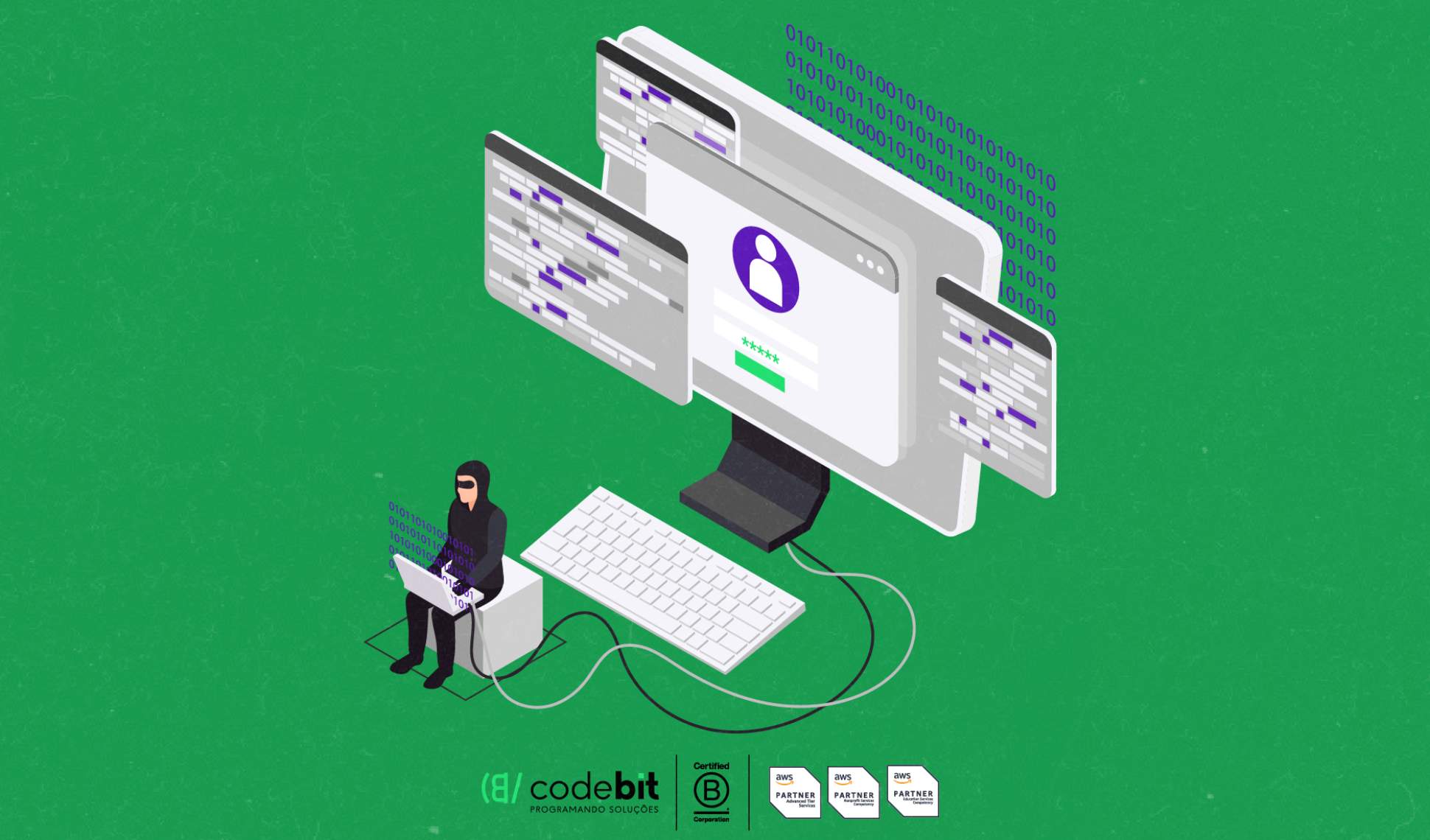
We live in an increasingly digitized era, and just like technological resources, cyber attacks are also evolving and becoming increasingly threatening.
For this reason, investing in online data security is a fundamental factor for any company.
According to research conducted by Lumu (a technological security company), small businesses have become frequent targets for cybercriminals.
This occurs mainly because large organizations are already adopting measures to prevent criminal actions, while most SMEs still present a limited level of cybersecurity.
In recent years, attackers have expanded their range of operations and prepared themselves to attack multiple targets at the same time, rather than running complex schemes to target only a single company.
The truth is that organizations of all sizes are in the crosshairs, but those that outline preventive actions are less likely to have their information leaked or lost.
For these and many other reasons, it is necessary to not only consider, but also prioritize, cybersecurity strategies for maintaining the reliability and scalability of your business.
To help you in this mission and show that it is possible to adopt preventive measures without the need for major efforts or investments, we have separated some simple tips for you to take the first steps towards more secure processes.
Go on with the reading and check it out in the blog post we prepared for you!
1. Awareness and training
The first step to preventing cyberattacks is to ensure effective awareness of a company's collaborative team. This is because many cyberattacks originate from social engineering techniques, where hackers exploit the naivety or lack of knowledge of employees.
Therefore, it is essential to propose continuous training and capacity-building to educate the team about safe practices for storage, downloads, browsing, recognizing fraudulent actions, and appropriate handling of sensitive information.
2. Updates and security patches
Keeping all systems, applications, and devices updated with the latest security patches is also an indispensable measure to prevent cyberattacks.
After all, many cybercriminals exploit system vulnerabilities that could have been fixed with software updates.
Make sure to implement effective patch management policies and ensure that all systems are updated regularly.
3. Strong passwords and multi-factor authentication
Weak passwords are an open door for cyber attackers.
Try to create strong and unique credentials, preferably with sequences of numbers, letters, and special characters.
Technology can help you in this mission. Currently, there are several applications and password managers that control passwords and assist in creating more secure passwords.
In addition, it is also worth resorting to multi-factor authentication, which adds an extra layer of security, requiring a second form of verification, such as a code sent via SMS or generated by an app, before granting access to accounts.
4. Implementation of Firewalls and Antivirus
Any company that depends on technological resources to maintain its operation needs antivirus software capable of protecting all equipment and devices from viruses, ransomware, phishing scams, spyware, endpoints, malware, and data leakage.
Furthermore, it is also important to configure firewalls to monitor and control incoming and outgoing network traffic, blocking suspicious activities.
It is worth remembering that these tools must also be updated regularly, so they can perform constant scans on all devices, detecting and removing malware.
5. Do not ignore backups
As obvious as this tip may seem, the truth is that many companies still do not perform periodic backups of files and increase the chances of losing all their data in cases of cyberattacks, compromising their reputation with customers and even the development of their activities.
To prevent this disaster from happening, invest in a backup program capable of automatically copying and storing files. Thus, in the event of an attack, your organization will be able to restore all files through the backups.
It is also recommended to choose a program that allows scheduling or automation of this process, to make everything more practical.
Do not forget to store backup copies offline so that they are not encrypted or rendered inaccessible if the system is targeted by cybercriminals.
Count on CodeBit!
Do you want access to customized services and solutions to ensure the security of your business? Count on the team of specialists at CodeBit! We work with international partners and use ultra-technological resources to guarantee total protection for your internal processes and ensure the reliability of all your operations.
Click here, access the website, and learn more!
Otherwise, keep an eye on the CodeBlog. Soon, we will have news here.
A big hug and until the next post!




" width="15.500294250860316px"><path d="M 0 15.475 L 0 0 L 15.5 0 L 15.5 15.475 Z" fill="transparent" height="15.475099999999998px" id="tPiDQU_MP" width="15.5px"/><path d="M 3.167 1.589 C 3.847 0.724 4.607 0.171 5.61 0.046 C 6.532 -0.07 7.436 0.022 8.277 0.451 C 9.235 0.938 9.681 1.797 9.877 2.797 C 9.987 3.364 10.049 3.948 10.056 4.525 C 10.079 6.395 10.055 8.265 10.075 10.135 C 10.08 10.527 9.944 10.648 9.574 10.641 C 8.799 10.627 8.023 10.63 7.248 10.644 C 6.911 10.65 6.787 10.528 6.789 10.181 C 6.803 8.533 6.799 6.884 6.789 5.236 C 6.788 4.892 6.754 4.545 6.698 4.206 C 6.57 3.433 6.106 2.974 5.443 2.925 C 4.405 2.849 3.714 3.206 3.495 4.018 C 3.37 4.478 3.333 4.972 3.326 5.451 C 3.306 7.002 3.307 8.555 3.327 10.105 C 3.332 10.504 3.208 10.654 2.807 10.644 C 2.032 10.625 1.257 10.63 0.481 10.642 C 0.156 10.647 -0.001 10.546 0 10.193 C 0.007 7.035 0.006 3.876 0 0.718 C 0 0.391 0.104 0.24 0.458 0.249 C 1.219 0.269 1.981 0.267 2.743 0.252 C 3.068 0.245 3.197 0.361 3.17 0.688 C 3.148 0.948 3.166 1.211 3.166 1.589 Z" fill="rgb(245, 240, 237)" height="10.64451194394125px" id="Hw1mXDepj" transform="translate(5.425 4.831)" width="10.075487656011685px"/><path d="M 3.284 5.2 C 3.284 6.764 3.27 8.327 3.292 9.892 C 3.297 10.284 3.158 10.403 2.79 10.396 C 2.015 10.382 1.24 10.386 0.465 10.399 C 0.14 10.403 -0.001 10.305 0 9.947 C 0.012 6.792 0.012 3.637 0.002 0.481 C 0.001 0.123 0.105 -0.01 0.473 0.001 C 1.261 0.023 2.05 0.02 2.839 0.004 C 3.183 -0.003 3.294 0.124 3.29 0.467 C 3.276 2.044 3.284 3.623 3.284 5.2 Z" fill="rgb(245, 240, 237)" height="10.39869818980116px" id="sgvgyFXCr" transform="translate(0.237 5.076)" width="3.292113077251912px"/><path d="M 3.768 1.898 C 3.761 2.945 2.91 3.782 1.859 3.772 C 0.828 3.763 -0.012 2.892 0 1.842 C 0.012 0.824 0.864 -0.003 1.897 0 C 2.956 0.003 3.776 0.834 3.768 1.898 Z" fill="rgb(245, 240, 237)" height="3.772444228811899px" id="M8BOm1cI0" transform="translate(0 0)" width="3.768370362042166px"/></g></svg>)
" height="17px" id="G9twDfI1x" transform="translate(2 2)" width="17px"/></svg>)
" height="17px" id="q6YSjVL3w" transform="translate(6 2)" width="8.5px"/></svg>)
" height="12.720532384492868px" id="Jh_taQ7si" transform="translate(1 3.586)" width="18.00050025px"/></svg>)