Technology
The Contribution of IaaS to Enterprise Infrastructure Management
The Contribution of IaaS to Enterprise Infrastructure Management
05/02/2024


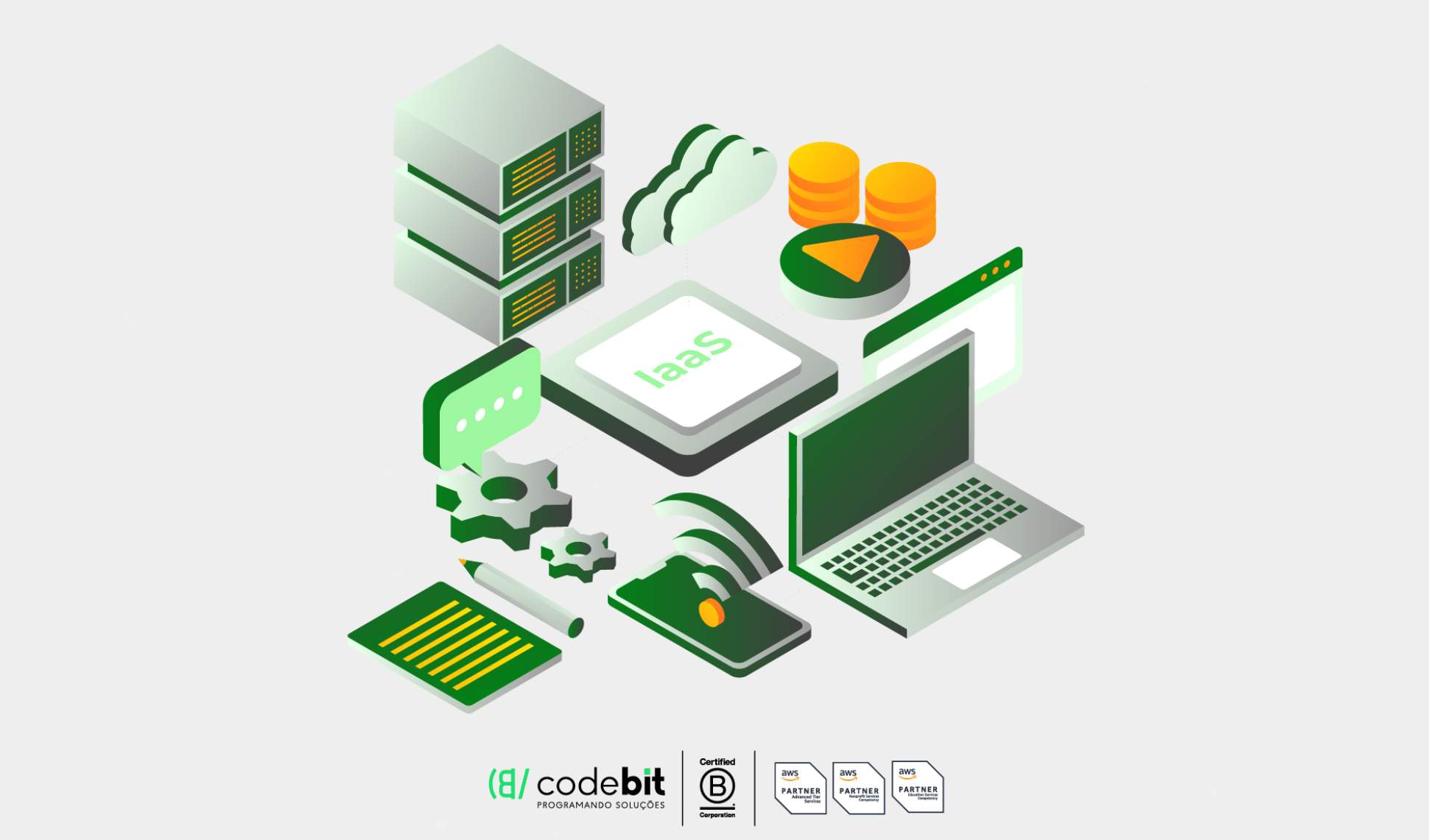
The Contribution of IaaS in Corporate Infrastructure Management
It is no secret that, over the last few decades, information technology has evolved astronomically and contributed to the expansion of digital transformation in the most diverse corporate areas.
In this scenario, one of the most significant trends is the adoption of IaaS (infrastructure as a service) solutions - a form of cloud computing that presents virtual resources such as servers, storage, and networks to users through an internet connection.
Want to discover how this technology has been transforming the way organizations manage their infrastructure and what the main advantages offered are? Then you are in the right place! Read on and check out the article that we, from the CodeBlog team, have prepared for you!
After all, what is IaaS?
IaaS is a resource available specifically on updated hardware, or, in other words, in computing infrastructure. In practice, it covers server space, network connections, bandwidth, IP addresses, and load balancers.
Infrastructure as a Service offers users the ability to provision processing, storage, and network connectivity according to their needs. From this service model, clients can use the resources to develop their own applications.
Compared to other hosting formats, IaaS can be used by companies wishing to implement scalable IT solutions, in which the expenses and difficulties implicit in hardware management are the full responsibility of the service provider.
Thus, if the company grows and needs to expand services, there is the possibility to explore cloud resources in a customized way, without the need to purchase, install, or integrate hardware in the physical environment.
In other words, the solution reduces costs and contributes to team productivity, as it does not require interrupting processes to be installed or updated.
IaaS: Main Advantages
Scalability and Elasticity
Before the arrival of cloud computing, businesses had to invest in physical servers to build their own infrastructure. Besides being limited in terms of storage, this equipment generates high costs for company coffers, with frequent maintenance and updates.
Now, with the availability of IaaS resources, a team can adjust storage capacity whenever necessary. As a result, members free themselves from waste, since they only need to pay for what they actually use, and the organization as a whole can adapt, with greater ease and elasticity, to market demands.
Agility in IT Processes
Another major advantage of IaaS in corporate infrastructure management is the increased agility in IT processes. This is because, unlike internal servers, which demand physical installations, hardware acquisitions, and complex configurations, cloud computing allows for the creation of new virtual machines and resource allocation in a practical and fast manner.
This solution significantly contributes to accelerating the development of new products and services, ensuring that the launch of projects occurs in an uncomplicated way.
Mobility
IaaS offers team members a mobile infrastructure, which allows them to operate systems at any time, anywhere, through any authorized device (computer, tablet, notebook).
That is, it is no longer necessary to be limited to the four walls of the office to share information or analyze reports.
Even away from the workplace, it is possible to gather professionals for meetings (via teleconference), enter data into management systems, and accelerate the decision-making process.
Furthermore, monitoring performance in the IT environment, as well as resource availability and operation development, also becomes more practical and effective.
Therefore, by counting on cloud-based solutions, leaders can operate remotely and monitor the technological performance of enterprises in different branches, business units, etc.
Savings
Unlike physical infrastructure, IaaS does not require investment in hardware.
After all, in these cases, the hardware that supports the IaaS service is deployed, maintained, and updated by the provider itself, which generates savings, not only in time but also in money.
Additionally, the investment in IT infrastructure to adopt the tool is considerably low compared to the operational costs of physical storage.
Expenses on printers, ink, and paper are also considerably reduced, as there is no need to print patient files, for example.
Information Security
Finally, a good IaaS provider, like AWS - made available by CodeBit, keeps corporate data 100% secure and works with internationally approved methods and tools, alongside a highly qualified team.
In practice, this solution, in addition to refining and modernizing the IT infrastructure, also follows and provides best practices to reinforce the protection of software and applications against potential intrusions by hackers and cybercriminals, thanks to the multiple security, governance, and compliance protection policies applied.
If, after checking all this information and understanding the transformation generated by cloud computing, you want to find ways to apply them in your company or institution to simplify and reduce bureaucracy in processes related to infrastructure management, get in touch with CodeBit's team of specialists and discover all the customized solutions available to meet your demand!
Furthermore, keep an eye on CodeBlog. Soon, we will have many updates here.
Warm regards, and see you in the next post.
post.




" width="15.500294250860316px"><path d="M 0 15.475 L 0 0 L 15.5 0 L 15.5 15.475 Z" fill="transparent" height="15.475099999999998px" id="tPiDQU_MP" width="15.5px"/><path d="M 3.167 1.589 C 3.847 0.724 4.607 0.171 5.61 0.046 C 6.532 -0.07 7.436 0.022 8.277 0.451 C 9.235 0.938 9.681 1.797 9.877 2.797 C 9.987 3.364 10.049 3.948 10.056 4.525 C 10.079 6.395 10.055 8.265 10.075 10.135 C 10.08 10.527 9.944 10.648 9.574 10.641 C 8.799 10.627 8.023 10.63 7.248 10.644 C 6.911 10.65 6.787 10.528 6.789 10.181 C 6.803 8.533 6.799 6.884 6.789 5.236 C 6.788 4.892 6.754 4.545 6.698 4.206 C 6.57 3.433 6.106 2.974 5.443 2.925 C 4.405 2.849 3.714 3.206 3.495 4.018 C 3.37 4.478 3.333 4.972 3.326 5.451 C 3.306 7.002 3.307 8.555 3.327 10.105 C 3.332 10.504 3.208 10.654 2.807 10.644 C 2.032 10.625 1.257 10.63 0.481 10.642 C 0.156 10.647 -0.001 10.546 0 10.193 C 0.007 7.035 0.006 3.876 0 0.718 C 0 0.391 0.104 0.24 0.458 0.249 C 1.219 0.269 1.981 0.267 2.743 0.252 C 3.068 0.245 3.197 0.361 3.17 0.688 C 3.148 0.948 3.166 1.211 3.166 1.589 Z" fill="rgb(245, 240, 237)" height="10.64451194394125px" id="Hw1mXDepj" transform="translate(5.425 4.831)" width="10.075487656011685px"/><path d="M 3.284 5.2 C 3.284 6.764 3.27 8.327 3.292 9.892 C 3.297 10.284 3.158 10.403 2.79 10.396 C 2.015 10.382 1.24 10.386 0.465 10.399 C 0.14 10.403 -0.001 10.305 0 9.947 C 0.012 6.792 0.012 3.637 0.002 0.481 C 0.001 0.123 0.105 -0.01 0.473 0.001 C 1.261 0.023 2.05 0.02 2.839 0.004 C 3.183 -0.003 3.294 0.124 3.29 0.467 C 3.276 2.044 3.284 3.623 3.284 5.2 Z" fill="rgb(245, 240, 237)" height="10.39869818980116px" id="sgvgyFXCr" transform="translate(0.237 5.076)" width="3.292113077251912px"/><path d="M 3.768 1.898 C 3.761 2.945 2.91 3.782 1.859 3.772 C 0.828 3.763 -0.012 2.892 0 1.842 C 0.012 0.824 0.864 -0.003 1.897 0 C 2.956 0.003 3.776 0.834 3.768 1.898 Z" fill="rgb(245, 240, 237)" height="3.772444228811899px" id="M8BOm1cI0" transform="translate(0 0)" width="3.768370362042166px"/></g></svg>)
" height="17px" id="G9twDfI1x" transform="translate(2 2)" width="17px"/></svg>)
" height="17px" id="q6YSjVL3w" transform="translate(6 2)" width="8.5px"/></svg>)
" height="12.720532384492868px" id="Jh_taQ7si" transform="translate(1 3.586)" width="18.00050025px"/></svg>)