Technology
Data Lake: what is it and what are the advantages?
Data Lake: what is it and what are the advantages? Discover in the article that the CodeBlog team has prepared for you.
06/03/2024


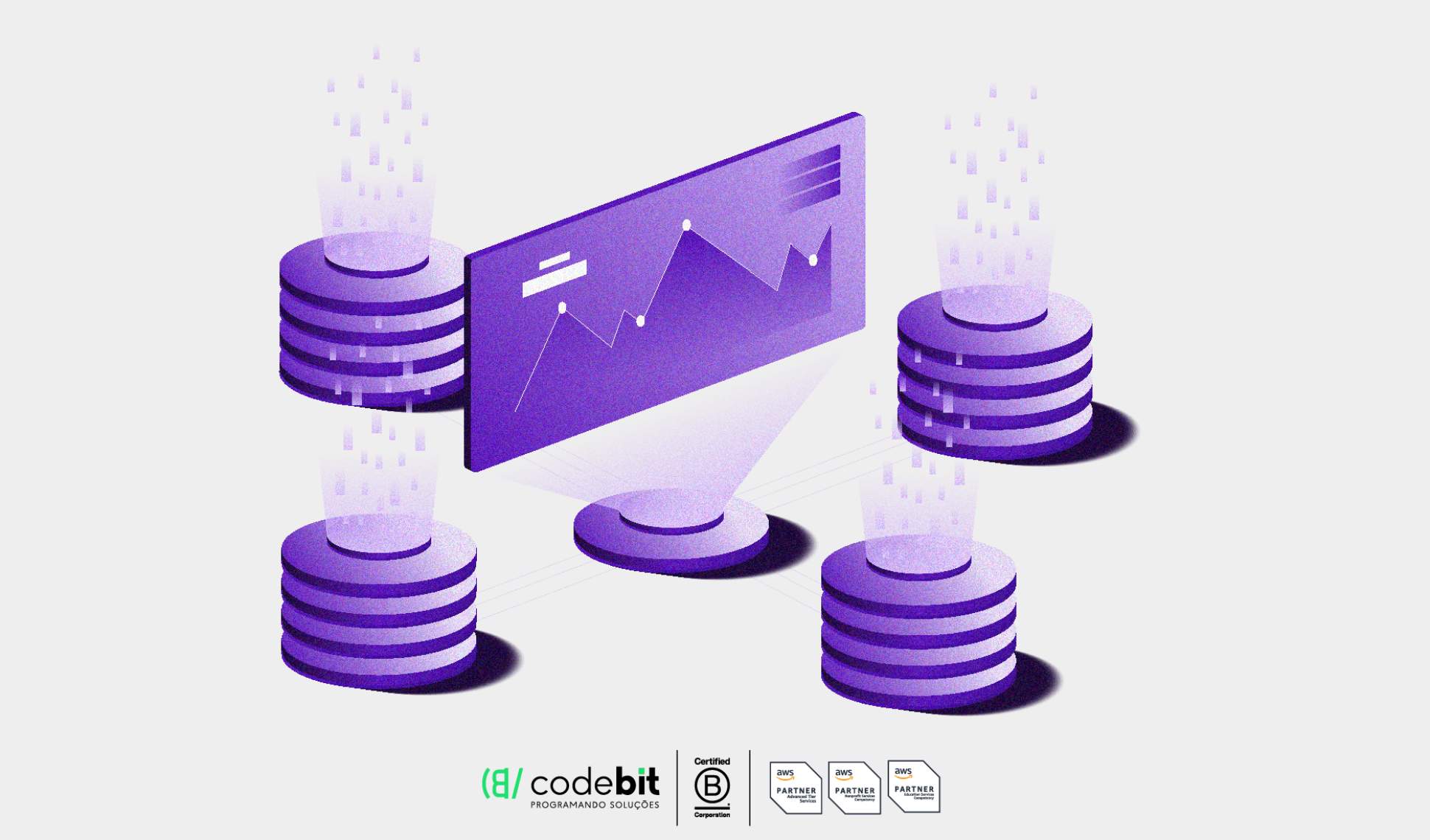
It is not, exactly, a novelty how much relevance data has in business processes. After all, they allow strategic decision-making, identification of trends, anticipation of changes in the market, and analysis of growth opportunities.
Furthermore, data also helps organizations understand their customers better, personalizing products and services to meet their demands and needs.
Proof of this was a study conducted by the Cappra Institute in 2021, which found that Brazilian companies store, on average, 10 petabytes of data, and even projected a growth of 175% over the next five years.
The numbers reinforce how important the use of advanced methodologies is, both for data collection and analysis.
Faced with this reality, the so-called Data Lake emerges as a great solution to add more efficiency, assertiveness, and, consequently, competitiveness to companies in an increasingly fierce market.
Do you want to know more about the Data Lake and how it can benefit your business? Then, you are in the right place!
Keep reading and check out the article that we, from the CodeBlog team, have prepared for you.
After all, what is a Data Lake?
The term "Data Lake" might sound strange at first glance, but it makes perfect sense when we understand its analogy to a "lake of data".
This is because, just as water in a lake flows freely in its raw state, in a Data Lake, data is stored without any prior treatment.
In practice, the concept acts as a space with a large storage capacity. Within this environment, information is inserted into a repository without any type of prior treatment.
This process starts right at the moment the data is stored, and subsequently, it is subjected to the necessary treatments and then used in research, if necessary.
Generally speaking, Data Lakes are recognized as next-generation hybrid data management solutions, capable of meeting the challenging scenario that encompasses data, promoting new levels of real-time analysis.
How does it work?
A Data Lake acts as a large repository of information in real-time; thus, it is essential for dealing with the complexities of Big Data, for example.
The solution allows for the storage of a large set of information from various sources, such as solutions based on IoT (Internet of Things), sensors, interaction records on web pages and social networks, JSON objects, streaming data, and much more.
It is important to highlight that the Data Lake is more of a concept than a technology. After all, the ingestion and processing of data are only performed if additional technologies are used.
Data Lake vs Data Warehouse: what is the difference?
The Data Lake, just like the Data Warehouse, is a tool used for data storage, but, believe it or not, the similarities between the concepts end there.
This is because while the Data Warehouse is dedicated to already treated and standardized information, with the purpose of delivering a "clean" view of the data, the Data Lake stores information in its raw state.
To make it easier to understand, think of the Data Warehouse as a bottle of water, ready for consumption in a practical way, and the Data Lake as a lake, which holds a quantity of the liquid in its natural format and is replenished by various sources.
It is important to outline that the objectives as well as the functionalities of the solutions are distinct. Faced with this fact, it is up to organizations to analyze their needs, measure the amount of data that will be used in the future, and only then decide which is the best option to meet their demands.
What are the advantages of the Data Lake?
Now that you have understood what a Data Lake is and how it works, it is time to discover the main benefits that this intuitive and highly integrative concept can bring to your business.
Cost reduction
Due to its simple structure, which does not demand prior data treatment or constant maintenance to ensure operation, the Data Lake has lower costs than the Data Warehouse, for example.
In other words, by adopting the concept, in addition to ensuring more efficiency, organizations can eliminate major investments in developing routines.
Furthermore, implementation-related costs are significantly reduced when cloud servers are used, as they operate with their own infrastructure and simplify the overall use of the solution.
Scalability
Regarding scalability, the Data Lake also presents great advantages compared to other models. After all, because it dispenses with prior data treatment, it can scale to even higher levels in real-time.
Another advantage is that, if cloud computing solutions are applied together, this expansion can happen even faster, merely requiring the acquisition of more disk space.
In practice, the result of this integration generates a more optimized search for insights, which, according to the amount of data inserted into the system, favors a more agile and deeper analysis of the business demands, pain points, needs, and strategies.
Compatibility
Considering that, in a Data Lake, data is made available in the same way it is received, it is certain that it must be usable and manipulable by any other tool.
This ease of integration allows corporate teams to meet various types of demands simultaneously through the same Data Lake.
In other words, data analysis professionals who need to generate reports gain more agility and productivity, regardless of the depth of the study.
Agility
Taking into account that, in a Data Lake, data does not need to go through any type of prior processing, it is a fact that the information is included in the database faster, practically in the same period it is generated.
Thus, professionals can prioritize tasks and execute their work in an optimized way, without having their activities interrupted during processing.
Integration
The use of the Data Lake contributes to collaborative teamwork. Due to the simplicity it presents, this solution allows access and use of the tool to occur even without the presence of the IT team in the company.
That is, professionals from different sectors such as finance, maintenance, commercial, and human resources can count on all the resources of the solution without difficulties.
Why implement a Data Lake in the Cloud?
The Data Lake is an ideal workload to be deployed in the cloud, as the cloud environment is known for its high performance capacity, scalability, reliability, availability, in addition to presenting a diverse set of analytical engines and promoting considerable cost reduction for businesses.
For this reason, by implementing a data lake in the cloud, it is possible to experience greater security, faster deployment time, better availability, more frequent feature/functionality updates, more elasticity, more geographical coverage, and costs linked to actual usage.
How do AWS services, provided by CodeBit, assist in the implementation, maintenance, and modernization of the Data Lake?
Response agility:
The AWS Data Lake allows you to get fast answers from all data, for all users.
Ease of creation:
AWS provides a simple way to build Data Lakes and perform all necessary analyses.
Automation:
With AWS Lake Formation, it is much easier to automate manual tasks, reducing the time needed to build a successful Data Lake.
Scalability and economy:
AWS provides scalable and cost-effective tools to store and analyze large volumes of data.
Open compatibility:
AWS supports open file formats, such as Apache Parquet, allowing you to store data in a standard format and analyze it with various tools and techniques.
In short, dear reader, if after checking out all the benefits of Data Lake modernization, you decided to take your company to the future, click here and learn more about all the solutions developed by the team of experts at CodeBit. Our group is highly qualified and fully supports the migration process, assisting with training, qualification, doubts about AWS products, architecture, and even the study of migration to the AWS cloud.
For the rest, keep an eye on CodeBlog. Soon, we will have news here.
A big hug and see you in the next post!




" width="15.500294250860316px"><path d="M 0 15.475 L 0 0 L 15.5 0 L 15.5 15.475 Z" fill="transparent" height="15.475099999999998px" id="tPiDQU_MP" width="15.5px"/><path d="M 3.167 1.589 C 3.847 0.724 4.607 0.171 5.61 0.046 C 6.532 -0.07 7.436 0.022 8.277 0.451 C 9.235 0.938 9.681 1.797 9.877 2.797 C 9.987 3.364 10.049 3.948 10.056 4.525 C 10.079 6.395 10.055 8.265 10.075 10.135 C 10.08 10.527 9.944 10.648 9.574 10.641 C 8.799 10.627 8.023 10.63 7.248 10.644 C 6.911 10.65 6.787 10.528 6.789 10.181 C 6.803 8.533 6.799 6.884 6.789 5.236 C 6.788 4.892 6.754 4.545 6.698 4.206 C 6.57 3.433 6.106 2.974 5.443 2.925 C 4.405 2.849 3.714 3.206 3.495 4.018 C 3.37 4.478 3.333 4.972 3.326 5.451 C 3.306 7.002 3.307 8.555 3.327 10.105 C 3.332 10.504 3.208 10.654 2.807 10.644 C 2.032 10.625 1.257 10.63 0.481 10.642 C 0.156 10.647 -0.001 10.546 0 10.193 C 0.007 7.035 0.006 3.876 0 0.718 C 0 0.391 0.104 0.24 0.458 0.249 C 1.219 0.269 1.981 0.267 2.743 0.252 C 3.068 0.245 3.197 0.361 3.17 0.688 C 3.148 0.948 3.166 1.211 3.166 1.589 Z" fill="rgb(245, 240, 237)" height="10.64451194394125px" id="Hw1mXDepj" transform="translate(5.425 4.831)" width="10.075487656011685px"/><path d="M 3.284 5.2 C 3.284 6.764 3.27 8.327 3.292 9.892 C 3.297 10.284 3.158 10.403 2.79 10.396 C 2.015 10.382 1.24 10.386 0.465 10.399 C 0.14 10.403 -0.001 10.305 0 9.947 C 0.012 6.792 0.012 3.637 0.002 0.481 C 0.001 0.123 0.105 -0.01 0.473 0.001 C 1.261 0.023 2.05 0.02 2.839 0.004 C 3.183 -0.003 3.294 0.124 3.29 0.467 C 3.276 2.044 3.284 3.623 3.284 5.2 Z" fill="rgb(245, 240, 237)" height="10.39869818980116px" id="sgvgyFXCr" transform="translate(0.237 5.076)" width="3.292113077251912px"/><path d="M 3.768 1.898 C 3.761 2.945 2.91 3.782 1.859 3.772 C 0.828 3.763 -0.012 2.892 0 1.842 C 0.012 0.824 0.864 -0.003 1.897 0 C 2.956 0.003 3.776 0.834 3.768 1.898 Z" fill="rgb(245, 240, 237)" height="3.772444228811899px" id="M8BOm1cI0" transform="translate(0 0)" width="3.768370362042166px"/></g></svg>)
" height="17px" id="G9twDfI1x" transform="translate(2 2)" width="17px"/></svg>)
" height="17px" id="q6YSjVL3w" transform="translate(6 2)" width="8.5px"/></svg>)
" height="12.720532384492868px" id="Jh_taQ7si" transform="translate(1 3.586)" width="18.00050025px"/></svg>)