Technology
Multi-Cloud: how to make it more secure?
Multi-Cloud: how to make it more secure? Discover in the article that the CodeBlog team has prepared for you.
02/19/2024


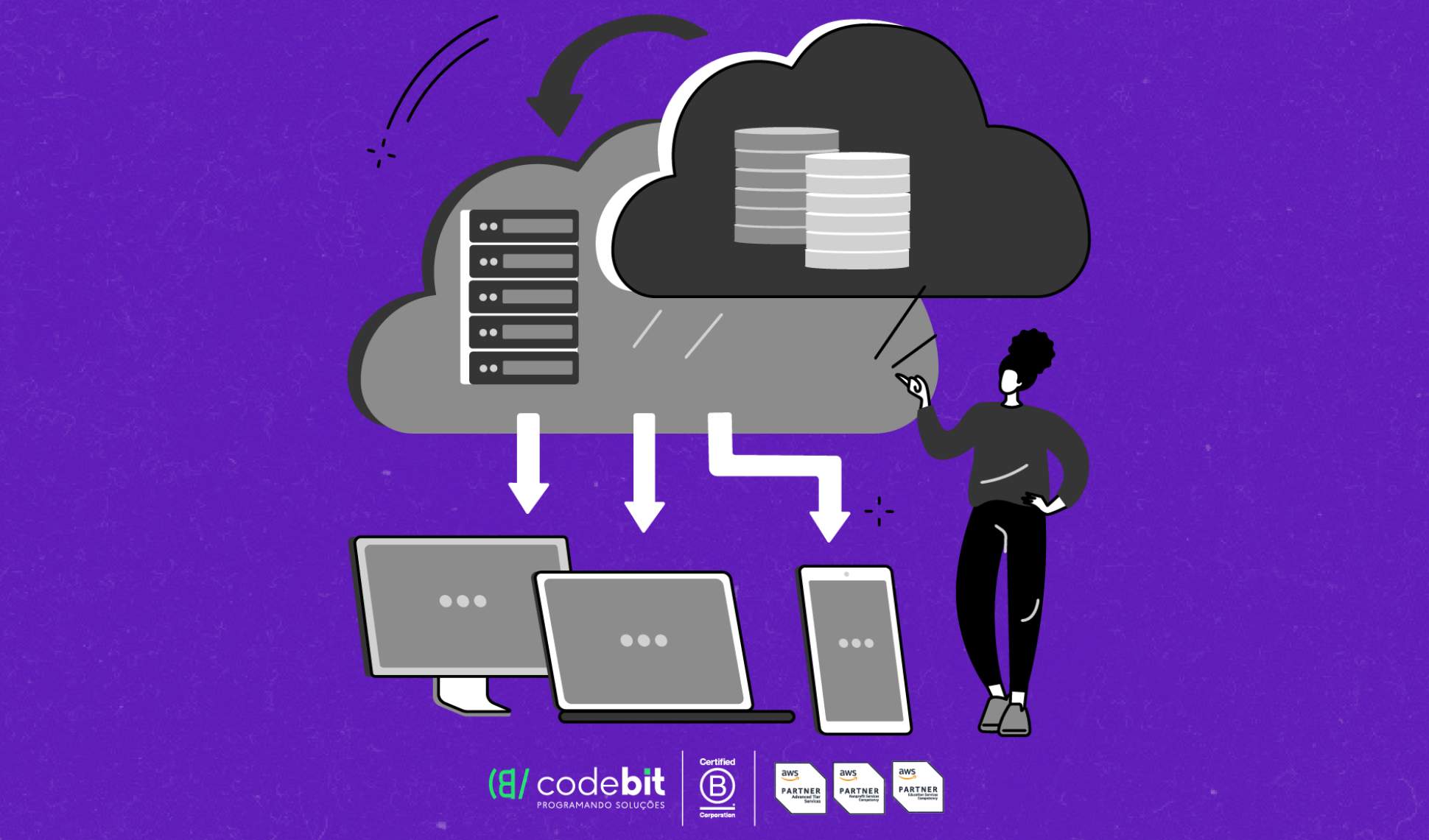
As cloud computing has gained more adoption and popularity, new solutions related to the storage model have emerged to optimize business processes and ensure even greater flexibility, such as the so-called multi cloud - a smart strategy for organizations looking to maximize the benefits provided by cloud computing.
Instead of relying exclusively on a single cloud service provider, with multi-cloud, businesses can use multiple providers to meet their specific needs.
In practice, in addition to ensuring greater flexibility, agility, and efficiency, the tool also helps mitgate the risks associated with dependency on a single provider.
After all, by distributing workloads and applications across different cloud environments, organizations can optimize data access and storage, keeping operations running effectively, even in remote environments.
However, even with so many advantages, many managers still worry about the issue of data security in multi-cloud environments.
With this in mind, in today's blog post, we, the team at CodeBlog, have prepared some tips to maintain protection across multiple environments with the same practicality and effectiveness as using just a single system.
Come check it out with us!
Multi cloud: what are the main vulnerabilities?
The multi cloud is, above all, a combination of private, public, and hybrid clouds operating through multiple cloud providers.
Below, we have listed the main specifications of each of them:
Private cloud
Ideal for meeting the needs of a single business, the private cloud has fully customizable resources, architecture, and maintenance.
In this format, all hardware and software are kept on a private network and fully directed to the demands and needs of the contracting company.
Public cloud
The public cloud, on the other hand, is hosted in a virtual environment, which is shared with other users. Seen as the most popular model on the market, it integrates a simple yet highly functional solution.
Unlike the private cloud, the public cloud does not integrate hardware or infrastructure developed exclusively for a business, so its resources cannot be customized.
Hybrid cloud
As the name suggests, the hybrid cloud is the combination of public and private clouds, and its mission is to extract the best of both models to meet all the company's needs.
In practice, the hybrid cloud operates with exclusive servers to ensure the storage of the most sensitive, confidential, or important data. On the other hand, it also features some shared software to store less sensitive information.
As is it a practical, fast, and highly cost-effective option, many organizations have been betting on the public cloud, which stores data in environments shared with other users.
But, contrary to what many people believe, the public cloud also has several security layers and measures to ensure the protection of all stored information, files, and systems.
However, it is necessary to consider that, as this model stores data together with that of thousands of other users, sometimes a small security flaw is enough to allow unauthorized people access to the information.
Among the main vulnerabilities of the public cloud are:
- unauthorized access;
- insecure interfaces;
- improper configuration;
- hijacking (or account hijacking).
How to prevent it?
First of all, it is important to mention that both the protection of a public cloud and that of multi-cloud environments is a shared responsibility between the service provider and the users who utilize the servers.
Therefore, it is necessary to implement some measures to ensure the effective security of stored data.
Although antivirus and antimalware protection are necessary, the truth is that they are no longer enough to keep operations completely secure. In view of this fact, it is essential that organizations implement internal marketing campaigns aimed at raising awareness and training employees on their responsibilities and roles in shared environments.
This is an excellent way, not only to educate professionals about digital best practices, but also to effectively and continuously ensure that all equipment is properly configured and protected against most attacks.
Directing efforts to frequently analyze the applied security features, platforms, software, access permissions, and using tools such as password managers and encryption, in addition to preventing potential breaches, also assists in monitoring processes occurring in the cloud.
By applying these measures (for both cloud environments and on-premise infrastructure), organizations can implement aligned and efficient security strategies, experiencing greater digitization while strengthening process protection.
How to ensure greater security in multi-cloud environments?
1. Take care of applications:
To ensure the protection of multi cloud, organizations must give due importance to the security of applications kept in the environment. To do this, it is necessary to adopt measures to ensure that the codes do not present flaws or bugs and that all used apps work properly, without presenting any type of vulnerability.
In addition, to keep data protected, it is necessary to implement appropriate masking and hiding strategies, such as tokenization, encryption, among others.
2. Intensify protection
When it comes to multi-cloud, one thing is certain: prevention is always better than cure.
Therefore, to reduce the risks of human errors or failures, it should be kept in mind that no protection strategy is an exaggeration.
The first step to ensure the necessary security is to apply access restrictions.
The best alternative for this is to create a registration for employees who use the cloud environment.
In addition, it is important to adopt monitoring tools to track which users have permission to view, edit, and store files and to check if all connected devices are properly secure.
It is also necessary to create different passwords for each user and, preferably, ones that can be changed from time to time. Finally, it is also necessary to be attentive to the organization's turnover rate. Whenever any employee leaves the company, their login should be deleted immediately to prevent external access or intrusion attempts.
3. Choose the best tools:
Choosing the best tools and technology to create a customized cloud computing solution is definitely not a simple task. After all, there are countless variations of security applications that are incorporated into different types of clouds.
To facilitate this mission, observe the providers and check if they feature resources such as:
- authentication;
- authorization;
- credential mapping;
- encryption;
- malware detection and prevention;
- alerts;
- log;
- authorization;
- device profile.
These are several components that must be considered individually, always taking into account the complexity of each environment.
If you intend to adapt your company to a cloud computing environment with reliability and safety, you can count on CodeBit.
Our team of specialists offers, together with AWS (Amazon Web Services), several solutions that guarantee the support your institution needs throughout the entire journey, from understanding the technological maturity level to implementing cloud environments with high efficiency and low operational cost.
Click here, access the website, and check out all the services offered to support and assist educational institutions in the processes of implementation and maintenance of the cloud model.
On a final note, keep an eye on CodeBlog. Soon, we will have code news here.
Warm regards, and see you in the next post.



" width="15.500294250860316px"><path d="M 0 15.475 L 0 0 L 15.5 0 L 15.5 15.475 Z" fill="transparent" height="15.475099999999998px" id="tPiDQU_MP" width="15.5px"/><path d="M 3.167 1.589 C 3.847 0.724 4.607 0.171 5.61 0.046 C 6.532 -0.07 7.436 0.022 8.277 0.451 C 9.235 0.938 9.681 1.797 9.877 2.797 C 9.987 3.364 10.049 3.948 10.056 4.525 C 10.079 6.395 10.055 8.265 10.075 10.135 C 10.08 10.527 9.944 10.648 9.574 10.641 C 8.799 10.627 8.023 10.63 7.248 10.644 C 6.911 10.65 6.787 10.528 6.789 10.181 C 6.803 8.533 6.799 6.884 6.789 5.236 C 6.788 4.892 6.754 4.545 6.698 4.206 C 6.57 3.433 6.106 2.974 5.443 2.925 C 4.405 2.849 3.714 3.206 3.495 4.018 C 3.37 4.478 3.333 4.972 3.326 5.451 C 3.306 7.002 3.307 8.555 3.327 10.105 C 3.332 10.504 3.208 10.654 2.807 10.644 C 2.032 10.625 1.257 10.63 0.481 10.642 C 0.156 10.647 -0.001 10.546 0 10.193 C 0.007 7.035 0.006 3.876 0 0.718 C 0 0.391 0.104 0.24 0.458 0.249 C 1.219 0.269 1.981 0.267 2.743 0.252 C 3.068 0.245 3.197 0.361 3.17 0.688 C 3.148 0.948 3.166 1.211 3.166 1.589 Z" fill="rgb(245, 240, 237)" height="10.64451194394125px" id="Hw1mXDepj" transform="translate(5.425 4.831)" width="10.075487656011685px"/><path d="M 3.284 5.2 C 3.284 6.764 3.27 8.327 3.292 9.892 C 3.297 10.284 3.158 10.403 2.79 10.396 C 2.015 10.382 1.24 10.386 0.465 10.399 C 0.14 10.403 -0.001 10.305 0 9.947 C 0.012 6.792 0.012 3.637 0.002 0.481 C 0.001 0.123 0.105 -0.01 0.473 0.001 C 1.261 0.023 2.05 0.02 2.839 0.004 C 3.183 -0.003 3.294 0.124 3.29 0.467 C 3.276 2.044 3.284 3.623 3.284 5.2 Z" fill="rgb(245, 240, 237)" height="10.39869818980116px" id="sgvgyFXCr" transform="translate(0.237 5.076)" width="3.292113077251912px"/><path d="M 3.768 1.898 C 3.761 2.945 2.91 3.782 1.859 3.772 C 0.828 3.763 -0.012 2.892 0 1.842 C 0.012 0.824 0.864 -0.003 1.897 0 C 2.956 0.003 3.776 0.834 3.768 1.898 Z" fill="rgb(245, 240, 237)" height="3.772444228811899px" id="M8BOm1cI0" transform="translate(0 0)" width="3.768370362042166px"/></g></svg>)
" height="17px" id="G9twDfI1x" transform="translate(2 2)" width="17px"/></svg>)
" height="17px" id="q6YSjVL3w" transform="translate(6 2)" width="8.5px"/></svg>)
" height="12.720532384492868px" id="Jh_taQ7si" transform="translate(1 3.586)" width="18.00050025px"/></svg>)