Education
Technology in education: 6 trends for schools
Technology in education. Check out 6 trends for schools in this article by Codeblog.
03/14/2022


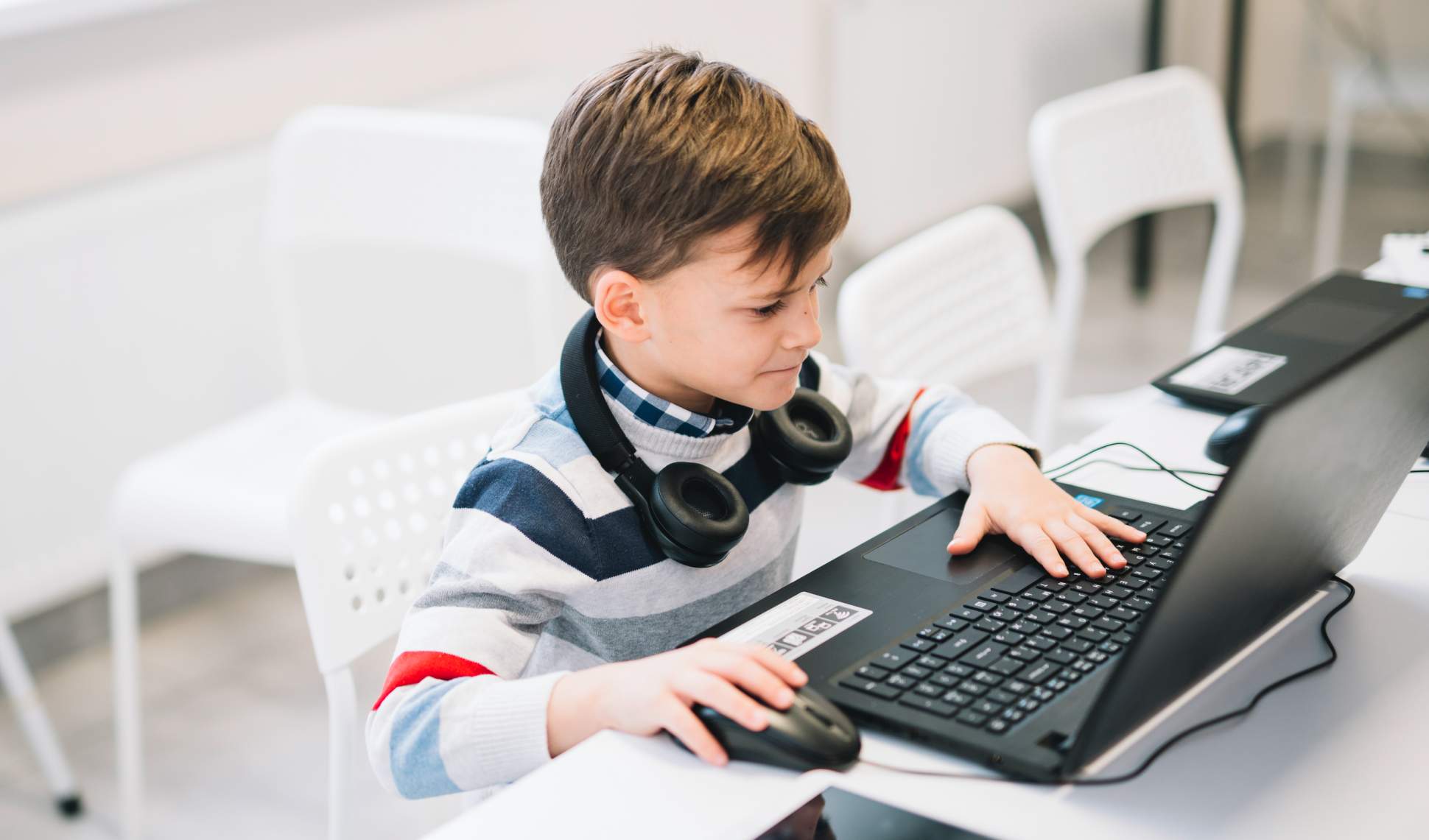
If there were still doubts that technology would completely change the educational context, the pandemic scenario contributed to finally making them extinct. After all, it is a fact that social isolation accelerated the digital transformation in the most varied spheres of society.
Remote teaching, for example, proved to be a viable alternative during the period and made it possible to maintain student learning. Together, the application of technological resources became essential for the continuity and improvement of students' experiences in educational processes, both in the classroom and at a distance.
Thinking about this, in today's article, we, from the team of CodeBit's blog, have listed 6 trends that promise to be present in schools in 2022.
Continue reading and check them out:
1. The metaverse in education
Viewed as a digital universe that enables real-world activities such as meeting friends, going to the mall and much more, the metaverse is a technology that aims to bring users closer to reality through sensory gloves, glasses and other tools.
In schools, the metaverse tends to enable the creation of environments and even cities that can be shared among students as a parallel reality, thus motivating an increase in student interest and engagement in the classroom.
Furthermore, it is important to point out that this solution shortens distances and promotes remote access to people, places, and educational institutions anywhere in the world.
2. CryptoArt
CryptoArt is nothing more than limited-edition collectible digital art, cryptographically registered as an NFT - Non-Fungible Token.
In other words, it is a kind of seal, which makes it impossible for an artistic work to be reproduced by other people and ensures its authenticity, in the same way as occurs with physical works presented in renowned museums and galleries.
The expansion of CryptoArt has led numerous artists to produce content with NFTs.
Thus, when acquiring digital art, the person is guaranteed that they are buying a properly authenticated file.
Although CryptoArt still has a subtle presence on the Brazilian scene, everything indicates that the solution will soon be able to revolutionize art classes.
3. Programming and robotics
Increasingly present in educational technologies, programming and robotics appear as ways to stimulate students' logical reasoning ability. Additionally, they also help students solve problems in a more dynamic and interactive way.
Together, these tools provoke greater scientific curiosity in students in subjects such as physics, mathematics, engineering, etc.
4. Augmented reality
Also known by the acronym AR, Augmented Reality integrates technology that enables interaction between the physical and virtual worlds through a device.
Although it is still taking slow steps in Brazil, AR has been showing itself increasingly strong in schools worldwide, allowing educators to optimize students' learning levels with greater interactivity and engagement in the classroom.
In a history class, for example, where the teacher presents the pyramids of Ancient Egypt, in addition to illustrating the content with photos and videos, by resorting to AR, they will allow students to point their phone cameras at the textbook and visualize the monuments in front of them, as if they were on an in-person visit.
5. Social networks
Very popular in Brazilian daily life, social networks can also be great drivers of learning.
After all, through them, students can easily access content suggested by teachers, in addition to participating in groups, forums and specific communities about a certain subject or proposed theme.
Within a virtual environment fully geared towards socialization, teachers are able to promote new teaching methodologies and transform the dynamics of tests and performance assessments, through different educational channels and content.
6. Chatbots
Very present in e-commerces and sales-oriented apps, chatbots are also good solutions to stimulate learning, since they are actually software developed specifically to enable digitized interaction, whether through text or voice messages.
In the educational context, chatbots are very useful for facilitating distance learning and helping teachers and students in the learning process.
Another major advantage is that this technology can be easily implemented in students' daily lives and used to clarify doubts, send and correct homework, etc.
Conclusion
We hope you enjoyed discovering the 6 trends that promise to be present in schools. Some very soon, others in a more distant future, but all extremely important to simplify learning and optimize the absorption of the contents proposed in the classroom.
If this article was interesting to you, keep an eye on the CodeBlog and check out all the posts related to technology, the startup market, innovation, and education.
Best regards, and see you soon.




" width="15.500294250860316px"><path d="M 0 15.475 L 0 0 L 15.5 0 L 15.5 15.475 Z" fill="transparent" height="15.475099999999998px" id="tPiDQU_MP" width="15.5px"/><path d="M 3.167 1.589 C 3.847 0.724 4.607 0.171 5.61 0.046 C 6.532 -0.07 7.436 0.022 8.277 0.451 C 9.235 0.938 9.681 1.797 9.877 2.797 C 9.987 3.364 10.049 3.948 10.056 4.525 C 10.079 6.395 10.055 8.265 10.075 10.135 C 10.08 10.527 9.944 10.648 9.574 10.641 C 8.799 10.627 8.023 10.63 7.248 10.644 C 6.911 10.65 6.787 10.528 6.789 10.181 C 6.803 8.533 6.799 6.884 6.789 5.236 C 6.788 4.892 6.754 4.545 6.698 4.206 C 6.57 3.433 6.106 2.974 5.443 2.925 C 4.405 2.849 3.714 3.206 3.495 4.018 C 3.37 4.478 3.333 4.972 3.326 5.451 C 3.306 7.002 3.307 8.555 3.327 10.105 C 3.332 10.504 3.208 10.654 2.807 10.644 C 2.032 10.625 1.257 10.63 0.481 10.642 C 0.156 10.647 -0.001 10.546 0 10.193 C 0.007 7.035 0.006 3.876 0 0.718 C 0 0.391 0.104 0.24 0.458 0.249 C 1.219 0.269 1.981 0.267 2.743 0.252 C 3.068 0.245 3.197 0.361 3.17 0.688 C 3.148 0.948 3.166 1.211 3.166 1.589 Z" fill="rgb(245, 240, 237)" height="10.64451194394125px" id="Hw1mXDepj" transform="translate(5.425 4.831)" width="10.075487656011685px"/><path d="M 3.284 5.2 C 3.284 6.764 3.27 8.327 3.292 9.892 C 3.297 10.284 3.158 10.403 2.79 10.396 C 2.015 10.382 1.24 10.386 0.465 10.399 C 0.14 10.403 -0.001 10.305 0 9.947 C 0.012 6.792 0.012 3.637 0.002 0.481 C 0.001 0.123 0.105 -0.01 0.473 0.001 C 1.261 0.023 2.05 0.02 2.839 0.004 C 3.183 -0.003 3.294 0.124 3.29 0.467 C 3.276 2.044 3.284 3.623 3.284 5.2 Z" fill="rgb(245, 240, 237)" height="10.39869818980116px" id="sgvgyFXCr" transform="translate(0.237 5.076)" width="3.292113077251912px"/><path d="M 3.768 1.898 C 3.761 2.945 2.91 3.782 1.859 3.772 C 0.828 3.763 -0.012 2.892 0 1.842 C 0.012 0.824 0.864 -0.003 1.897 0 C 2.956 0.003 3.776 0.834 3.768 1.898 Z" fill="rgb(245, 240, 237)" height="3.772444228811899px" id="M8BOm1cI0" transform="translate(0 0)" width="3.768370362042166px"/></g></svg>)
" height="17px" id="G9twDfI1x" transform="translate(2 2)" width="17px"/></svg>)
" height="17px" id="q6YSjVL3w" transform="translate(6 2)" width="8.5px"/></svg>)
" height="12.720532384492868px" id="Jh_taQ7si" transform="translate(1 3.586)" width="18.00050025px"/></svg>)