Education
Technology in education: the impact, advantages, and challenges
Check out an overview of the potential, impact, and challenges of implementing technology as an education enabler. Visit our blog.
06/28/2021


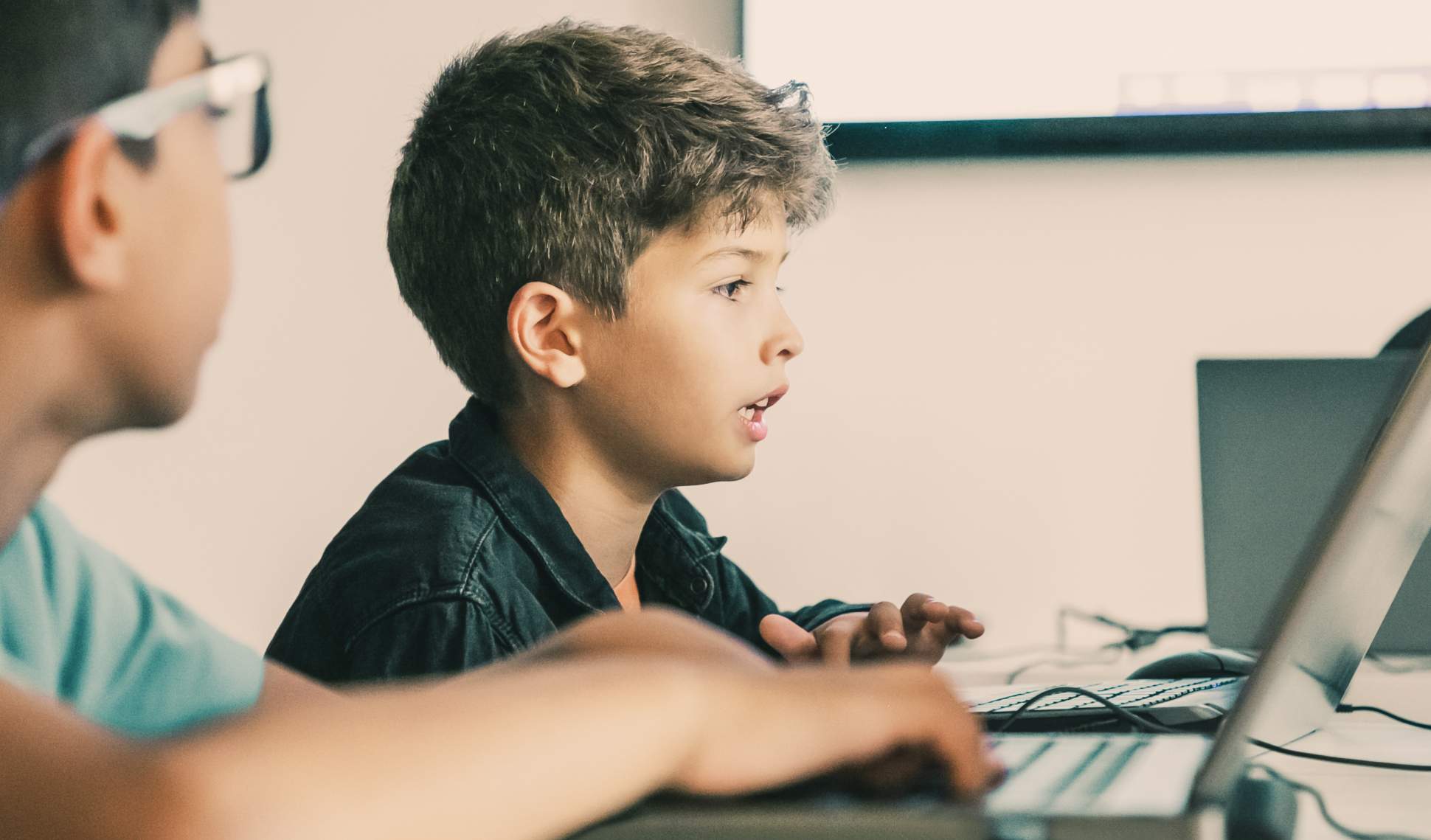
Any teaching professional who stays up to date on the biggest trends in the field knows that the use of technology in education is already an urgent necessity. After all, it is impossible to ignore how much digitalization has directly impacted the pace of social transformations and changed the behavior and expectations of parents and students in relation to the learning system.
However, it is necessary to find ways for this resource to be employed in the classroom to effectively improve students' knowledge and teachers' routines.
This is because, since the arrival of the blackboard and its extensions (projector, photocopier, and VCR), the purpose of using technology in schools was precisely to streamline the presentation of information. In recent times, thanks to the spread of computers and interactive tools, the question is now different: how to access information.
Thinking about this issue, CodeBit has prepared an overview of what technology in education is, its impact, its advantages, and its challenges.
Follow along with us and check it out:
What is technology in education?
Thanks to the impact caused by computerization, most people see technology in education as a process of implementing computers, digital whiteboards, and gadgets in schools. However, the use of tools aimed at facilitating teaching has always been a great ally of learning. An example of this is the tools mentioned above, such as projectors, photocopiers, VCRs, and later, DVD players. However, starting in the 2000s, with the popularization of computers, ICTs (Information and Communication Technologies) began to impact our lives and soon became essential in educational processes.
When we mention ICTs, we refer to the plurality of technologies that allow the creation, capture, storage, receipt, and transmission of information.
In the educational context, ICTs can be excellent tools to optimize techniques and generate positive results.
The impacts of technology in education
It is no secret that, nowadays, children under two years old already handle smartphones to watch cartoons. In fact, contact with technological resources is emerging earlier and earlier. Cell phones, tablets, and games make up the daily lives of so-called "digital natives." Given this reality, educational institutions must reinvent themselves to meet the demands of the new profile of undergraduate students, who are more critical, dynamic, and, above all, connected. However, this entire integration is not a simple process for schools, as technology in teaching must be well-planned, so as to focus on the student's comprehensive development.
According to research conducted by the Latin American Faculty of Social Sciences, more than 70% of young Brazilians use the internet to help them in their studies. This data only reinforces the fact that technology and students are inseparable partners.
Therefore, ignoring this trend can cause several risks for educational institutions and even motivate the loss of students.
The advantages
All the benefits brought by technology to the various spheres of today's society also extend to education.
When well applied, technological resources are true facilitators of monitoring each student's individual performance and allow the learning process to be personalized, according to each individual's strengths and difficulties.
Another great advantage is that technology, in general, stimulates student autonomy and acts as an active agent in the construction of knowledge.
Furthermore, connectivity encourages teamwork through collaborative and interactive activities, which make learning more dynamic.
The advantages of technology in education are not limited to students only. With it, educators can manage bureaucratic tasks in simplified ways to make work more practical.
Last but not least, it is worth considering that the mobility of ICTs allows learning to happen in a contextual and situated way, since instruction can occur anywhere and at any time.
In this context, it is undeniable how much new technologies can contribute to universal access to education, reduce inequality, and promote equity. However, several challenges must be overcome to achieve these purposes.
The challenges
In the same way that technology in education can expand access to information, if the tools are applied incorrectly, they can further intensify the abyss that separates the public school system from the private one.
Furthermore, no type of technology, no matter how advanced, is capable of replacing the teacher's role in the educational process. However, it is essential that these professionals are trained to use and lead all available resources and tools. Therefore, it is imperative that schools invest in the continuous training of their educators, so that they are able, not only to handle new technologies, but also to develop practices that make classes more dynamic, closer to the students' reality.
Taking into account the fully dynamic world in which we live, marked by constant changes, technology in education is a true game-changer that can be the key to forming more informed, critical, autonomous, and participative citizens.
So, did you enjoy learning more about the importance of technology in education? Keep an eye on CodeBlog and follow all the news and trends from the technological universe.
Warm regards and see you next time!




" width="15.500294250860316px"><path d="M 0 15.475 L 0 0 L 15.5 0 L 15.5 15.475 Z" fill="transparent" height="15.475099999999998px" id="tPiDQU_MP" width="15.5px"/><path d="M 3.167 1.589 C 3.847 0.724 4.607 0.171 5.61 0.046 C 6.532 -0.07 7.436 0.022 8.277 0.451 C 9.235 0.938 9.681 1.797 9.877 2.797 C 9.987 3.364 10.049 3.948 10.056 4.525 C 10.079 6.395 10.055 8.265 10.075 10.135 C 10.08 10.527 9.944 10.648 9.574 10.641 C 8.799 10.627 8.023 10.63 7.248 10.644 C 6.911 10.65 6.787 10.528 6.789 10.181 C 6.803 8.533 6.799 6.884 6.789 5.236 C 6.788 4.892 6.754 4.545 6.698 4.206 C 6.57 3.433 6.106 2.974 5.443 2.925 C 4.405 2.849 3.714 3.206 3.495 4.018 C 3.37 4.478 3.333 4.972 3.326 5.451 C 3.306 7.002 3.307 8.555 3.327 10.105 C 3.332 10.504 3.208 10.654 2.807 10.644 C 2.032 10.625 1.257 10.63 0.481 10.642 C 0.156 10.647 -0.001 10.546 0 10.193 C 0.007 7.035 0.006 3.876 0 0.718 C 0 0.391 0.104 0.24 0.458 0.249 C 1.219 0.269 1.981 0.267 2.743 0.252 C 3.068 0.245 3.197 0.361 3.17 0.688 C 3.148 0.948 3.166 1.211 3.166 1.589 Z" fill="rgb(245, 240, 237)" height="10.64451194394125px" id="Hw1mXDepj" transform="translate(5.425 4.831)" width="10.075487656011685px"/><path d="M 3.284 5.2 C 3.284 6.764 3.27 8.327 3.292 9.892 C 3.297 10.284 3.158 10.403 2.79 10.396 C 2.015 10.382 1.24 10.386 0.465 10.399 C 0.14 10.403 -0.001 10.305 0 9.947 C 0.012 6.792 0.012 3.637 0.002 0.481 C 0.001 0.123 0.105 -0.01 0.473 0.001 C 1.261 0.023 2.05 0.02 2.839 0.004 C 3.183 -0.003 3.294 0.124 3.29 0.467 C 3.276 2.044 3.284 3.623 3.284 5.2 Z" fill="rgb(245, 240, 237)" height="10.39869818980116px" id="sgvgyFXCr" transform="translate(0.237 5.076)" width="3.292113077251912px"/><path d="M 3.768 1.898 C 3.761 2.945 2.91 3.782 1.859 3.772 C 0.828 3.763 -0.012 2.892 0 1.842 C 0.012 0.824 0.864 -0.003 1.897 0 C 2.956 0.003 3.776 0.834 3.768 1.898 Z" fill="rgb(245, 240, 237)" height="3.772444228811899px" id="M8BOm1cI0" transform="translate(0 0)" width="3.768370362042166px"/></g></svg>)
" height="17px" id="G9twDfI1x" transform="translate(2 2)" width="17px"/></svg>)
" height="17px" id="q6YSjVL3w" transform="translate(6 2)" width="8.5px"/></svg>)
" height="12.720532384492868px" id="Jh_taQ7si" transform="translate(1 3.586)" width="18.00050025px"/></svg>)